What are our goals with Email Marketing?
Email Marketing Is Not Just “Sending Emails”
Email marketing is not just writing one email, sending it, and hoping people buy. The real goal is to move the right people into your sales funnel and guide them toward a clear next step. That next step may be a purchase, a booked call, a quote request, a demo, a download, or another action that matters to your business.
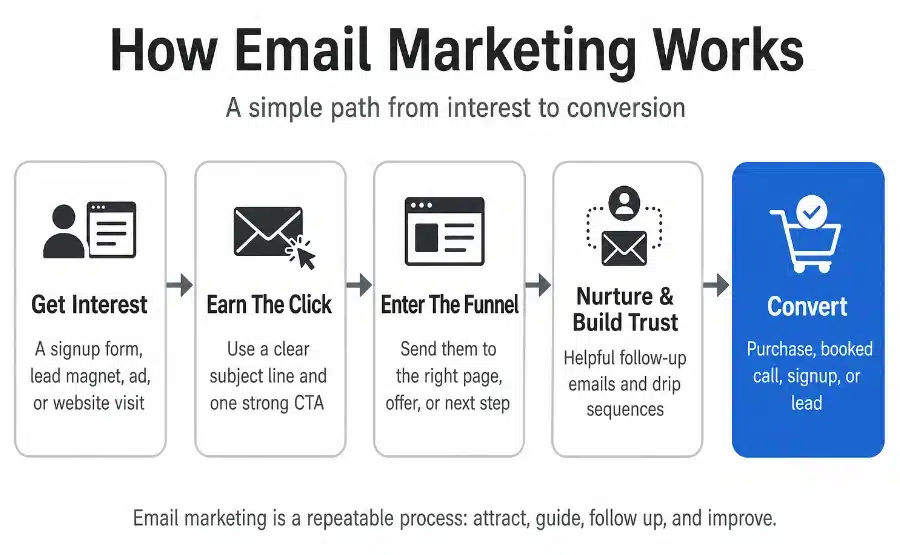
For a new founder, this is the first big idea to get: email marketing is a follow-up system, not a one-time announcement system. Someone may see your website, join your list, click a link, read more, compare options, and buy later. Email helps you stay connected through that process.
The Basic Goal: Interest, Click, Funnel, Follow-Up, Sale
A strong email marketing strategy follows a simple path. Get the customer’s interest, get them to click a call to action, move them into your funnel, build trust, and guide them toward the purchase or lead action. That is the basic flow.
This matters because most people do not buy the first time they hear about a business. Email gives you a way to keep educating, reminding, and helping people after the first point of contact. That is where the real value is.
What “The Funnel” Means In Plain English
A funnel is just the path someone takes from first interest to final action. At the top, they may only be curious; near the bottom, they are closer to buying or contacting you. Your emails should help move people from one stage to the next.
For example, someone may download a free checklist from your website. Then they receive a welcome email, a helpful tip, a customer example, and a final email inviting them to book a call. That sequence gives them a clear path instead of leaving them alone after they sign up.
Your Call To Action Is The Bridge
Every email should have one main call to action, often called a CTA. The CTA is the bridge between reading the email and entering the next step of your funnel. It could be “read the guide,” “download the checklist,” “book a call,” “view the product,” or “reply with a question.”
For a beginner, the mistake is often sending emails with no clear next step. If readers do not know what to do next, most of them will do nothing. That does not mean every email has to sell hard. It means every email should have a purpose.
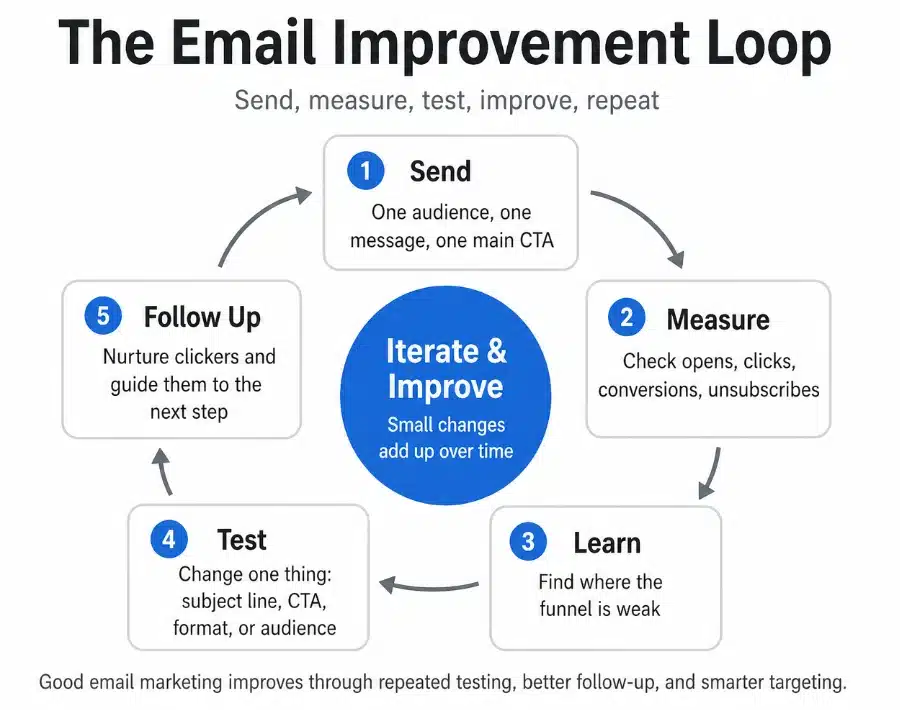
The Real Process: Send, Measure, Follow Up, Convert
The best way to think about email is as a repeatable process: send, measure, follow up, convert. You send an email, watch what people do, follow up based on their actions, and improve the next email. That is how email marketing gets better over time.
If someone clicks a pricing page link, that may show stronger interest than someone who only opened the email. If someone clicks a beginner guide, they may need more education before they are ready. Different actions should lead to different follow-up messages whenever possible.
Email Marketing Basics: The Simple Version
The List Comes First
Email marketing for beginners starts with a list of people you can contact. The best list is made of people who gave you permission and had a real reason to hear from you. They may have joined through your website, downloaded a resource, bought something, requested information, or signed up for updates.
This is why list quality matters more than list size. A small list of interested people is often more useful than a large list of strangers. If people do not know you, do not trust you, or did not ask to hear from you, your results will usually be weak.
The Email Platform Sends And Tracks
Most businesses use an email marketing platform to send campaigns and track results. The platform helps you manage subscribers, send emails, create signup forms, and see who opened, clicked, unsubscribed, or bounced. You do not need an advanced setup when you are new.
At the beginning, your email platform only needs to help you do a few things well. You need to collect emails, send clean messages, track basic results, and create simple follow-up sequences. That is enough to start learning.
The Offer Gives People A Reason To Join
People usually need a reason to join your list. A good signup offer gives them something useful in exchange for their email address. That could be a checklist, short guide, discount, webinar, calculator, template, early access list, or helpful email series.
The offer should match what your future customer already cares about. If the offer attracts the wrong people, your list may grow but your sales may not. A free giveaway may get signups, but many of those people may only want the prize.
Why Intent Matters More Than List Size
Intent Means “How Interested Are They?”
Intent is a simple idea. It means the person has shown some level of interest in your topic, product, service, or offer. A person who searched for your guide, filled out your form, or clicked your pricing page has more intent than someone who has never heard of you.
This is one of the most useful email marketing basics for new founders. You do not want random attention; you want attention from people who may care enough to act. That is why audience fit matters so much.
Clicks Tell You More Than Opens
Open rates can be useful, but they do not tell the full story. A click usually shows stronger interest because the reader took an extra step. They moved from “I saw your email” to “I want to know more.”
For example, if someone clicks a link about pricing, services, a product page, or a booking form, treat that as a signal. That click may mean they are closer to becoming a customer or lead. Your follow-up should match that interest.
The best email marketing strategy is simple: build a list of people with real intent, send useful emails, track what they do, and keep testing until the numbers improve.
Where Email Lists Come From
Build Your Own List First
The safest and strongest email list is the one you build yourself. These are people who came through your website, content, checkout page, ads, events, referrals, or social media. They know why they joined, which makes follow-up much easier.
A new founder can start with simple list-building steps. Add signup forms to useful pages, create one helpful lead magnet, and invite people to join from your social channels. For more help, read this guide on how to create a lead magnet.
Good Sources For Email Signups
You do not need ten different list-building tactics at first. Pick one or two places where your target customer already interacts with your business. Then make the signup offer clear and useful.
- Website forms: Add forms to your homepage, blog posts, and contact page.
- Lead magnets: Offer a checklist, guide, worksheet, template, or short email course.
- Checkout opt-ins: Let buyers join your list after purchase.
- Social media: Send followers to a signup page, not just your homepage.
- Webinars or events: Ask people to register with their email address.
If you are still defining your audience, start there first. Email works better when you know who you are trying to reach and what problem they want solved. This guide on finding your target customer can help you sharpen that part.
The Risk Of Purchased Email Lists
Purchased lists sound tempting because they seem fast. The problem is that fast does not mean useful, trusted, or safe. Many people on purchased lists did not ask to hear from you, which can lead to poor results and complaints.
There are real business risks here. Purchased lists can hurt deliverability, damage your sender reputation, create spam complaints, and make your brand look careless. The FTC says the CAN-SPAM Act sets rules for commercial email, gives recipients the right to opt out, and includes penalties for violations. Read the FTC’s CAN-SPAM guide here.
That does not mean every cold email is illegal, but it does mean you need to be careful. For most beginners, building a permission-based list is the cleaner and smarter path. It may take longer, but the people on the list are more likely to trust you.
What Every Beginner Should Track
Track The Numbers That Show Movement
Email tracking can feel confusing at first because platforms show lots of numbers. Focus on the numbers that show whether people are moving through your funnel. You want to know if they received the email, opened it, clicked, converted, unsubscribed, or complained.
Litmus has reported email marketing ROI averaging $36 for every $1 spent, but that kind of value comes from smart follow-up, testing, and list quality. The money is not in sending random emails; it is in learning what causes people to act. See Litmus email ROI research here.
The Main Email Metrics
- Delivery rate: How many emails reached inboxes or mail servers.
- Open rate: How many people opened the email.
- Click-through rate: How many people clicked a link.
- Conversion rate: How many people took the desired action.
- Bounce rate: How many emails could not be delivered.
- Unsubscribe rate: How many people left your list.
- Spam complaint rate: How many people marked the email as spam.
- Revenue or leads: The real business result from the campaign.
Do not treat every number the same. Clicks, conversions, leads, and sales usually matter more than opens. Opens can help you compare subject lines, but clicks and conversions show stronger intent.
Find The Weak Spot
Your numbers can show where the funnel is breaking. If many people open but few click, your email body or CTA may need work. If many people click but few buy, your landing page, offer, price, or follow-up may need work.
This is why email marketing strategy should connect with your website and offer. Email gets people to the next step, but the next step still has to make sense. For help with the website side, see this guide on creating an effective website.
How To Test Subject Lines, CTAs, Formats, And Lists
Test One Thing At A Time
Testing is where beginners often get messy. If you change the subject line, CTA, layout, offer, and audience all at once, you will not know what caused the result. Keep tests simple so the lesson is clear.
Start with subject lines because they affect opens. Send two versions of the same email with different subject lines and see which one gets more opens or clicks. Then save the winner and test a new idea next time.
Subject Line Tests To Try
- Clear vs. curious: “How to price your first offer” vs. “Most new founders miss this.”
- Benefit vs. problem: “Get more qualified leads” vs. “Why your leads are not buying.”
- Short vs. longer: Test a tight subject line against a more descriptive one.
- Question vs. statement: “Are your emails getting clicks?” vs. “Your emails need one clear CTA.”
After subject lines, test CTAs. The CTA is often where interest either turns into action or fades away. Try “Get the checklist” against “Download the checklist,” or “Book a call” against “See if we can help.”
Format Tests To Try
Email format matters too. Some audiences respond better to plain, personal-looking emails; others respond better to designed emails with images and buttons. You will not know until you test with your own list.
- Plain text vs. designed email: Test a simple letter-style email against a branded layout.
- Short vs. longer email: Test a quick message against a fuller explanation.
- One CTA vs. several links: For beginners, one CTA is often easier to measure.
- Story vs. direct offer: Test a short example against a direct sales message.
You can test audience segments too. People who clicked a past email may respond differently than people who have not clicked in months. That is a clue about intent, not just email design.
If you want a deeper beginner guide to testing, read this article on A/B testing in marketing and advertising.
How Large Should Your Test Campaigns Be?
Small Tests Can Mislead You
Testing is useful, but tiny tests can fool you. If you send version A to 10 people and version B to 10 people, one or two clicks can make the results look bigger than they really are. That does not mean the test is worthless, but you should be careful.
For a very small list, use tests as clues instead of final answers. Look for repeated patterns across several sends, not one lucky result. If the same kind of subject line wins five times, that lesson is stronger than one test.
A Practical Beginner Rule
If your list is small, send to the full list and learn from the results. Once your list gets larger, split it into two groups and test one clear change. Many email platforms can handle this with a simple A/B test feature.
For example, if you have 1,000 subscribers, you might test two subject lines with 200 people each, then send the winner to the rest. The point is to let real behavior guide the larger send. Keep the test simple and keep notes.
Iterating And Testing: The Habit That Makes Email Work
Email Gets Better Through Repetition
This is the part new founders should take seriously: email marketing for beginners works best when you keep testing and iterating. The first email will rarely be your best email. Your first subject line, first CTA, first offer, and first sequence are starting points.
Think of each send as a small lesson. You are learning what your audience opens, what they click, what they ignore, and what makes them take action. That data should shape the next campaign.
The Simple Improvement Loop
- Send: Choose one audience, one message, and one CTA.
- Measure: Check opens, clicks, conversions, unsubscribes, and replies.
- Learn: Decide what the results suggest.
- Adjust: Change one meaningful part.
- Send again: Use the lesson in the next campaign.
This habit matters because email is never fully “done.” Your audience changes, your offer changes, your market changes, and your message should improve with real feedback. Testing keeps you from relying on guesses.
This idea matches a broader startup habit: launch, learn, and improve. Do not wait for the perfect email system before you start getting feedback. This article on launching, iterating, and improving explains that mindset well.
What To Do With People Who Click
A Click Is A Signal
When someone clicks, pay attention. A click tells you the person cared enough to leave the email and take the next step. That does not mean they are ready to buy today, but it does mean they showed interest.
Your email platform may let you tag people based on what they clicked. Tagging helps you send better follow-up instead of treating every subscriber the same. For example, someone who clicked “pricing” may need a different email than someone who clicked “beginner guide.”
Follow Up Based On Intent
If someone clicks a product page, send a follow-up that answers buying questions. If someone clicks an educational guide, send more helpful content before asking for the sale. Match the follow-up to the action they already took.
- Clicked pricing: Send FAQs, proof, comparison points, or an invitation to talk.
- Clicked a beginner guide: Send a simple next lesson or related checklist.
- Clicked a case study: Send another example or a soft offer.
- Clicked but did not buy: Send a reminder, objection answer, or bonus reason to act.
This is where many beginners miss sales. They get the click, then fail to follow up with the person who showed interest. Email marketing strategy should include a plan for clickers, not just a plan for the first send.
Using Drip Email Sequences To Nurture Leads
What A Drip Sequence Does
A drip sequence is a planned series of emails sent over time. It helps nurture people who are interested but not ready to act yet. Instead of asking for the sale right away, you guide them step by step.
This is useful because many customers need more context before buying. They may need to know why the problem matters, what options they have, why your offer helps, and what to do next. A drip sequence gives you room to explain.
A Simple Five-Email Drip Sequence
- Email 1: Welcome. Thank them, set expectations, and give them what they asked for.
- Email 2: Helpful tip. Teach one useful idea that solves a small problem.
- Email 3: Problem. Explain a common mistake or pain point.
- Email 4: Proof. Share a customer example, result, review, or story.
- Email 5: Offer. Invite them to buy, book a call, request a quote, or take the next step.
Keep the sequence simple at first. You do not need a massive automation system to start nurturing leads. One helpful welcome sequence can already do a lot of work for a new business.
A Simple Beginner Email Marketing Strategy
Start With One Audience And One Offer
Beginners often try to do too much too soon. Start with one target audience, one signup offer, one welcome sequence, and one main business goal. That goal may be product sales, booked calls, quote requests, free trials, or event signups.
Write your emails for that one person. Speak to their problem, explain the next step, and remove confusion. Clear beats clever when someone is deciding whether to click.
Your First 30-Day Email Plan
- Week 1: Create one useful lead magnet and one signup page.
- Week 2: Write a five-email welcome sequence.
- Week 3: Send one campaign to your list with one clear CTA.
- Week 4: Review results, pick one thing to improve, and send again.
This simple plan is enough to begin. The goal is not to build the perfect email machine; the goal is to start learning from real people. Once you have data, you can improve your subject lines, CTAs, offers, and follow-up.
Keep Your Emails Useful
People stay on email lists when the emails help them. If every email is only “buy now,” readers may stop paying attention. Mix helpful content with clear offers so people get value before they are ready to buy.
For a novice founder, this may mean sending tips, examples, mistakes to avoid, customer stories, short guides, or answers to common questions. Useful emails build trust before the sales message arrives. That trust can make the CTA feel like a helpful next step instead of pressure.
Final Takeaway
Email Marketing Is A System, Not A Single Campaign
The big lesson is this: email marketing is not about blasting messages and hoping something happens. It is about moving people from interest to click, from click to funnel, from funnel to trust, and from trust to purchase or lead action.
Start small, but take the process seriously. Build your own list, respect intent, send useful emails, test one thing at a time, and follow up with people who show interest. That is the practical path.
Email marketing for beginners does not need to be complicated. Send, measure, follow up, convert, then improve the next send. Repeat that cycle long enough, and your email list can become one of the most valuable assets in your business.