A practical, no-nonsense guide and workbook for first-time founders
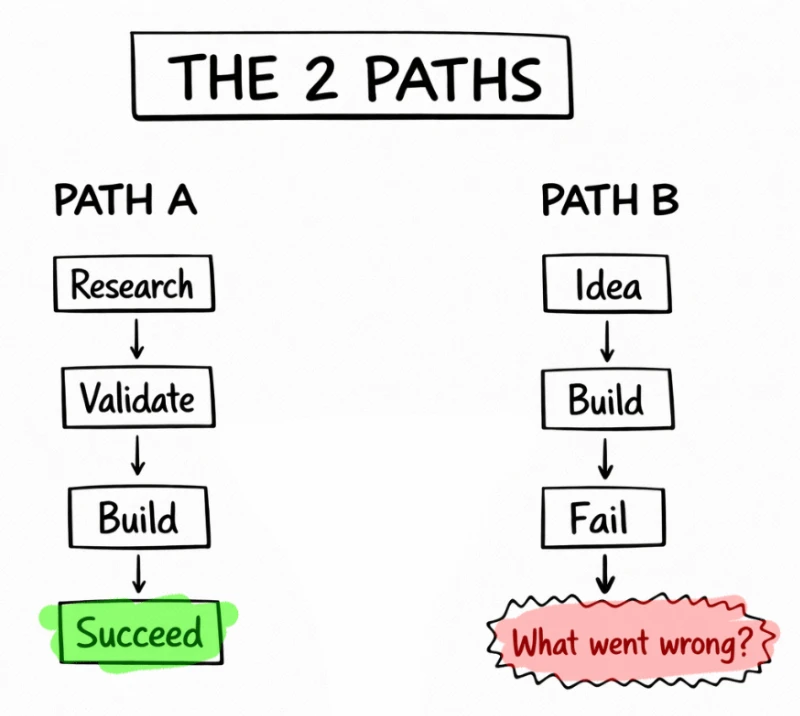
Here’s the most common founder story in the world:
You get an idea. It feels brilliant. You tell a few friends — they love it. You start sketching plans, buying domain names, maybe even building a prototype. Six months later, you launch.
And… nothing happens. No customers. No revenue. Just confusion, frustration, and a quiet voice in the back of your head asking, “What went wrong?”
What went wrong is simple: you skipped the validation homework.
Validating your business means testing it out in the real world to see if people are interested. This chapter and the next Guide 'Test Your Business Idea Before You Build' will walk you through exactly how to do this.
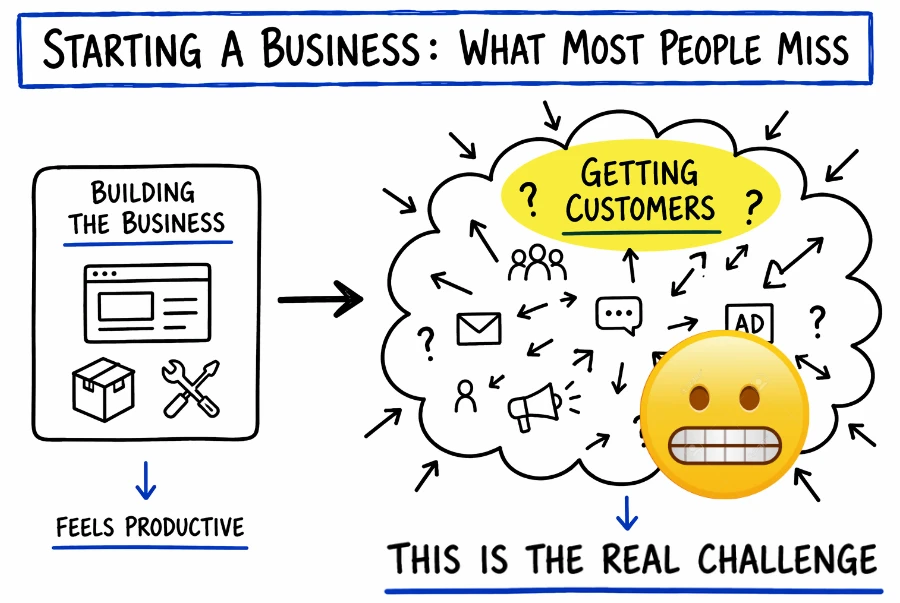
Hands down, this is the lesson you need before you commit several years to this effort: Marketing and customer traffic will make or break your business. 100% guaranteed. You can take that to the bank.
Whatever you do, you MUST have a solid plan to bring customers to your business. They will not show up magically.
Starting a business is not like buying a lottery ticket. It’s a real commitment — often a year or more of your life, and significant time, energy and expense. That’s time you could spend with your family, money you could put toward your future.
You owe it to yourself to pressure-test your idea before you go all-in.
The good news? It doesn’t take long. A few focused weeks of research can save you years of chasing the wrong thing. That’s what this guide is for.
This guide is not a motivational pep talk. It’s a step-by-step system to evaluate whether your business idea has real potential — or whether it needs work before you invest serious time and money.
By the end of this guide, you’ll be able to:
Treat this like a workbook, not a novel. Don’t just read it — do the exercises. Grab a notebook or open a blank document. Work through each chapter in order. By the end, you’ll have a clear picture of your idea’s strengths, weaknesses, and your honest next step.
Let’s get started.
Before we dive in, here's your roadmap. This is the exact process we'll follow to assess whether your business idea is worth pursuing:
The Assessment Journey:
Step 1: Does The World Actually Need This?
Find out if real demand exists. Talk to potential customers, research competitors, and test your idea with strangers who have no reason to be polite. Actions count—not compliments.
Step 2: Does The Math Work?
Run back-of-napkin financial projections. Can this business realistically generate the income you need? If you need 10,000 customers to make $50K/year, the math might not work.
Step 3: Can You Solve The Problem Better?
Assess your competition honestly. What makes your solution different or better? If you can't clearly answer why someone would choose you over existing options, you have work to do.
Step 4: Is There a Big Enough Market?
Determine if your target market is large enough to support your business goals. A tiny niche might be passionate, but can it generate the revenue you need?
Step 5: Can You Reach Your Customers?
Figure out where your customers gather and whether you can actually reach them. The best product in the world fails without a distribution plan.
Step 6: Can This Idea Make Money?
Look at pricing, profit margins, and business models. Will the unit economics work? Can you charge enough to cover costs and make a living?
Step 7: Do You Have What It Takes?
Honestly assess your skills, resources, and commitment level. Some ideas require capabilities you don't have yet—can you acquire them, or should you pivot?
Step 8: What Could Go Wrong?
Identify the biggest risks and failure points. What assumptions are you making? What could kill this business? How can you mitigate those risks early?
Step 9: Does This Idea Fit Your Life?
Consider lifestyle, time commitment, and personal goals. A profitable business that makes you miserable is not success. Make sure this aligns with the life you want.
Step 10: Is This Idea Worth Testing and Pursuing?
Make your final decision. Based on everything you've learned, should you GO (test and validate), PIVOT (adjust your approach), or PARK IT (move to a different idea)?
That's the assessment framework. Each chapter will guide you through one of these critical questions with exercises, examples, and honest evaluation criteria.
By the end, you'll have a clear, evidence-based answer about whether your idea is worth your time and investment.
Let’s find out if real demand exists — before you spend a dime.
The 3 things you must take away from this chapter
You’ve defined your idea. You can describe it clearly. You might even feel pretty excited about it. Good.
Now here’s the question that separates real businesses from expensive hobbies: Does anyone actually want this enough to pay for it?
Not “do people think it’s cool.” Not “did your friend say she’d buy one.” The question is whether real strangers — people who have no reason to be polite — will reach into their wallets.
Let’s find out.
Most ideas that fail don’t fail because they’re bad ideas. They fail because the founder assumed there was demand without actually checking. Here are the five most common reasons business ideas fall apart:
If even one of these applies to your idea, you have work to do. That’s not a bad thing — it’s exactly why you’re reading this guide instead of blindly building.
Here’s your research plan. Do all three rounds — not just the easy ones.
This is the most important round and the one most people skip. You need to talk to 10 real people who fit your target customer description. Not text. Not email. Actual conversations — phone, video, or in person.
What to ask:
What NOT to ask:
What to listen for: Pay attention to the words they use to describe their problem. Write them down — verbatim. These are the words you’ll eventually use in your marketing, and they’re worth more than anything a copywriter could invent.
Where to find these 10 people:
Pick 5 businesses that serve a similar audience or solve a similar problem. For each one, write down:
You’re not doing this to copy them. You’re doing this to find gaps — things customers want that nobody is providing well. Those gaps are your opportunity.
If you can’t find any competitors at all, that’s usually a warning sign, not an opportunity. It often means there’s no demand — not that you’re the first to think of it.
This is where you put something real in front of strangers and see if they act. Pick one:
The goal is not to launch a business. The goal is to see whether strangers take action when presented with your idea. Actions include: giving you contact info, asking when it will be ready, pre-ordering, or expressing unprompted interest.
This is critical. Most founders confuse encouragement with evidence. Here’s the difference:
Real Validation (Actions):
Vanity Signals (Opinions):
Actions require effort. Opinions are free. Only actions count.
If your landing page gets 500 visitors and 2 signups, that’s a 0.4% conversion rate — and that’s a problem. If it gets 500 visitors and 40 signups, that's a very good sign. The numbers don’t lie, even when encouragement does.
This deserves its own section because it derails more first-time founders than almost anything else.
Your friends and family love you. They want you to succeed. And because of that, they will not give you honest feedback. They will tell you your idea is great even if they’d never buy it themselves. They will say “I’d totally use that” and then never follow up.
This isn’t their fault. They’re being kind. But kindness is not what you need right now — you need truth.
If you only take one thing from this chapter, let it be this: the market does not owe you demand. You have to earn it by solving a real problem for real people — and the only way to know if you’re doing that is to ask people who will tell you the truth.
Before moving on, make sure you’ve done these:
If most of these are checked, you’re ready for Chapter 3. If not — don’t skip ahead. The homework you do here is the foundation for everything that follows.
Validation Signals vs. Vanity Signals
The brutal question most founders skip: Can this business actually pay you what you need?
Here's what most first-time founders do:
They confirm there's a real problem. They validate that people want a solution. They research the market. They analyze competitors. They build a business plan.
And then, six months in, they realize the business can never make them enough money.
Maybe it works. Maybe customers buy. Maybe you even turn a profit. But when you run the actual numbers, you discover you'd need 10,000 customers just to replace your $60K salary. And getting 10,000 customers? That's a 5-year grind you didn't sign up for.
This is the silent killer of small businesses. Not failure. Not lack of customers. Just... underwhelming economics that can't support your life.
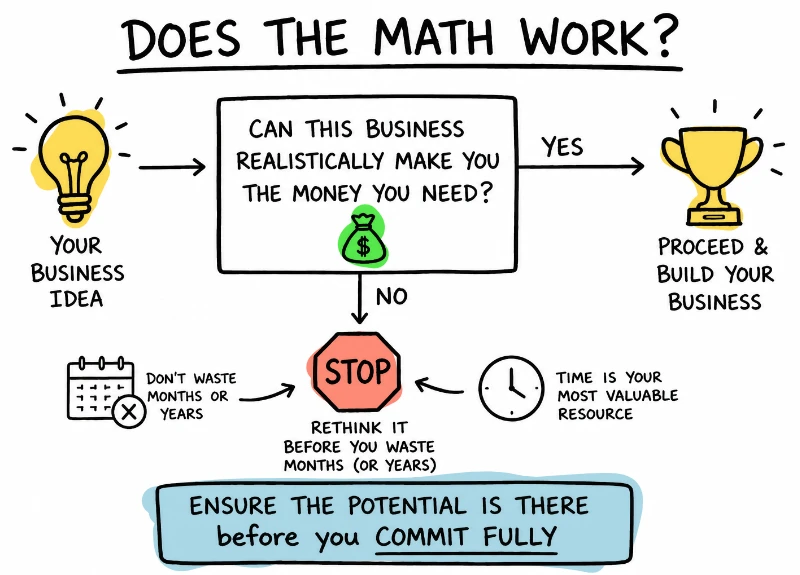
Before you research your market, before you validate demand, before you build anything—you need to know if the math works.
Because here's the truth: If the financial potential isn't there, everything else is a waste of time.
You can have:
But, but but... if the unit economics require 30,000 customers to make you $100K/year, and you're in a niche that only has 5,000 potential buyers total... the idea is dead.
ALERT!
This chapter is your financial reality check.
Do it now. Save yourself months of wasted effort.
If it doesn't, why would you waste years on this idea?
Here's the simple math that tells you if your idea is viable:
Step 1: What do you need to make annually?
Be specific. $50K? $75K? $100K? Write it down.
Step 2: Work backward to revenue
Step 3: How many sales does that require?
Step 4: How many customers?
Now ask yourself honestly:
Can you realistically get that many customers?
1. Annual income you need:
2. Revenue needed (income ÷ 0.30):
3. Your price per sale:
4. Sales needed (revenue ÷ price):
5. Purchases per customer per year:
6. Total customers needed:
7. Size of your target market:
8. Can you realistically get that many customers? YES / NO
If YES: Keep going. Your idea has financial potential.
If NO: Read the next section carefully. There may still be hope!
Don't panic. You have five options:
1. Raise Your Prices
Most founders under-price. If you doubled your price, you'd need half the customers. Can you add more value and charge more?
2. Improve Your Margins
Cut costs. Source cheaper. Automate manual work. Going from 30% to 50% margins cuts your revenue target nearly in half.
3. Expand Your Market
If your niche is too small, serve a broader audience. "Productivity tools for freelance designers" becomes "productivity tools for all freelancers."
4. Change Your Business Model
5. Pivot to a Different Idea
Sometimes the honest answer is: This idea can't support your life. And that's okay. Better to learn that now than two years from now.
You've run the numbers. Now be honest:
Can this business realistically make you the money you need?
If the financial potential isn't there, everything else is a waste of time.
You just confirmed the business has financial potential. Great. But here's the question that stops most founders before they even begin:
Can you afford to build it, launch it, and survive the first 6-12 months?
This is where dreams meet reality. Every business—no matter how "lean"—requires some upfront capital. And most founders drastically underestimate how much they'll need and how long it takes to become profitable.
1. Startup Costs (One-Time)
Money needed to get your business off the ground:
2. Operating Costs (Monthly)
Money needed to keep the lights on every month:
3. Survival Runway (Personal)
Money you need to live while building the business:
One-Time Startup Costs:
Legal & setup: $
Website & branding: $
Inventory/equipment: $
Initial marketing: $
Other: $
TOTAL ONE-TIME: $
Monthly Operating Costs:
Rent/utilities: $
Software & tools: $
Marketing budget: $
Other recurring: $
TOTAL MONTHLY: $
Personal Living Expenses (Monthly): $
Months of runway needed (3-12):
Personal runway needed: $
TOTAL CAPITAL REQUIRED:
Startup costs + (Monthly ops × months) + Personal runway = $
Now answer honestly:
Do you have access to this money?
STOP HERE IF YOU CAN'T FUND IT
If you don't have the capital—and no realistic way to get it—you cannot move forward. Freezing here is not failure. It's wisdom. Figure out your funding before you waste months planning a business you can't afford to start.
If you're short on capital, you have choices:
1. Radically Reduce Costs
Can you start with a service instead of a product? (No inventory). Can you build it yourself? (No contractors). Can you keep your day job? (No personal runway needed).
2. Get Creative With Funding
3. Start Smaller
Launch a simpler version first. Prove it works. Use early revenue to fund growth. Many successful businesses started as one-person operations with $500.
4. Choose a Different Idea
If this idea requires $50K and you have $2K, it's not the right time. Park it. Find a business model that matches your resources.
Most founders fail Chapter 2 for one of two reasons:
Reason 1
The business model doesn't have enough financial potential. Even if successful, it won't make you enough money.
Reason 2
You don't have the capital to start. The idea is solid, but you can't afford to build it yet.
If you answered NO to either:
Both questions must be YES to move forward. Otherwise, you're wasting your time.
Let’s figure out how you fit into a market that already has solutions.
The 4 things you must take away from this chapter
You’ve validated that people want a solution to this problem. Good. Now here’s the harder question: Why would they choose you over what already exists?
Unless you’re solving a genuinely new problem (rare), there are already businesses serving this market. That’s not a bad thing — it’s proof the market exists. But it means you need a clear answer to the question every potential customer will ask: “Why not just stick with what I’m already using?”
Pick 5 businesses that serve a similar audience or solve a similar problem. For each one, write down:
You’re not doing this to copy them. You’re doing this to find gaps — things customers want that nobody is providing well. Those gaps are your opportunity.
If you can’t find any competitors at all, that’s usually a warning sign, not an opportunity. It often means there’s no demand — not that you’re the first to think of it.
Now that you know who you’re up against, let’s get clear on where you fit. This is where a simplified competitive analysis helps — not a 40-page report, just an honest assessment of your Strengths, Weaknesses, Opportunities, and Threats relative to the market.
Your Competitive SWOT
Strengths: What do you do better than competitors?
Weaknesses: Where are they stronger than you?
Opportunities: What gaps can you fill that they miss?
Threats: What could make it hard to compete?
Let’s build a detailed profile of exactly who you’re selling to — and make sure there are enough of them.
The 3 things you must take away from this chapter
In Chapter 3, you talked to real people and tested for real demand. Now it’s time to go deeper. Not just “who might buy this” — but who exactly is this person, what does their day look like, what keeps them up at night, and where do they already spend money trying to fix this problem?
The better you understand your customer, the easier everything else gets. Your marketing writes itself. Your pricing makes sense. Your product fits like it was designed for them - because if you understand your customer deeply, it was.
Here’s the difference between a vague audience and a useful one:
The first one describes half the planet. The second one tells you exactly where to find them (LinkedIn, remote work forums, co-working spaces), exactly what to say to them (“You deserve better than your third reheated cup”), and exactly what they’d pay for (convenience, quality, a small daily luxury).
Specificity is not limiting. It’s liberating. When you know exactly who you’re talking to, you stop wasting time and money shouting into the void.
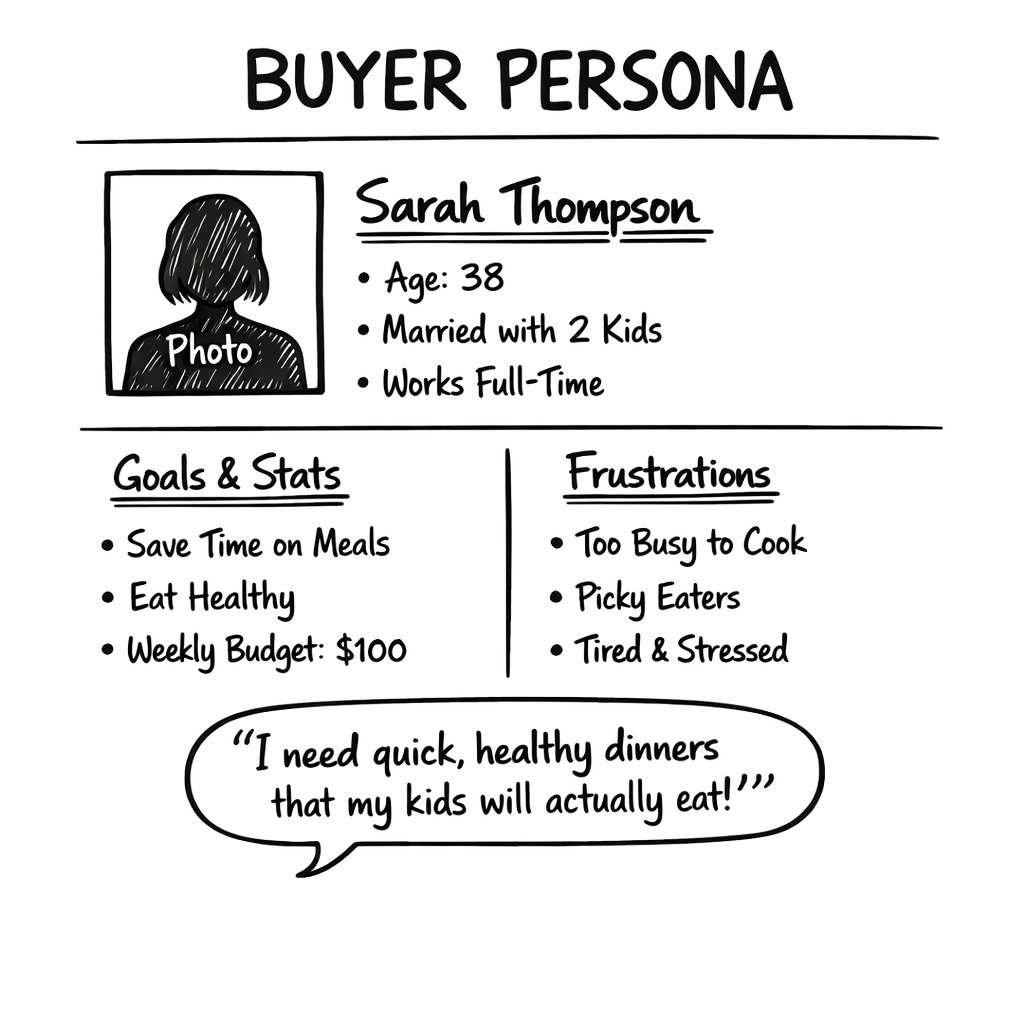
A buyer persona is a detailed profile of your ideal customer (sometimes called an ICP - Ideal Customer Profile). Not a real person — a composite based on research, conversations, and observation. This is the person you’ll think about every time you write an ad, set a price, or make a product decision.
Fill this in based on what you learned from your customer conversations in Chapter 2:
Name: (Give them a name — it makes this feel real)
Age / Gender / Location:
Income level:
Job / Daily routine:
Biggest frustration related to your offer:
What they’ve already tried:
What they currently spend money on to solve this:
Where they hang out online:
Where they hang out offline:
What would make them switch to you:
How they’d describe the problem in their own words:
That last line is the most valuable one on the page. The exact words your customer uses to describe their pain — that’s your marketing headline, your ad copy, your elevator pitch. Use their language, not yours.
Here’s an example — for our meal-prep kit business:
Name: Sarah
Age / Gender / Location: 34 / Female / Suburban Denver
Income level: $85K household, dual income
Job / Daily routine: Marketing manager, remote. Works 8–5, picks up two kids from school at 3:30, juggles homework and dinner from 4–7 p.m.
Biggest frustration: By 5:30 p.m. she’s too exhausted to cook but feels guilty ordering takeout again
What she’s tried: HelloFresh (too complicated for weeknights), frozen meals (kids won’t eat them), batch cooking on Sundays (can’t sustain it)
What she currently spends: $60–80/week on takeout she wishes she didn’t order
Where she hangs out online: Mom Facebook groups, Instagram, r/MealPrepSunday, Pinterest recipes she never makes
Where she hangs out offline: School pickup line, Target, her kids’ soccer games
What would make her switch: Something faster than HelloFresh, healthier than takeout, and under $80/week
In her own words: “By dinnertime I have nothing left. I just need something healthy that doesn’t require me to think.”
Now you know Sarah. You know where to reach her, what to say, and what she’ll pay. That’s not a guess — it’s a strategy.
If you can answer these clearly, you understand your market. If you can’t, you need more conversations.
1. Who exactly are you selling to?
Not a demographic category. A real type of person you could point to in a coffee shop. “See that woman juggling a laptop and a toddler? That’s my customer.”
2. What problem do they feel in their bones?
Not a mild inconvenience — a real frustration that costs them time, money, sleep, or sanity. The bigger the pain, the more they’ll pay to fix it.
3. Where do they already spend money — and why would they switch?
If they’re not spending money on something related to this problem, there may not be a real market. And if they are spending, you need a clear reason they’d switch to you: cheaper, faster, better, easier, more specialized.
4. How will you realistically connect with them?
Having a great product doesn’t matter if you can’t get it in front of the right people. Where do they spend time? What do they read, watch, listen to? Who do they trust? That’s where your marketing starts.
Stop guessing. Go straight to the source and join some online channels and even ask for advice on your product as you develop it. Here’s where your target customers are already having conversations about the problems you solve:
You don’t need all of these. You need 2–3 where your specific audience is active. Find them, listen before you talk, and take notes.
Here’s a trick that separates good marketers from great ones:
When you talk to your target customers, write down the exact phrases they use to describe their problems. Not your interpretation — their actual words.
Then use those words in your marketing. Your website headline, your ad copy, your email subject lines — all of it should sound like it came from your customer’s mouth, not from a marketing textbook.
Having the right offer doesn’t matter if you can’t get it in front of the right people.
The 3 things you must take away from this chapter
You know who your customer is. You know they have a problem worth solving. But here’s the question that trips up most new founders: How will you actually reach them?
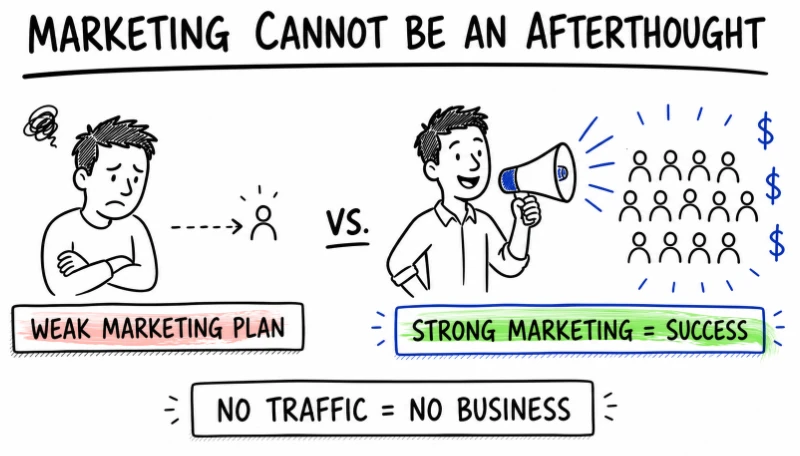
A brilliant product that nobody hears about is a failed business. A strong and viable marketing plan is potentially the most vital aspect of your business.
Don't start a business without a strong and reasonable marketing plan that you've really researched and understand.
Of all the new business founders I've mentored, only 5% - 10% of them have a viable marketing plan that they've really thought about, planned and understand.
That's an extraordinary amount of risk for the other 95% who assumed customers would magically show up, and believe me, they find out after launch how important that plan is.
Stop guessing. Here’s where your target customers are already having conversations about the problems you solve:
You don’t need all of these. You need 2–3 where your specific audience is active. Find them, listen before you talk, and take notes.
Your Customer Acquisition Plan
Where will your first 10 customers come from?
Where will your next 100 come from?
What will it cost (in time or money) to reach them?
If you can’t answer these questions with specifics, your idea isn’t ready yet. That’s not a failure — it’s a signal that you need to do more customer research and channel testing before you build.
Let’s do the simple math that tells you if this idea can make the profit you need to survive - before you go all in.
The 3 things you must take away from this chapter
You’ve defined your idea. You’ve validated demand. You know your customer. Now it’s time for the question that makes most first-time founders uncomfortable: Can this idea actually generate profit?
One simple spreadsheet will save you from wasting years on a poor idea with low potential.
This isn’t about building a 40-page financial model. It’s about doing one simple calculation that tells you whether the basic economics of your business work — before you invest real money finding out the hard way.
You don’t need an accounting degree. You need to understand three numbers:
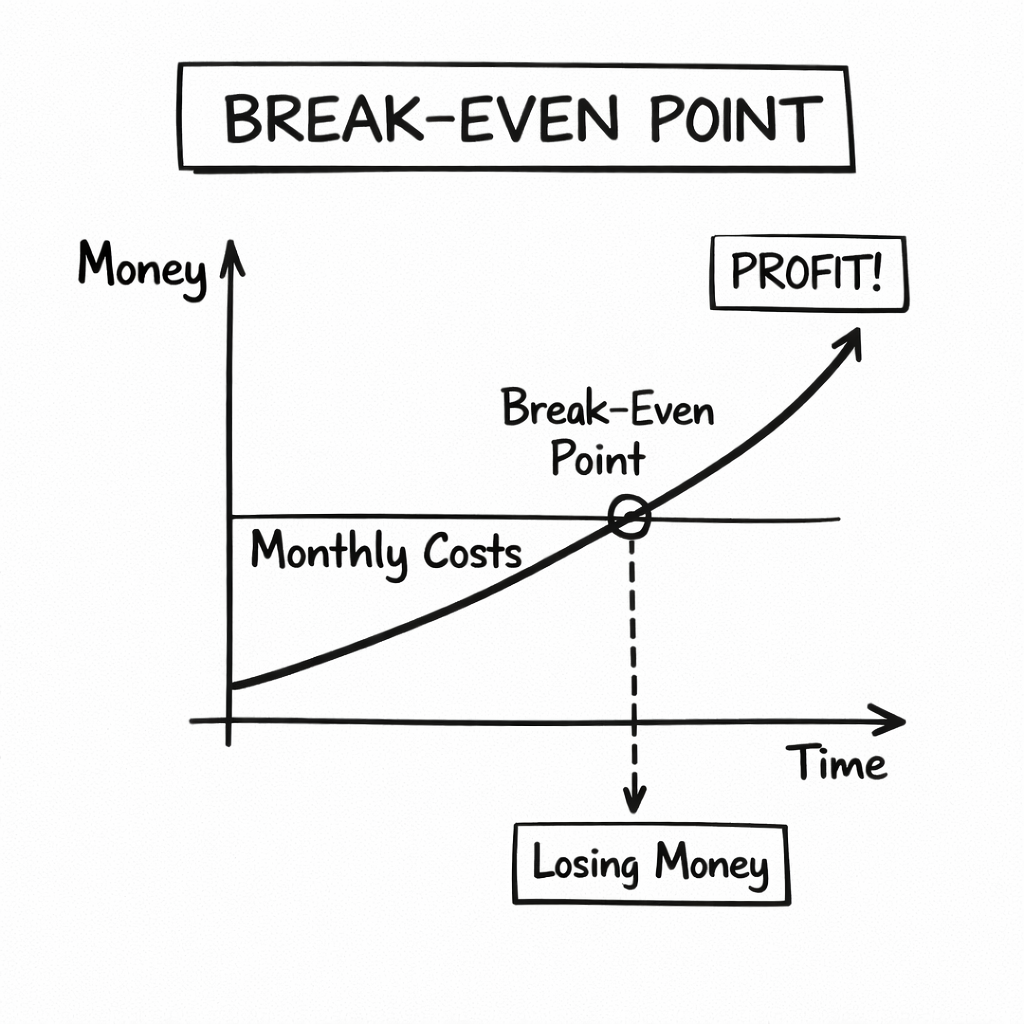
That’s it. From those three numbers, you can figure out exactly how many sales you need per month to break even — the point where you stop losing money and start making it.
Gross Profit Per Sale = Price − Variable Cost
Break-Even Point = Fixed Monthly Costs ÷ Gross Profit Per Sale
That’s the whole thing. Let’s walk through it.
Let’s use our meal-prep kit business as an example:
Price per weekly kit: $79
Variable cost per kit (ingredients, packaging, delivery): $35
Gross profit per kit: $79 − $35 = $44
Fixed monthly costs (kitchen rental, website, insurance, software): $2,200
Break-even: $2,200 ÷ $44 = 50 kits per month
Now you have a real question to answer: Can I realistically sell 50 meal-prep kits per month?
That’s roughly 12–13 per week. If you have a neighborhood of busy parents, a decent Instagram following, and you’re doing local delivery — that might be very doable. If you’re starting from zero with no audience in a small town — that’s a harder climb.
Either way, you now know the target. No guessing.
Variable costs — things that increase with each sale:
Fixed costs — things you pay regardless of sales:
If you’re not sure about a cost, estimate high. Surprises in business are almost always more expensive than you expected, not less.
This is the moment of truth. If your break-even number looks unreachable — say you’d need 200 sales per month in a market where 30 would be impressive — don’t panic. You have three levers to pull:
Lever 1: Raise your price.
This is the lever most new founders are afraid to touch, and it’s usually the most powerful. If you raise the meal-prep kit from $79 to $99, your gross profit jumps from $44 to $64, and your break-even drops from 50 kits to 35. That’s a 30% easier target just by charging $20 more.
Ask yourself: would Sarah (from Chapter 4) pay $99 instead of $79? She’s already spending $60–80 on takeout she feels guilty about. A $99 healthy alternative might still feel like a win.
Lever 2: Cut your variable costs.
Can you find cheaper ingredients without sacrificing quality? Negotiate a better delivery rate? Use simpler packaging? Every dollar you save per unit drops your break-even point.
Lever 3: Lower your fixed costs.
Do you really need that commercial kitchen at $1,200/month, or could you start from a licensed home kitchen at $200? Can you use free tools instead of paid software? Can you run lean for the first 6 months?
Take 10 minutes and fill this in. Use rough numbers — they don’t need to be perfect. They need to be honest.
At 6 months:
Monthly revenue (realistic): $
Monthly expenses (all costs): $
Monthly profit/loss: $
At 12 months:
Monthly revenue (realistic): $
Monthly expenses (all costs): $
Monthly profit/loss: $
At 24 months:
Monthly revenue (realistic): $
Monthly expenses (all costs): $
Monthly profit/loss: $
If you’re still showing a loss at 12 months, that’s not automatically a dealbreaker — but you need to know why, and you need to have enough financial runway to survive it.
If you’re showing a loss at 24 months, something fundamental needs to change.
Don’t fall into the trap of thinking “once we get big enough, the numbers will work.” That almost never happens. If the basic unit economics don’t work with 50 customers, they won’t magically fix themselves with 500. Fix the math first. Then grow.
Let’s honestly assess whether you’re the right person to build this — and what to do if you’re not sure.
The 3 things you must take away from this chapter
This is a chapter most founders skip. They’ve validated the idea, they’ve run the numbers, and they’re ready to go. But there’s one more critical question: Are you the right person for this particular business?
Not “are you smart enough” or “are you worthy.” The question is whether your specific skills, financial situation, available time, and lifestyle match what this business actually needs to succeed.
A great idea in the wrong hands is still a bad bet. And an honest self-assessment now will save you from discovering that mismatch the hard way — six months in, exhausted, broke, and wondering what happened.
Remember: You can LEARN the skills you need too. You'll need to be motivated, curious and adaptable though.
This isn’t a motivational poster. It’s the truth.
Starting a business requires a specific set of traits: determination, resilience, the ability to learn fast, adaptability, and patience. You’ll need to work through uncertainty, handle rejection, and keep going when things aren’t working.
If that sounds exhausting rather than exciting — pay attention to that feeling. It doesn’t mean you’re a failure. It means this might not be your path, and there are plenty of other ways to build a great career and a great life.
But if you read that list and thought, “Yeah, I can do that” — let’s make sure the fit is there.
Every business requires a mix of skills. No founder has all of them on day one. The goal isn’t perfection — it’s awareness. You need to know where you’re strong, where you’re weak, and what you’re going to do about the gaps.
Rate yourself honestly on each of these (1 = I’m lost, 5 = I’m solid):
Marketing (can you get your offer in front of the right people?):
Sales (can you close the deal when someone’s interested?):
Finance (can you track money, set prices, manage cash flow?):
Technical / Product Skills (can you build or deliver the thing you’re selling?):
Industry Knowledge (do you understand this market from the inside?):
Time Available (can you commit 20+ hours per week?):
Now look at the pattern. Where are you strong? Where are the gaps?
If you scored 1–2 on anything, you have three options:
This one’s uncomfortable but necessary. Be honest.
☐ Can you keep your day job while building this? (Strongly recommended. Almost always the right move.)
☐ Do you have 3–6 months of living expenses saved? (Not business money — personal survival money.)
☐ Can you fund the startup costs without borrowing? (Debt adds pressure that makes everything harder.)
☐ Could you handle 6–12 months of zero business income? (Because that’s a realistic scenario.)
When you’re desperate for cash, you make desperate decisions — cutting prices too low, taking on bad clients, rushing a product to market. Financial stability isn’t just nice to have. It’s what allows you to make smart decisions instead of panicked ones.
Ask yourself honestly - how running a new business will mesh with your day to day life:
1. Does the day-to-day work of this business excite you or drain you?
Not the vision. Not the “someday when it’s successful” fantasy. The actual daily work. If you’re starting a meal-prep business, do you enjoy cooking, sourcing ingredients, managing deliveries, and talking to customers about their dietary needs? Or do you just like the idea of owning a meal-prep business?
Because the work is what you’ll be doing 20–40 hours a week, and if it drains you, no amount of willpower will sustain it for 2–3 years.
2. Can you sustain this if growth is slow?
Most businesses take longer to get traction than founders expect. If your business needs 12–18 months to reach profitability, can you keep showing up? Do you have the patience, the financial runway, and the emotional endurance?
3. Does the schedule work with your life?
If you have young kids and this business requires Saturday farmers markets and 5 a.m. prep sessions, that’s a real conflict worth facing now — not after you’ve signed a lease on a commercial kitchen.
Here’s what this chapter comes down to:
You can have a validated idea, a willing market, and numbers that work on paper. But if you don’t have the skills (or a plan to fill the gaps), the financial runway (or a job to sustain you), and the genuine desire to do the daily work — the business will struggle.
That’s not a judgement. It’s a practical reality. And understanding it now means you can either fix the gaps - or find a business that fits you better.
Both of those are wins.
Let’s see the full picture — the good, the bad, and the risks you need to plan for.
The 3 things you must take away from this chapter
You’ve tested demand. You’ve run the numbers. You’ve assessed yourself. Now let’s zoom out and look at the full picture — the internal factors you can control and the external forces you can’t.
That’s what a SWOT analysis does. It’s one of the oldest tools in business for a reason: it works. And it takes about 30 minutes.
SWOT stands for four things:
Strengths and weaknesses are about you and your business. Opportunities and threats are about the world around you. The first two you can change. The second two you have to navigate.
Divide a page into four quadrants. For each one, list 3–5 honest factors. Don’t overthink it — write what comes to mind first, then refine.
STRENGTHS (What’s working in your favor?)
1.
2.
3.
4.
WEAKNESSES (What’s working against you?)
1.
2.
3.
4.
OPPORTUNITIES (What external trends or gaps could help you?)
1.
2.
3.
4.
THREATS (What external forces could hurt you?)
1.
2.
3.
4.
Here’s an example — our meal-prep kit business:
Strengths: Registered dietitian designs recipes, lower cost than competitors, founder has food industry experience, low overhead with home kitchen start
Weaknesses: No marketing experience, small personal network, limited startup budget, no brand recognition
Opportunities: Growing demand for healthy convenience food, remote work trend means more people eating at home, few local competitors in this specific niche
Threats: HelloFresh and other major players dominate brand awareness, ingredient costs rising due to inflation, local health department regulations could increase costs
Now step back and ask three questions:
1. Do the strengths and opportunities outweigh the weaknesses and threats?
If your strengths side looks strong and your opportunity is real, that’s encouraging — even if you have weaknesses to address. But if your threats column is scary and your strengths are thin, that’s a signal to pause.
2. Can you reduce or eliminate the weaknesses?
Look at each weakness. Is it fixable? “No marketing experience” can be solved with a course, a freelancer, or a co-founder. “Limited budget” can be managed by starting lean. But “no clear differentiation from major competitors” is a harder problem.
3. Can you protect against the threats?
Some threats are manageable (you can navigate regulation changes by staying informed). Some are existential (if a massive competitor launches the exact same product at half your price, that’s a serious problem). Be honest about which is which.
SWOT Analysis — Example: Meal-Prep Kit Business
Let’s make sure this business fits with your time availability, and what you actually want day-to-day.
The 3 things you must take away from this chapter
You can have a great idea, real demand, and solid numbers. But if you cannot make enough time to work the business consistently, it will not move fast enough to succeed.
This chapter is about being realistic. What does this business actually require each week, and can you truly give it that time?
Most first-time founders underestimate the workload. In the beginning, you are not just doing one job. You are handling product, marketing, sales, customer service, admin, and problem-solving all at once.
Even a simple business often requires 10–20 focused hours a week just to get traction, and more if you are building while learning everything from scratch.
If you can only give this business random scraps of time, one exhausted hour here and there, progress will be painfully slow. Consistency matters more than bursts of motivation.
Ask yourself honestly:
If your answer is vague, the business plan is vague. A serious business needs real time on the calendar, not good intentions.
Most people are building around a job, family responsibilities, health needs, or financial pressure. That’s normal. But it means you need to look at your current life honestly.
If your business needs nights, weekends, travel, or unpredictable availability, can your life absorb that? If not, you may need to simplify the idea, slow the timeline, or choose a model that fits your reality better.
This is not about laziness or ambition. It is about math. If your obligations leave you 5 usable hours a week, then your plan needs to fit inside 5 hours a week, or it is not a realistic plan.
Be brutally honest about your available time:
How many hours per week can you realistically commit?
When will you work on this? (specific days/times)
What will you stop doing to make room?
What responsibility is most likely to conflict with the plan?
If you can’t answer those clearly, don’t ignore that. It means the business may be possible, but the current setup is not.
Why are you really doing this? Not the surface answer — the real reason.
Your business should move you toward your life goals, not away from them. If it doesn’t — if it’s just “something to try” — think hard about whether it’s worth the cost.
You’ve done the homework. Now let’s make the call: GO, PIVOT, or PARK IT.
The 3 things you must take away from this chapter
This is really the MOST IMPORTANT chapter... it's time to decide if the business idea is worth the next few years of your life.
Please don't blast past this decision. If you're going to spend all this time, energy and money, shoudn't you really be careful and honest with yourself about choosing a solid business idea with a high chance of success?
You’ve done the work. Now sit down, look at everything you’ve gathered, and make an honest call.
Go through this list. Check the ones that are true — honestly.
☐ I have proof of real demand through actions — signups, pre-orders, payments (Chapter 1)
☐ I’ve talked to 10+ real target customers and know their pain in their own words (Chapter 1)
☐ I ran the financial math and the numbers work (Chapter 2)
☐ I understand my competitive advantage and how I’m different (Chapter 3)
☐ I know exactly who my customer is and where to find them (Chapter 4)
☐ I have a realistic plan for reaching my first 10 and next 100 customers (Chapter 5)
☐ I know my break-even number and the financial math works (Chapter 6)
☐ I have the skills or a concrete plan to fill the gaps (Chapter 7)
☐ I have the financial runway to sustain 6–12 months (Chapter 7)
☐ I’ve assessed the risks and have a plan for the biggest threats (Chapter 8)
☐ This business fits my life goals, time availability, and what I want day-to-day (Chapter 9)
If you checked 8 or more, you’re ready to test this idea. If you checked 5–7, you have gaps to close. If fewer than 5, you have more homework to do — and that’s fine.
Based on your checklist and everything you’ve learned, you’re looking at one of three outcomes:
GO — This Idea Is Worth Testing
Demand signals are strong. The numbers work. You have the skills and the runway. You understand the market and can reach your customers. The risks are manageable.
Your next step: Move to validation and testing. Build a minimum viable version, test it with real customers, and gather feedback. This idea has passed the assessment phase — now it’s time to prove it in the real world.
PIVOT — Adjust and Re-Test
Interest was lukewarm but not dead. Maybe the price was wrong. Maybe the target audience needs adjusting. Maybe the product needs a different angle.
A pivot isn’t failure. It’s refinement. Go back to the specific chapter where the weakness showed up, make the adjustment, and re-test that piece. Common pivots: changing the price point, narrowing the target market, adjusting the offer, switching the delivery method.
PARK IT — Shelve It Without Guilt
Nobody cared. The numbers don’t work no matter how you adjust them. You don’t have the resources or the desire to make it happen right now.
The idea might work later, in a different market, with different timing, or for a different founder. But right now, the honest answer is no — and that’s the most valuable conclusion this guide can give you.
If you’re torn between multiple ideas — or between GO and PIVOT — this framework takes the emotion out of it.
How it works:
Here’s a worked example — comparing our meal-prep kit (Idea A) against a personal chef service (Idea B):
| Criteria | Weight | Idea A Score |
Idea A W × S |
Idea B Score |
Idea B W × S |
|---|---|---|---|---|---|
| Startup cost | 4 | 4 | 16 | 3 | 12 |
| Time to first revenue | 5 | 3 | 15 | 4 | 20 |
| Skills match | 3 | 4 | 12 | 5 | 15 |
| Customer access | 4 | 4 | 16 | 2 | 8 |
| Profit potential | 5 | 3 | 15 | 4 | 20 |
| Enjoyment of daily work | 4 | 4 | 16 | 3 | 12 |
| Risk level | 3 | 4 | 12 | 2 | 6 |
| TOTAL | 102 | 93 |
In this example, the meal-prep kit (102) edges out the personal chef service (93) — largely because of better customer access and lower risk.
Now fill in yours:
| Criteria | Weight | Idea A Score |
Idea A W × S |
Idea B Score |
Idea B W × S |
|---|---|---|---|---|---|
| Startup cost | |||||
| Time to first revenue | |||||
| Skills match | |||||
| Customer access | |||||
| Profit potential | |||||
| Enjoyment of daily work | |||||
| Risk level | |||||
| TOTAL |
Confidence level (how sure are you of your scores?): Idea A: Idea B:
The idea with the higher total is the stronger choice on paper. But check the confidence row — if your confidence is low, your next step isn’t deciding. It’s getting more information. Go back, fill the gap, then decide.
Here’s the hardest part of this chapter: letting go if the answer is no.
You’ve spent weeks doing this research. You’ve talked to people. You’ve run the numbers. You’ve built an MVP. And if all of that points to PARK IT, it’s going to feel like a waste.
It’s not. Every hour you spent on evaluation is an investment in not wasting years on the wrong thing. The founders who lose the most aren’t the ones who park a bad idea early. They’re the ones who keep going out of stubbornness long after the evidence told them to stop.
Trust what the data told you. Make the call. Move forward with confidence — whether that means building this business, adjusting it, or starting fresh with a better idea.
The GO / PIVOT / PARK IT Decision Flowchart
You've done something rare: you pressure-tested your idea before committing years of your life to it.
Most founders skip this step. They chase ideas without knowing if the math works, if customers exist, or if they can realistically reach them. Then they wonder why they're exhausted, broke, and stuck two years in.
You're not most founders.
If your idea passed the assessment:
If your idea didn't pass:
Not every idea deserves to be built.
And that's okay. Better to kill a weak idea in Week 1 than Year 2.
The homework you did here—the financial math, the market research, the honest self-assessment—just saved you months (maybe years) of wasted effort.
That's the win. Even if your answer is "no" or "not yet," you made a smart, informed decision instead of gambling blind.
If your idea passed, you're ready. You know:
Stop researching. Start building.
The world needs founders who do their homework, ship real products, and solve real problems.
Go be one of them.
Tim Donahue is the founder of StartABusiness.Center, a resource hub for new entrepreneurs navigating the messy early stages of building a business.
With hundreds of articles, tools, and guides, StartABusiness.Center helps founders validate ideas, find customers, and build sustainable businesses without burning out or going broke.
Tim believes the best business advice is practical, actionable, and gets straight to the point—no fluff, no motivational speeches, just what works.
Follow StartABusiness.Center on social media for more practical business advice:
Have questions? Email: tim@startabusiness.center
© 2026 StartABusiness.Center | All rights reserved
