A practical, step-by-step guide for validating and testing your business idea before you invest serious time or money
You've got an idea. You're excited about it. Maybe you've already told a few friends and they said, "That's awesome!" or "You should totally do that!"
Here's the truth: enthusiasm is not evidence.
No matter how strong your hunch, you need to make sure you can find market fit.
Just because you're excited doesn't mean customers will pay. Just because your mom thinks it's brilliant and it feels like a good idea doesn't mean it is.
Every year, thousands of founders skip validation and dive straight into building. They design websites, develop products, create inventory, and hire help. Six months later, they launch to crickets. No customers. No revenue. Just confusion and regret.
At this stage, you don't have a business. You have a guess. A theory about who might want what you're offering and whether they'd pay for it.
The only way to turn that guess into something real is to test it with strangers who have the problem you're solving.
That's what validation is. It's the process of gathering evidence — real actions from real people — that proves demand exists before you invest serious time and money.
By the end of this guide, you'll know:
Throughout this guide, we'll follow Sarah, who has an idea for a meal-prep kit service targeting busy working parents.
The idea: Weekly meal-prep kits delivered to busy parents with pre-portioned ingredients and simple recipes that take under 20 minutes to cook. Every recipe is designed by a registered dietitian, and each kit costs less than $8 per serving.
The target customer: Working parents with kids under 10 who feel guilty ordering takeout but are too exhausted to cook from scratch on weeknights.
The big question Sarah needs to answer: Will real people pay $79/week for this before she invests in a kitchen, inventory, and a delivery system?
We'll watch Sarah validate this idea step-by-step using the exact framework in this guide.
Work through each chapter in order. Don't skip ahead. Each step builds on the previous one.
Do the exercises. The blanks exist for a reason — fill them in. By the end, you'll have a complete validation roadmap tailored to your specific idea.
Let's find out if your idea is worth building.
Before we dive in, here's your roadmap. This is the exact process we'll follow to validate your business idea:
The Validation Journey (2-4 Weeks):
Step 1: Define Your Customer
Get crystal clear on who you're serving. Create a specific customer profile so you know exactly who to talk to and where to find them.
Step 2: Find 10 People to Interview
Locate real potential customers who have the problem you're solving. Learn where they gather online and offline, and reach out directly.
Step 3: Conduct Customer Interviews
Talk to these people one-on-one. Ask the right questions to understand their pain points, what they've tried, what they're willing to pay, and whether your solution resonates.
Step 4: Test Your Offer
Put together a simple offer and see if people actually respond. This could be a landing page, a pitch in a Facebook group, or a direct outreach campaign. The goal: get people to raise their hand and say "I'm interested."
Step 5: Pre-Sell and Take Deposits
Before you build anything, ask people to pay you. Pre-selling proves demand better than any survey or focus group ever could. If people won't pre-pay, you don't have validation yet.
Step 6: Build Your MVP (Minimum Viable Product)
Create the simplest version of your offer that delivers real value. Don't build the whole thing—build just enough to test with your first customers and get feedback.
Step 7: Get Your First 5 Customers
Use direct outreach to land your first handful of paying customers. These early customers will teach you everything you need to know about your market.
Step 8: Make Your Go/No-Go Decision
After 2-4 weeks of testing, you'll have real data. Now decide: Go all-in, pivot your approach, or walk away before you waste more time.
That's the plan. Each chapter will walk you through one of these steps with specific tactics, examples, and exercises.
By the end, you'll know whether your idea has real potential—or whether you need to adjust your approach.
Let's understand what validation really means — and why skipping it is the fastest way to fail.
The 3 things you must take away from this chapter
Here's the most common founder story in the world:
You get an idea. It feels brilliant. You research it for a few days. Maybe you tell some friends — they love it. You start building: designing a logo, registering a business name, creating a website, maybe even ordering inventory.
Six months later, you launch. And... nothing. No customers. No traction. Just a sinking feeling that you might have wasted months on something nobody wants.
What went wrong? You skipped validation.
Insider's secret: 95% of founders I help tell me of their absolute certainty that their business idea will work. They can't be bothered with validating first, because they are so certain. Most of those businesses do not work, and fail eventually. I don't want your business to follow this trend.
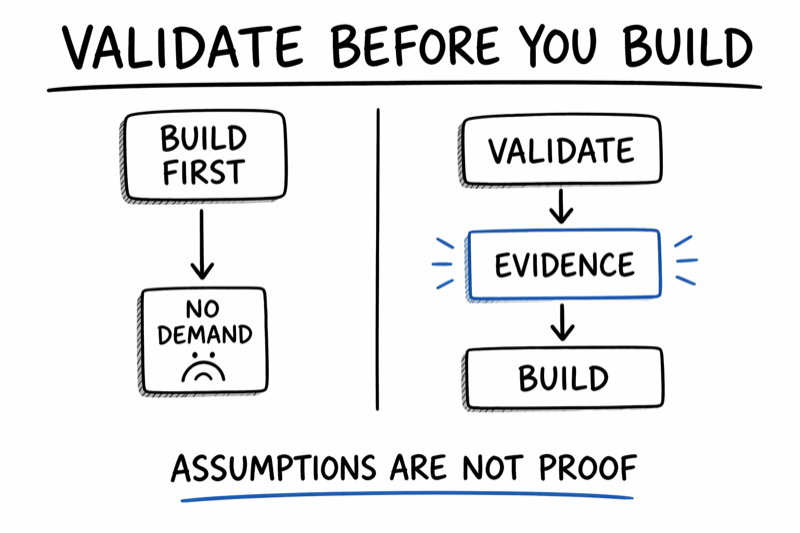
Validation is the process of testing your assumptions about who wants your product, what they'll pay, and how to reach them before you invest serious time and money building the full thing.
It's about gathering evidence — not opinions, not compliments, but real actions from real people — that proves (or disproves) demand exists.
Not Validation:
Real Validation:
Actions cost effort. Opinions are free. Only actions count.
Most failed businesses don't fail because of bad execution. They fail because the founder assumed something critical that turned out to be wrong:
Validation is the process of testing these assumptions one by one before you bet your savings and your next two or three years on them.
I get it. Validation feels slow. You want to start building. You want to see progress. You want something tangible to show for your effort.
But here's the math: two weeks of validation can save you six months of building the wrong thing.
Think about it. Would you rather spend:
Validation is not wasted time. It's the most efficient use of your time because it tells you whether to keep going or pivot before you're in too deep.
Let's say Sarah wants to validate her meal-prep kit idea. Here's what that process might look like:
Week 1: Customer Discovery
Week 2: Offer Testing
Week 3: Pre-Selling
Week 4: MVP Delivery
That's validation. In four weeks, Sarah went from "I think this might work" to "I have paying customers and real feedback."
Now she can decide: scale this up, tweak the offer, or walk away. But she's making that decision based on evidence, not hope.
When you're validating, your job is not to convince people your idea is great. Your job is to run experiments and gather data.
You're testing hypotheses:
Each experiment either confirms or contradicts your hypothesis. If it confirms, keep going. If it contradicts, adjust and test again.
Good founders are wrong all the time. The difference is they find out early, when it's cheap to pivot, instead of after they've invested $20,000 and a year of their life.
Let me paint the picture:
You skip the research and dive straight into building. You spend three months creating a website, sourcing suppliers, and setting up logistics. You invest $5,000 of your own money. You launch.
Week 1: No sales.
Week 2: Still nothing.
Week 3: You panic and start running ads. $500 spent, zero conversions.
Week 4: You're confused, stressed, and starting to doubt yourself.
Now you're in a hole. You've already invested significant time and money. Sunk cost fallacy kicks in. You think, "I've come this far, I can't quit now." So you keep pushing, spending more, hoping something clicks.
Six months later, you're out $10,000, exhausted, and no closer to traction. You finally give up — not because the idea was bad, but because you never validated the assumptions it was built on.
That's the cost of skipping validation. And it happens to new founders every single day.
When you validate properly, one of two things happens:
1. You find traction. People respond. They sign up. They pay. You have evidence this idea has legs. Now you can confidently invest more time and money, knowing you're building something people actually want.
2. You find nothing. People are polite but don't act. Nobody pays. Nobody signs up. The market is telling you this idea — in its current form — doesn't work.
Both outcomes are valuable. The second one saves you from wasting months on the wrong thing. That's a win, not a failure.
You don't need six months. You need 2 to 4 weeks of focused effort.
Here's a realistic timeline:
By the end of week 4, you should have enough data to make a Go/Pivot/No-Go decision.
If you're still unsure, run another round of tests. But don't spend months in research paralysis. Validation is about action, not endless planning.
You're convinced validation matters. Good! Now let's get specific.
In the next chapter, we'll nail down exactly who your customer is — not a vague demographic, but a real, specific human you can point to and say, "That's who I serve."
Because if you don't know who you're building for, you can't validate whether they want it.
Let's make sure you know exactly who your target customer is - with great specificity - so we can be most effective.
The 3 things you must take away from this chapter
Before you can validate your idea, you need to know exactly who you're validating it with.
Not "busy professionals." Not "people who like coffee." Not "anyone who wants to save time."
You need to get so specific that you could walk into a coffee shop, point to someone, and say, "That's my customer."
Here's the difference between a vague audience and a useful one:
The first one describes half the planet. The second one tells you exactly where to find them (LinkedIn, remote work forums, co-working spaces), exactly what to say to them ("You deserve better than your third reheated cup"), and exactly what they'd pay for (convenience, quality, a small daily luxury).
Specificity is not limiting. It's liberating. When you know exactly who you're talking to, you stop wasting time and money shouting into the void.
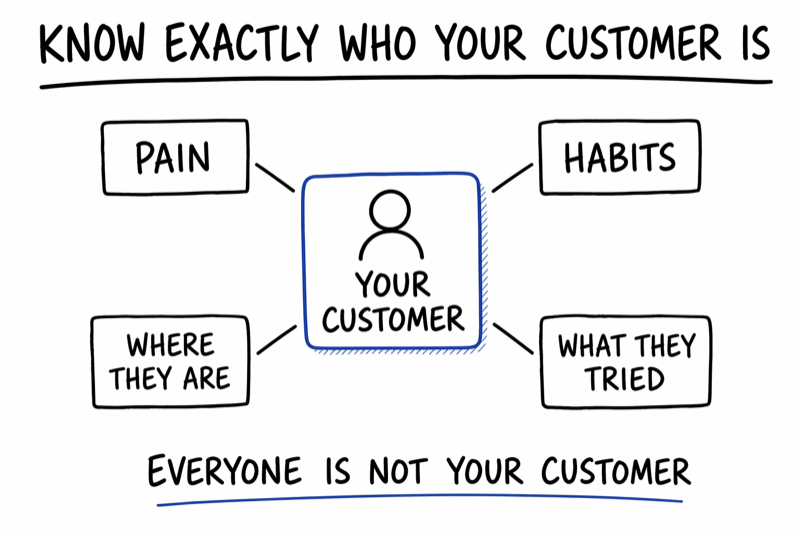
A customer profile is a detailed snapshot of your ideal customer. Not a real person — a composite based on research, observation, and conversations. Sometimes this is called an ICP, an Ideal Customer Profile.
This is the person you'll think about every time you write an ad, test an offer, or make a product decision.
Name: (Give them a name — it makes this feel real)
Age / Gender / Location:
Income level:
Job title or role:
Daily routine:
Biggest frustration related to your offer:
What they've already tried (and why it failed):
What they currently spend money on to solve this:
Where they hang out online:
Where they hang out offline:
What would make them switch to you:
How they'd describe the problem in their own words:
That last line is gold. The exact words your customer uses to describe their pain — that's your marketing headline, your ad copy, your elevator pitch. Use their language, not yours.
Here's Sarah's ideal customer profile (ICP) for her meal-prep business:
Name: Jessica
Age / Gender / Location: 34 / Female / Suburban Denver
Income level: $85K household, dual income
Job title: Marketing manager, remote 3 days/week
Daily routine: Works 8–5, picks up two kids from school at 3:30, juggles homework and dinner from 4–7 p.m.
Biggest frustration: By 5:30 p.m. she's too exhausted to cook but feels guilty ordering takeout again
What she's tried: HelloFresh (too complicated for weeknights), frozen meals (kids won't eat them), batch cooking on Sundays (can't sustain it)
What she currently spends: $60–80/week on takeout she wishes she didn't order
Where she hangs out online: Mom Facebook groups, Instagram, r/MealPrepSunday, Pinterest recipes she never makes
Where she hangs out offline: School pickup line, Target, her kids' soccer games
What would make her switch: Something faster than HelloFresh, healthier than takeout, and under $80/week
In her own words: "By dinnertime I have nothing left. I just need something healthy that doesn't require me to think."
Now Sarah knows Jessica. She knows where to reach her, what to say, and what she'll pay. That's not a guess — it's a strategy.
If you can answer these clearly, you understand your customer. If you can't, you need more research.
1. What problem do they feel in their bones every single day?
Not a mild inconvenience — a real frustration that costs them time, money, sleep, or sanity. The bigger the pain, the more they'll pay to fix it.
2. Where do they already spend money on this problem — and why would they switch to you?
If they're not spending money on something related to this problem, there may not be a real market. And if they are spending, you need a clear reason they'd switch to you: cheaper, faster, better, easier, more specialized.
3. Where are they right now — and how will you reach them?
Having a great product doesn't matter if you can't get it in front of the right people. Where do they spend time? What do they read, watch, listen to? Who do they trust? That's where your validation — and eventually your marketing — starts.
Stop guessing. Here's where your target customers are already having conversations about the problems you solve:
Online:
Offline:
Where Sarah's customers hang out:
Online: Mom Facebook groups (5,000+ members in Denver), r/workingmoms, Instagram accounts that share quick dinner ideas, local parenting blogs
Offline: School pickup lines, weekend farmers' markets, kids' sports games, Target on weeknights
Once you know where your customers hang out, go there and read what they write.
Copy the exact phrases they use to describe their problem. Write them down verbatim. Screenshot them if you have to.
When your customers see their own words reflected back in your marketing, it feels like you're reading their mind. Because you are.
Here's the ultimate test: Can you name 10 real people — actual humans, not types of people — who fit your customer profile?
Not "working moms." Write down 10 names: Jessica, Lauren, Amanda, Sarah T., Maria...
If you can't, your target customer is too vague, or you're not close enough to the market yet. Go deeper.
These 10 people are your validation pool. They're the ones you'll talk to in Chapter 3.
You know who your customer is. You know where they are. Now it's time to talk to them.
In the next chapter, we'll cover how to find 10 people willing to give you 20 minutes of their time — and what to do when they say yes.
Let's find real people who fit your customer profile — and get them to say yes to a conversation.
The 3 things you must take away from this chapter
You've defined your customer. You know what problem they have and where they hang out. Now comes the most important step in the entire validation process:
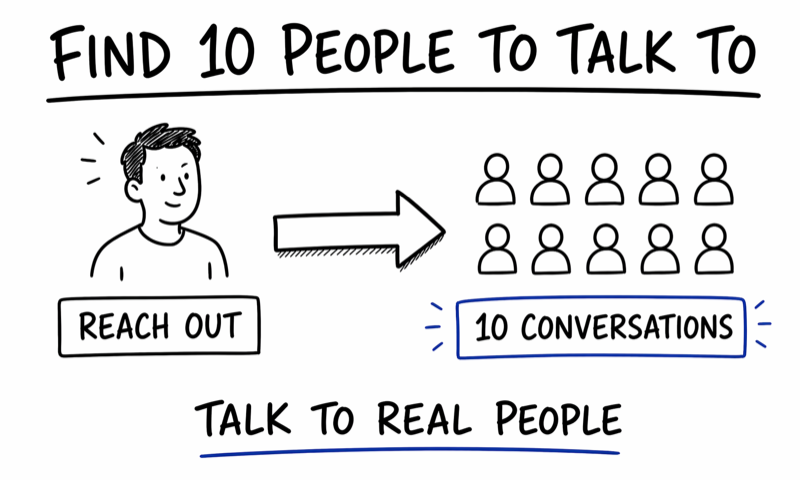
Talking to 10 real people who fit that profile.
Not reading about them. Not assuming you know what they think. Actually having real conversations where you listen more than you talk.
This step is where most founders quit. They find excuses: "I don't know anyone in that market." "People are too busy." "What if they say no?"
Here's the truth: finding 10 people to talk to is easier than you think. And it's the difference between building something people want and wasting six months on something nobody needs.
Why not 3? Why not 50?
Because 10 is the sweet spot where you start seeing patterns without drowning in noise.
After 10 conversations, you'll notice:
Three conversations aren't enough to spot trends. Fifty is overkill at this stage. Ten is the Goldilocks number.
You have three main channels: your network, online communities, and cold outreach. Let's break down each one.
Start by asking your existing network for introductions.
Post in your personal Facebook, LinkedIn, or email list: "I'm researching [topic] and looking to talk to people who [fit your customer profile]. Do you know anyone who might be willing to chat for 15 minutes?"
You're not asking your friends to be your customers. You're asking them to introduce you to people who fit the profile.
Friends and family will lie to be supportive. But their friends — the strangers they introduce you to — will tell you the truth.
Remember those Facebook groups, Reddit threads, and forums you found in Chapter 2? Now's the time to engage.
How to do it without being spammy:
Be transparent. Don't pretend you're not researching a business idea. People respect honesty.
Sarah's outreach post in a Denver moms Facebook group:
"Hey everyone! I'm researching healthy weeknight dinner solutions for busy parents and would love to chat with a few of you about what's working (or not working) in your house. I'm happy to Venmo you $10 for a coffee in exchange for 15 minutes of your time. If you're interested, send me a DM. Thanks!"
Sarah got 12 responses in 24 hours. She picked 10 and scheduled calls.
If your network and online communities don't get you to 10 people, it's time for cold outreach.
This sounds scary, but it works. Most people are flattered when someone genuinely wants their input — as long as you're respectful and make it easy.
Where to find people for cold outreach:
Cold outreach template:
Subject: Quick question about [topic]
Hi [Name],
I came across your [LinkedIn profile / Instagram post / blog] and noticed you [something specific about them that shows you did your homework].
I'm researching [topic] and would love to hear your perspective. Would you be open to a quick 15-minute call sometime this week? I'm happy to work around your schedule — and I'll buy you a coffee (virtual or real) as a thank-you.
No sales pitch, I promise — just genuinely trying to learn from people who know this space better than I do.
Thanks for considering!
[Your Name]
Keep it short. Make it personal. Offer something (coffee, their time compensated). Be clear this is research, not a pitch.
Here are the keys to getting people to agree to talk to you:
They will. Some people will ignore your message. Some will say they're too busy. Some will say yes and then ghost.
That's fine. You only need 10 yeses. If your outreach gets a 20% response rate, you need to reach out to 50 people. That's one afternoon of work.
Don't take it personally. Most people are just busy. The ones who say yes are the ones who matter.
Create a simple spreadsheet to track who you've reached out to, their response, and when you're scheduled to talk.
Outreach Tracker (sample columns):
This keeps you organized and makes it easy to follow up if someone doesn't respond in a few days.
You've found your 10 people. They've agreed to talk. Now comes the most important part: the conversation itself.
In the next chapter, we'll cover exactly what to ask, what not to ask, and how to listen in a way that uncovers the truth instead of polite encouragement.
Let's learn how to run interviews that reveal the truth — not what people think you want to hear.
The 3 things you must take away from this chapter
You've scheduled your 10 conversations. Now comes the moment of truth: the interview itself.
This is where most founders screw up. They go into the conversation wanting to validate their idea, so they ask leading questions, pitch their solution too early, and walk away thinking they got great feedback when all they got were polite nods.
Here's the key: Your job is not to convince them your idea is good. Your job is to learn whether the problem you're solving is real and whether your solution is something they'd actually pay for.
Those are very different goals.
A good customer interview is 80% them talking, 20% you asking questions.
If you find yourself explaining your idea for 10 minutes, you're doing it wrong. Your job is to ask open-ended questions and then shut up and listen.
The more they talk, the more you learn. The more you talk, the more you bias them.
Here's the framework for a great customer interview. Spend 15–20 minutes on these questions:
Here's a simple 20-minute interview structure that works:
Minute 0–2: Set the stage
"Thanks for taking the time to talk. I'm researching [topic] and trying to learn from people who've dealt with this firsthand. There are no right or wrong answers — I'm just here to listen and learn. Sound good?"
Minute 2–10: Explore the problem
Minute 10–15: Understand their current solution
Minute 15–18: Test your concept (lightly)
"I'm working on something that [brief 1-sentence description]. Based on what you've told me, does that sound like something that would fit into your life?"
[Listen. Don't defend. Don't pitch.]
Minute 18–20: Close strong
"This has been super helpful. Is there anything else you think I should know about this problem?"
"Would you be open to me following up once I've built something? I'd love your feedback."
This is critical. Don't paraphrase. Don't summarize. Write down the exact words they use to describe their problem.
If they say, "By dinnertime I'm just... done. I have nothing left," write that down verbatim.
Those words are marketing gold. When Sarah uses that exact phrase in her landing page headline, every parent reading it will think, "That's exactly how I feel."
Create a simple notes template for each interview:
After 10 interviews, you'll notice patterns. Here's how to tell the difference between a real problem and polite sympathy:
Real Pain (They Need This):
Polite Interest (They Don't Really Care):
If 7 out of 10 people show real pain, you're onto something. If 7 out of 10 show polite interest, your problem might not be painful enough — or you're talking to the wrong people.
These are warning signs that your idea might need a pivot:
These aren't dealbreakers. They're signals to dig deeper, adjust your approach, or talk to more people.
You've talked to 10 people. You've gathered data. You've written down quotes and identified patterns.
Now it's time to test whether they'll actually pay for what you're offering — before you build it.
In the next chapter, we'll cover how to test your offer with a simple landing page or direct pitch to see if people take action.
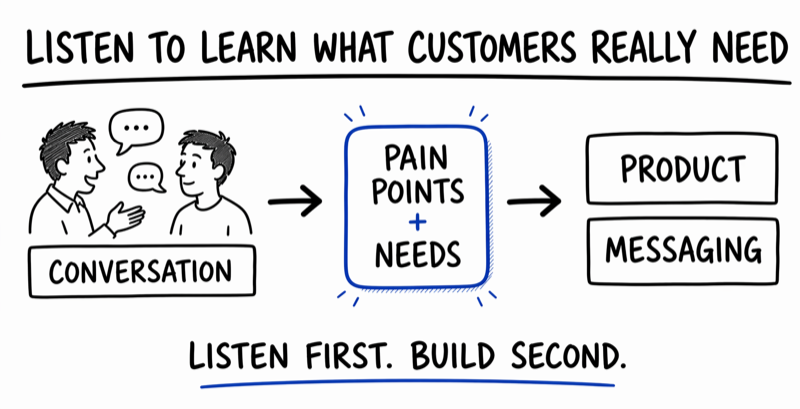
Let's put something in front of strangers and see if they take action — the ultimate validation test.
The 3 things you must take away from this chapter
You've talked to 10 people. They told you their problems. They said your solution sounds interesting. Maybe they even said, "Let me know when you launch!"
That's nice. But it's not validation.
Validation is what happens when you put your offer in front of people and they take action. Signing up. Paying. Booking a call. Anything that costs them effort.
Words are cheap. Actions are proof.
Testing your offer means creating a simple way for people to express real interest — and then measuring how many actually do.
You're not building the full product yet. You're testing whether the idea of the product is compelling enough to get people to act.
Here's what that looks like in practice:
The goal is not to make money (yet). The goal is to measure interest.
This is the most common validation test, and it's easy to set up in a few hours.
Here's what you need:
What to include on the page:
Sarah's Landing Page for Her Meal-Prep Business:
Headline: "By Dinnertime, You Have Nothing Left. We Get It."
Subheadline: "Healthy, dietitian-designed meals delivered to your door every week. Dinner on the table in under 20 minutes — no thinking required."
Bullet points:
Call to Action: "Join the Waitlist — Get 20% Off Your First Week"
[Email signup form]
That's it. Simple, clear, action-focused.
A landing page without traffic is worthless. Here's how to get 100–500 people to see it:
Your goal: Get 200–500 visitors to the page. That's enough to see a pattern.
Here's the reality check. For a waitlist signup (which costs the user nothing but their email), a good conversion rate is:
If Sarah gets 300 visitors and 20 signups (6.7%), that's a good signal. If she gets 300 visitors and 3 signups (1%), something's wrong.
If you don't want to build a landing page, you can test demand with direct outreach.
Go back to your list of 10 interview participants (and anyone else who fits your customer profile). Send them a direct message or email with your offer:
Sarah's Direct Pitch Email:
Subject: The meal-prep service we talked about — it's ready
Hi [Name],
A few weeks ago, we talked about your struggles with weeknight dinners. You mentioned you're spending $60–80/week on takeout and wish you had a healthier, faster option.
I've created exactly that: weekly meal-prep kits with dietitian-designed recipes that take under 20 minutes to cook. Fresh ingredients, pre-portioned, delivered to your door. $79/week for a family of four.
I'm launching a pilot program next month and looking for 10 people to try it. If you're interested, I'm offering the first week at 50% off ($39.50).
Would you like to give it a try? If so, just reply "yes" and I'll send you the details.
No pressure either way — just wanted to reach out since this came directly from our conversation.
Thanks!
Sarah
Send this to 20 people. See how many say yes.
If 5+ people respond positively, you have demand. If 1–2 respond, you might need to tweak the offer. If nobody responds, your pricing is too high or the problem isn't painful enough.
Post about your offer in a relevant online community and see how many people engage.
Sarah's post in a Denver Moms Facebook Group:
"Hey everyone, quick question: How many of you are sick of the dinnertime scramble? I'm launching a meal-prep service designed specifically for working parents — healthy, dietitian-approved recipes that take under 20 minutes. Delivered weekly, no subscription required. If that sounds like something you'd try, drop a 🙋 emoji below and I'll DM you the details."
If she gets 30+ emoji reactions and 10+ DMs, that's strong interest. If she gets 5 reactions and 1 DM, the offer isn't resonating.
Remember: opinions don't count. Only actions.
Real Validation:
Not Validation:
If you run a landing page test, a direct pitch, or a community post and get crickets, don't panic. You just learned something valuable: your current offer isn't compelling enough.
Here's what to do next:
Weak response is not failure. It's feedback. Use it to refine and test again.
You've tested demand. You've seen whether people take action. If you got strong interest (10+ waitlist signups, 5+ direct yeses, or meaningful engagement), you're ready for the next step:
Pre-selling.
In the next chapter, we'll cover how to take deposits and get paid before you build the full product — the ultimate validation move.
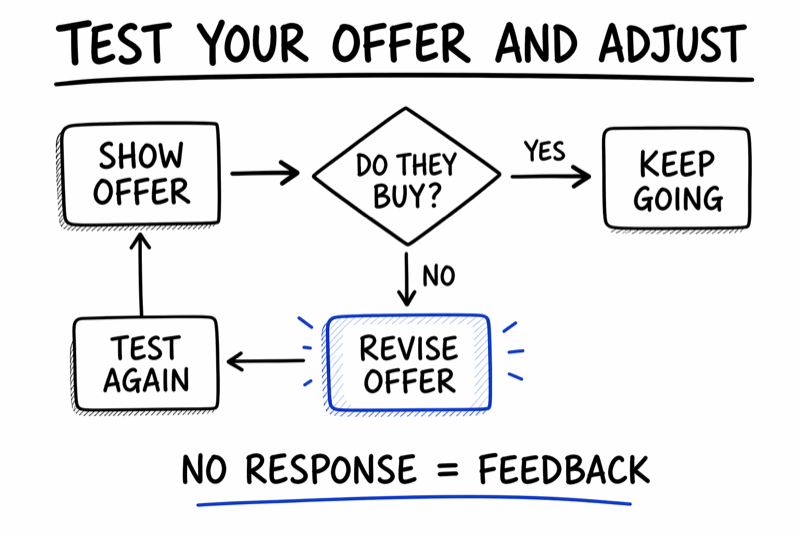
Let's get people to pay you real money before you build anything — the ultimate proof of demand.
The 3 things you must take away from this chapter
You've tested interest. People signed up for your waitlist. They said they'd try it. Maybe they even asked follow-up questions.
That's solid validation. But now let's take it to the next level.
Pre-selling—getting people to pay before you've built the thing—is the strongest validation signal.
Why? Because money is the ultimate signal. While email signups and "notify me when ready" commitments show real interest, actual payment proves people are serious enough to pull out their credit card for something that doesn't exist yet. That's the gold standard.
Pre-selling means selling your product or service before it's fully built.
You create an offer, set a price, and ask people to pay upfront (or put down a deposit) in exchange for getting access when it's ready — often at a discounted "early-bird" rate.
This is how smart founders validate demand without risking months of time and thousands of dollars building something nobody wants.
Here's why pre-selling beats every other form of validation:
Here's the framework for a compelling pre-sell offer:
Sarah's Pre-Sell Offer:
The Pitch:
"I'm launching a meal-prep service designed for busy working parents. Every week, you'll get fresh, pre-portioned ingredients and dietitian-approved recipes that take under 20 minutes to cook. Dinner on the table with zero stress.
I'm looking for 10 founding members to try the first month. Normally this will cost $79/week, but founding members get their first 4 weeks for $49/week (38% off).
Delivery starts in 3 weeks. If for any reason I can't deliver, I'll refund you in full — no questions asked.
Interested? Click here to reserve your spot."
That's clear, specific, and low-risk for the customer. Sarah is asking for $196 upfront ($49 × 4 weeks). If 10 people say yes, she has $1,960 in revenue before cooking a single meal.
You have three main channels:
1. Your Waitlist
Email everyone who signed up during your landing page test. They already expressed interest — now ask them to commit.
Subject: You're on the waitlist — here's your early access offer
Hi [Name],
A few weeks ago, you signed up for early access to [product/service]. I'm excited to say we're almost ready to launch — and I'm offering a founding member deal to the first 10 people who sign up.
[Include pre-sell offer details here]
If you're interested, click here to claim your spot. Only 10 spots available — first come, first served.
Thanks!
[Your Name]
2. Your Interview Participants
Go back to the 10 people you interviewed. They helped shape your offer — give them first access.
3. Direct Outreach
Reach out to people in online communities, local groups, or anywhere your target customer hangs out. Be transparent: you're pre-selling to validate demand.
You don't need 100 customers. You need 5–10 paying customers to validate demand.
If 5 strangers pay you real money before you've built anything, you have proof this idea has legs. If you can't get 5 people to pre-buy, that's a red flag that your offer, pricing, or positioning needs work.
If you pitch 50 people and nobody pays, don't panic. You just learned something critical: the gap between interest and commitment.
People might like your idea. They might even say they'd buy it. But when it's time to pull out their wallet, they hesitate. That tells you one of three things:
Don't take it personally. This is data, not rejection. Adjust your offer and test again.
Here are three ways to structure a pre-sell even if you haven't built anything yet:
1. The Founding Member Deal
Offer a steep discount (30–50% off) in exchange for early commitment. Founding members get lifetime access at the discounted rate.
2. The Pilot Program
Frame it as a pilot: "I'm testing this with 10 people before I launch publicly. You'll get it at half price, and I'll use your feedback to make it better." This lowers the stakes and makes customers feel like partners, not guinea pigs.
3. The Deposit Model
Ask for a small deposit (e.g., $25) to reserve their spot. If they love it after the first delivery, they pay the rest. If not, you refund the deposit. This removes risk and makes it easy to say yes.
When you ask people to pre-buy, you'll hear objections. Here's how to respond:
Objection: "I want to wait until it's ready."
Your response: "Totally fair. Just so you know, the early-bird price is only available now. Once we launch, it'll be full price. But no pressure — I'll let you know when we're live!"
Objection: "What if you don't deliver?"
Your response: "Great question. If for any reason I can't deliver what I've promised, you'll get a full refund. No questions asked."
Objection: "That's a lot of money upfront."
Your response: "I hear you. How about this: pay a $25 deposit now to reserve your spot, and then pay the rest after your first delivery. If you're not happy, I'll refund the deposit."
The key is to remove risk, not defend your offer. Make it easy to say yes.
Once you've collected pre-orders from 5–10 customers, you've officially validated demand. Congratulations — you have a business.
Now it's time to deliver. In the next chapter, we'll cover how to build your Minimum Viable Product (MVP) — the simplest version of your offer that keeps your promise without overbuilding.
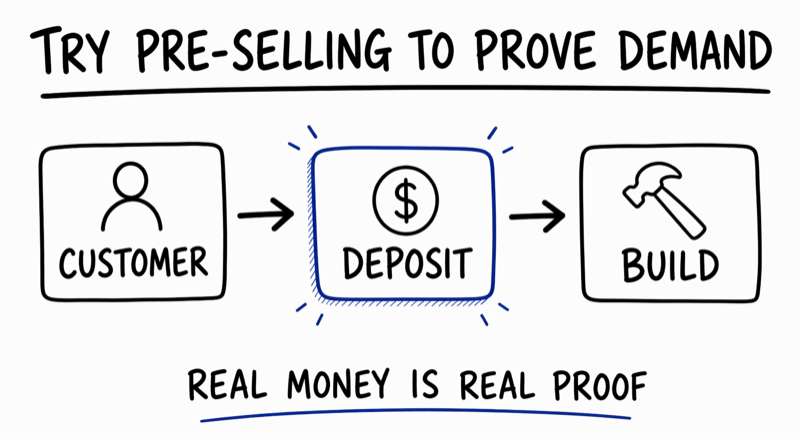
Let's build the smallest version that proves your idea works — without wasting months on features nobody needs.
The 3 things you must take away from this chapter
Quick note re MVPs: Often, very early in your business journey, you'll create an MVP (a prototype) to test yourself and to see if your idea even works. This chapter discusses a different, later version of the MVP: your public MVP that is your first sellable product.
You've validated demand. You have paying customers waiting. Now it's time to build something.
But here's where most founders screw up: they think "build something" means "build the perfect final product."
It doesn't.
Your job right now is to build the Minimum Viable Product (MVP) — the smallest, simplest version of your idea that delivers on your core promise and lets you learn whether this thing actually works.
An MVP is the simplest version of your product that solves the core problem for your customer.
It's not the full vision. It's not feature-complete. It's not polished. It's just good enough to deliver value - get the main job done - and gather feedback.
Not an MVP:
A Real MVP:
See the difference? The MVP is scrappy, manual, and imperfect. But it works. It delivers on the core promise. That's all that matters right now.
Here's the trap: you've been thinking about this idea for weeks (or months). You have a long list of features you want to include. You want to impress your first customers.
Stop. Start with 20% of what you think you need.
Most features you think are essential are actually nice-to-haves. Your customers don't care about bells and whistles yet. They care about one thing: Does this solve my problem?
If the answer is yes, they'll forgive a rough MVP. If the answer is no, no amount of polish will save you.
Here's a simple exercise to figure out what your MVP should include:
Step 1: Write down your core promise.
What is the one thing your product must deliver to be valuable?
Step 2: List every feature you want to include.
Everything. The full vision.
Step 3: Circle only the features that are absolutely required to deliver your core promise.
Be ruthless. If it's not essential, cross it out.
Step 4: That's your MVP.
Build only the circled features. Nothing else.
Example: Sarah's meal-prep MVP
Core promise: Healthy dinners on the table in under 20 minutes with zero planning.
Full feature list (what Sarah originally wanted):
MVP feature list (what she actually needs):
Everything else? Sarah can add it later if customers ask for it.
You don't need to hire a developer. You don't need to learn to code. You need to get scrappy and use tools that already exist.
Here are proven MVP strategies by business type:
If you're selling a service:
If you're selling a physical product:
If you're selling a course or info product:
If you're building an app or software:
If your MVP takes more than 2–4 weeks to build, you're overbuilding.
Seriously. Most MVPs can be built in a weekend if you focus on the core promise and ignore everything else.
Here's a realistic timeline:
By the end of week 4, you should have real customers using your real product and giving you real feedback.
Here's the truth: your MVP will be imperfect. It will have rough edges. Some things won't work as smoothly as you hoped. Customers will ask for features you don't have yet.
That's fine. That's the point.
Your MVP is not meant to wow people. It's meant to solve the core problem well enough that they want to stick around while you improve it.
If your first 5 customers keep using your product despite its flaws, you have product-market fit. If they bail after the first use, you need to fix something fundamental before scaling.
After your first customers use your MVP, ask them three questions:
Write down their answers verbatim. Use that feedback to prioritize your next iteration.
After you launch your MVP, you'll get feature requests. Lots of them. Customers will say, "It would be great if you could also..."
Don't build everything they ask for. Build only what 3+ customers request.
If one person asks for a feature, it's a nice-to-have. If three people ask for it independently, it's a pattern worth addressing.
You've built your MVP. You've delivered it to your first paying customers. Now it's time to get more.
In the next chapter, we'll cover how to get your first 5–10 customers through direct outreach — the fastest way to gain traction before you have a big marketing budget.
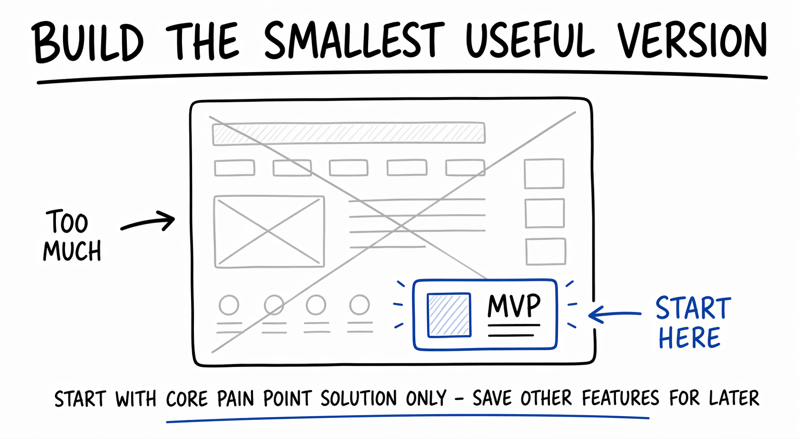
Let's land paying customers the fastest way possible — one conversation at a time.
The 3 things you must take away from this chapter
You've built your MVP. Now you need customers to use it.
At this stage, most founders make one of two mistakes:
The smarter move? Direct outreach.
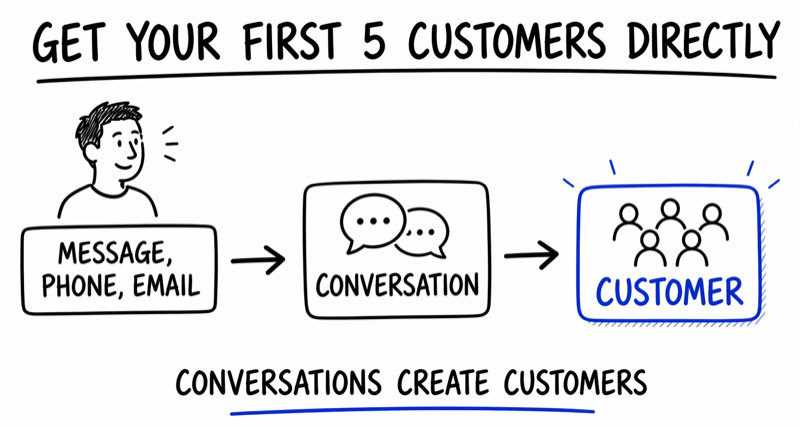
Direct outreach means personally reaching out to people who fit your customer profile and starting a conversation. No ads. No algorithms. Just you, talking to real people, one at a time.
It doesn't scale forever, but it's the fastest way to get your first 5–10 paying customers — and learn what messaging, pricing, and positioning actually work.
When you're just starting, you have zero brand recognition, zero social proof, and zero trust. Nobody knows who you are. Why would they buy from you?
Direct outreach solves that problem because it's personal. You're not a faceless company — you're a real human solving a real problem. People buy from people, especially when the product is new.
Here's what direct outreach gets you:
You already know who your customer is (Chapter 2) and where they hang out (Chapter 3). Now go there and start conversations.
Option 1: Your Interview List
Go back to the 10 people you interviewed in Chapter 4. They already know your story. They helped shape your offer. Reach out and offer them early access.
Subject: Remember our conversation? I built it.
Hi [Name],
A few weeks ago, we talked about [problem]. You mentioned [specific pain point they shared].
I took that feedback seriously and built [product/service]. It's live, and I'd love for you to be one of the first to try it.
[Include your offer: pricing, timeline, what they get]
Interested? Just reply and I'll get you set up.
Thanks!
[Your Name]
Option 2: Online Communities
Post in Facebook groups, Reddit threads, or forums where your target customer hangs out. Don't spam — add value first, then mention what you've built.
Sarah's post in a Denver Moms Facebook group:
"Hey everyone! A few months ago I asked for feedback about weeknight dinner stress, and so many of you shared your struggles (thank you!). Based on that feedback, I've launched a meal-prep service designed specifically for working parents: healthy, dietitian-approved dinners ready in under 20 minutes. Delivering in Denver starting next week.
I'm looking for 5 families to try the first week at a discounted rate ($49 instead of $79). If you're interested, comment or DM me and I'll send you the details. Thanks!"
Option 3: Cold Outreach
Find people on LinkedIn, Instagram, or email who fit your customer profile and reach out directly. Keep it personal and helpful, not salesy.
Subject: Thought you might be interested in this
Hi [Name],
I came across your [LinkedIn profile / Instagram post about X] and noticed you're [something specific about them].
I just launched [product/service] designed for [customer type]. Based on what I've seen, I think it might be a fit for you.
[1-sentence description of what you offer and the outcome they get]
If you're open to it, I'd love to offer you a discounted first month in exchange for feedback. No pressure either way — just thought I'd reach out.
Let me know if you're interested!
[Your Name]
Here's the structure for every direct outreach message:
When you reach out to 50 people, here's what to expect:
If you reach out to 50 people and get 10 positive responses, you're doing great. Convert 5 of those into paying customers, and you've hit your goal.
What to do when someone responds positively:
What to do when someone says no:
What to do when someone ignores you:
Most people won't respond to your first message. That's fine. A polite follow-up often gets a reply.
Subject: Following up — still interested?
Hi [Name],
I know inboxes get crazy. Just wanted to follow up on my message from last week about [product/service].
Still have a few spots open for the discounted first month if you're interested. If not, no worries at all — I won't bug you again.
Let me know!
[Your Name]
Keep it short. Keep it friendly. Give them an easy out.
Once someone expresses interest, your job is to make it easy for them to say yes.
Here's the sales process for early customers:
If you've reached out to 100 people and can't get 5 customers, something fundamental is off. Here's what to check:
Struggling to get customers is not failure. It's feedback. Use it to refine your offer and try again.
You've landed your first 5 customers. You've delivered your MVP. You've gathered feedback.
Now comes the biggest decision of the entire validation process: Do you go all-in, pivot, or walk away?
In the next chapter, we'll cover how to make the Go/No-Go decision based on real data, not hope.
Let's look at the evidence and decide: go all-in, pivot, or kill this idea.
The 4 things you must take away from this chapter
You've done the work. You've talked to customers, tested your offer, built an MVP, and landed your first paying customers.
Now comes the moment of truth: What does the data tell you?
This is where most founders get stuck. They've invested time and energy into their idea, so they want it to work. They ignore red flags. They rationalize weak signals. They keep pushing because quitting feels like failure.
But here's the truth: the smartest founders know when to double down and when to walk away.
In this chapter, we'll look at the evidence you've gathered and make a clear, honest decision: Go, Pivot, or No-Go.
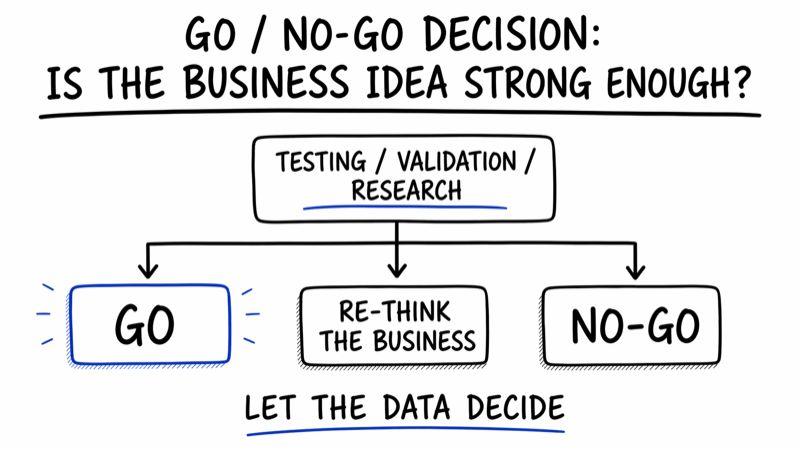
Based on your validation work, you'll land in one of three places:
1. GO — You've found strong demand. Double down and scale.
2. PIVOT — There's some interest, but something fundamental needs to change (pricing, positioning, customer segment, or offer).
3. NO-GO — The data shows this idea doesn't have legs. Walk away and save yourself months of wasted effort.
Let's break down how to know which one applies to you.
Here's what "GO" looks like. If you check most of these boxes, you're ready to scale:
Strong Signals to GO:
If this is you, congratulations. You've validated demand. It's GO TIME! Now your job is to:
You're no longer validating. You're building a business.
Here's what "PIVOT" looks like. You got some traction, but not enough. Something fundamental is off:
Signs You Need to Pivot:
If this is you, don't give up yet.
You need to see if you can revise the business to be stronger. You're onto something, but you need to adjust one of these variables:
A pivot is not starting over. It's making one strategic change based on what you learned.
Here's what "NO-GO" looks like. If you check most of these boxes, it's time to walk away:
Clear Signs to Walk Away:
If this is you, it's time to let this idea go.
I know that's hard to hear. You've invested time. You've told people about it. You've built things. Walking away feels like failure.
But it's not. Walking away based on evidence is one of the smartest things you can do.
You just saved yourself 6–12 months building something that would never gain traction. You can now take everything you learned and apply it to a better idea. That's not failure — that's smart entrepreneurship.
Sit down with your validation data and answer these questions honestly:
1. How many paying customers did you land?
2. How many came back for a second purchase (or asked when they could buy again)?
3. What was your landing page conversion rate?
4. Did customers describe the problem as urgent or nice-to-have?
5. Did you get any unsolicited referrals or word-of-mouth?
6. What did customers say when you asked, "Would you buy this again?"
7. If you had to pick one thing to change, what would it be?
Now look at your answers. What's the pattern?
If You're Going GO:
If You're Going PIVOT:
If You're Going NO-GO:
The hardest part of the Go/No-Go decision is separating hope from evidence.
It's easy to rationalize weak signals:
Maybe. Or maybe the market is telling you this idea doesn't work.
Here's the test: If your best friend showed you this exact data, what would you tell them to do?
Would you tell them to keep pushing? Or would you tell them to walk away and try something else?
Be as honest with yourself as you would be with them.
No matter which path you choose — GO, PIVOT, or NO-GO — you've done something most founders never do: you tested your idea before betting everything on it.
You talked to real customers. You built something. You put it in front of people and watched what they did. That's not common. Most founders skip this entirely and wonder why they fail.
You now have data, experience, and clarity. Whether you're scaling this idea, pivoting to a better version, or moving on to something new, you're miles ahead of where you started.
That's what validation is for. Not to guarantee success, but to give you the best possible shot at it — and the wisdom to walk away when the odds aren't in your favor.
Now go make your decision. And whatever you choose, make it based on evidence, not emotion.
Good luck.
You've validated your idea. Now put it on paper — not to impress anyone, but to force yourself to think clearly before you build.
The 4 things you must take away from this chapter
You’ve done the hard work. You validated your idea with real people. You landed paying customers. You made your Go decision.
Now comes a step that most early-stage founders either obsess over unnecessarily or skip entirely: writing a business plan.
Both approaches are wrong.
Skip it, and you’re running a business on a hunch — without ever forcing yourself to write down what you actually believe about your customers, your pricing, your competition, and how you’ll grow. Write a 40-page formal plan before you’ve validated anything, and you’ve wasted weeks crafting a beautifully detailed document full of assumptions that will all need to change anyway.
The right answer: write a short one, right now, based on what you’ve actually learned.
When most people hear “business plan,” they picture a dense 40-page document full of market research, five-year financial projections, org charts, and executive summaries. Something you’d hand to a bank or a venture capitalist.
That version exists for a reason — but it’s not what you need right now.
What you need is something far more useful: a clear, written answer to the questions that actually determine whether your business will succeed. Who are you serving? How do you make money? What will it cost you? How will you reach customers? What does the next 12 months look like?
You can answer all of that in 3–5 pages. And writing those answers down — not thinking about them, actually writing them — is one of the most valuable things you can do before you formalize your business and start spending real money.
You’ve just validated your idea. You have real customer data, a proven offer, and early paying customers. This is the perfect moment to write your plan — not before validation (when it would all be guesswork), and not after you’ve already built everything (when it’s too late to course-correct).
Writing the plan now does three things:
1. It forces vague ideas into specific decisions. You know roughly how you’ll find customers — but can you write it down in two paragraphs? You have a sense of your pricing — but have you actually calculated what it costs you to deliver the product and what margin you’re left with? The writing forces precision.
2. It surfaces planning gaps before they become expensive. The sections you struggle to write are the sections where your thinking is weakest. That’s valuable information. A gap in your plan is far cheaper to discover now than six months from now.
3. It gives you something to hand to partners, lenders, or collaborators. When you bring on a co-founder, apply for a small business loan, or pitch to a potential investor, they will ask what your plan is. Having it written down — clearly, concisely — signals that you’ve done serious thinking.
There are two formats worth knowing about:
Short-form plan (3–5 pages): This is what 95% of early-stage founders need. It answers the fundamental questions about your business in plain language. It takes one to two days to write. It forces you to think clearly without overwhelming you with research. Start here.
Traditional plan (20–40 pages): This is the version you’ll need if you’re applying for a bank loan, seeking outside investment, or bringing on a partner who has equity at stake. It includes deeper competitive analysis, detailed financial projections, and full market sizing. You can build this from your short-form plan when the time comes — but building the short-form first makes the full version much easier to write.
For now: write the short-form plan. It will surface everything you need to know at this stage, and it won’t consume weeks you should be spending on building your business.
Your short-form plan has six sections. Each one forces you to answer a question that matters:
Describe what you sell, who buys it, and what problem it solves. Keep it to a paragraph or two — no jargon, no buzzwords. If you can’t explain your business clearly in writing, you can’t explain it to customers either.
Sarah’s example: “We deliver weekly meal-prep kits to working parents with kids under 10. Each kit includes pre-portioned ingredients and recipes designed by a registered dietitian that take under 20 minutes to prepare. We solve the ‘too exhausted to cook, too guilty to order takeout’ problem that busy parents face every weeknight. Our target customer is a dual-income household earning $80K+ in a metro area who values healthy family meals but has limited time.”
Describe your revenue model. What do you charge? How often do customers pay? What does it cost you to deliver the product or service? What’s your gross margin?
This is where most founders discover they haven’t done the math. Do it now. If you can’t calculate a rough profit margin per customer, you don’t have a business model yet — you have a hobby.
Sarah’s example: “We charge $79/week per kit, billed weekly via subscription. Cost of goods (ingredients + packaging) runs approximately $38/kit. Delivery costs $9/kit via a local courier partnership. Gross margin per kit: $32 (40%). A customer who stays 6 months generates $2,028 in revenue and approximately $832 in gross profit before marketing costs.”
List 3–5 competitors and describe honestly how you stack up against each one. Then articulate your differentiation in one or two sentences. What do you offer that they don’t? Why would a customer choose you over them?
If you can’t answer that question clearly, your positioning needs more work.
Sarah’s example: “Main competitors: HelloFresh, Green Chef, local meal-prep services. HelloFresh and Green Chef target a broader audience with no dietitian involvement; their recipes average 35–45 minutes. Local services exist but don’t deliver. Our differentiation: the only kit service specifically designed for parents with kids under 10, with dietitian-designed recipes under 20 minutes. We’re not competing with Hello Fresh on price — we’re competing on specificity and health credibility.”
Describe your marketing approach. Where will you find customers? What channels will you use? What does it cost to acquire a new customer, and how do you know? Be specific — “social media” is not a marketing plan. “Facebook and Instagram ads targeting parents in Denver aged 30–45, with a target cost per acquisition under $40” is a marketing plan.
Sarah’s example: “Short-term: direct outreach through local parent Facebook groups and neighborhood apps (Nextdoor). Medium-term: Instagram content targeting working parents, partnering with local pediatricians and schools for referrals. Paid advertising after reaching 30 customers and understanding our retention rate. Target CAC: under $50. Current CAC via direct outreach: $0 (all customers from personal network and community posts).”
List your primary costs: startup costs (one-time), and monthly operating costs (ongoing). Be honest. Underestimating costs is one of the most common reasons new businesses run out of money.
Sarah’s example: “Startup costs: commercial kitchen rental deposit ($1,200), initial packaging inventory ($800), food handler permits ($150), basic website ($200). Total startup: ~$2,350. Monthly operating: kitchen rental ($600), insurance ($90), software/tools ($80), marketing ($300). Monthly fixed costs before COGS: ~$1,070. Need 34+ active weekly subscribers to cover fixed costs. Currently at 6.”
What does success look like one year from now? Set 3–5 concrete milestones — specific numbers, not vague goals. “Grow the business” is not a milestone. “Reach 50 active weekly subscribers by month 6” is.
Sarah’s example:
Here’s something every experienced founder knows that first-timers often don’t: your business plan will be wrong.
Not because you wrote it badly. Because that’s how business works. Customers surprise you. Costs shift. Channels that seemed obvious don’t convert. A partnership you didn’t expect opens a door.
The business plan isn’t a promise you’re making — it’s your best current thinking, written down so you can measure reality against it and adjust. The founders who treat it as sacred and unchangeable are the ones who get into trouble. The founders who revise it quarterly based on what they’re actually experiencing are the ones who build real businesses.
You don’t need it today. But here’s when you will:
For all three situations, the short-form plan you’re writing now becomes the foundation. You’ll expand each section, add financial detail, and deepen the research. But the bones are the same.
Resources for the full-length version:
SCORE.org offers free business plan templates and one-on-one mentoring from experienced entrepreneurs. It’s one of the best free resources available for first-time founders who need to build a formal plan. Visit score.org to access their templates and find a mentor in your area.
Don’t let this chapter be theoretical. Open a document and write your plan before you move to Guide 3.
Work through each section in order. When a section feels hard to write — when you find yourself staring at a blank page — pay attention to that feeling. That’s not writer’s block. That’s a planning gap.
If you can’t write a section, that’s the section to fix before you move forward.
Your Short-Form Business Plan Checklist:
Work through each section and check it off when written:
☐Section 1: What the business does and who it’s for (1–2 paragraphs)
☐Section 2: Revenue model — price, cost, margin per customer/sale
☐Section 3: 3–5 competitors and your differentiation in 1–2 sentences
☐Section 4: Specific customer acquisition channels and target cost per customer
☐Section 5: Startup costs and monthly operating costs
☐Section 6: 3–5 specific, numbered milestones for the next 12 months
Sections I struggled to complete (these are my planning gaps):
Use our short-form business plan template to make this easier. It’s a Google Doc you can copy and fill in — structured around the six sections above with prompts to guide your thinking: startabusiness.center/business-plan-template
Once your plan is written, you’re ready for the next step: setting up your business the right way — legal structure, finances, permits, and everything that turns your validated idea into a legitimate business. That’s what Guide 3 covers.
If you worked through this guide, you've done something rare: you validated your idea with real people before building the whole thing.
Most founders skip this step entirely. They spend 6-12 months building in isolation, then launch to silence. No customers. No feedback. Just confusion about what went wrong.
You took a different path. You:
That's not common. That's smart.
If you chose GO: You have validated demand and early customers. Now it's time to scale. Check out Guide 3: Set Up Your Business the Right Way to handle the legal and financial foundations, then Guide 5: Find Your First Customers to grow beyond your MVP.
If you chose PIVOT: You learned what doesn't work, and that's valuable. Adjust your offer, your target market, or your approach—then run through this validation process again. Most successful businesses pivoted at least once.
If you chose NO-GO: You just saved yourself 6-12 months of wasted effort. That's a massive win. Take what you learned and apply it to your next idea. You're now better at validation than 95% of founders.
Validation doesn't guarantee success. But it dramatically improves your odds.
Without validation, you're guessing. With validation, you're making informed bets backed by evidence from real customers.
Whether this idea worked out or not, you now have a process you can use for every business idea you ever consider. That's worth more than any single business.
Remember this: The goal of validation isn't to prove you're right. It's to discover the truth as quickly and cheaply as possible—so you can either go all-in with confidence or walk away before it's too late.
You did that. Now act on what you learned.
Tim Donahue is the founder of StartABusiness.Center, where he helps first-time founders turn ideas into real businesses without wasting years on the wrong approach.
After years of mentoring hundreds of new founders, Tim noticed the same pattern: most fail not because they lack drive, but because they skip critical validation steps. They build first, test later—and by then it's too late.
This guide series was created to give new founders a clear, step-by-step path through the messy early stages of starting a business: assessing ideas, validating with real customers, setting up legal and financial foundations, building websites that work, finding customers, and scaling sustainably.
Tim's approach: No fluff. No motivational speeches. Just practical frameworks that work in the real world.
© 2025 StartABusiness.Center | All Rights Reserved
