A practical, no-nonsense guide and workbook for first-time founders
Here's the most common founder story in the world:
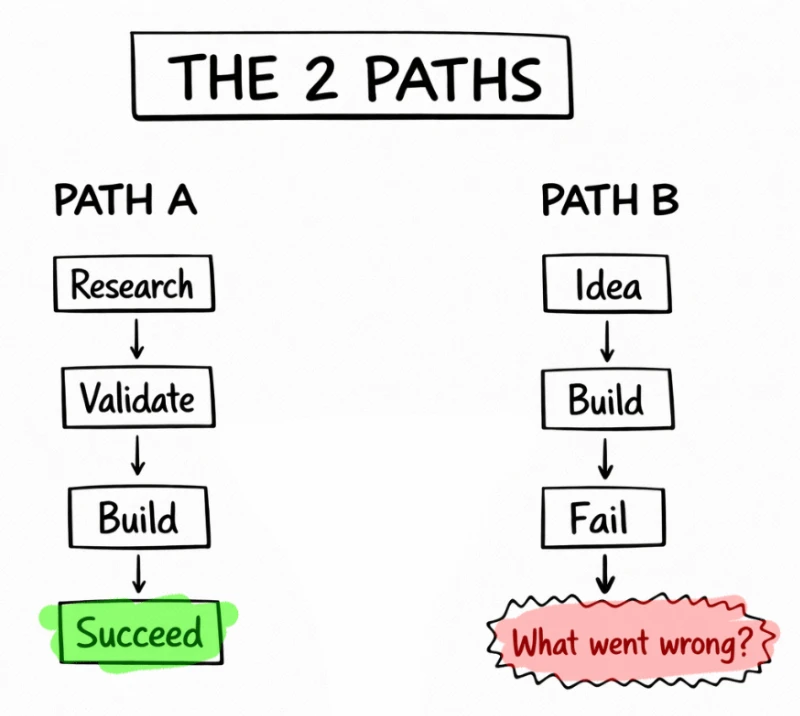
You get an idea. It feels brilliant. You tell friends—they love it. You start building: designing logos, creating websites, maybe ordering inventory. Six months later, you launch to crickets.
No customers. No revenue. Just confusion and regret.
What went wrong is simple: you skipped the validation homework.
Validating your business means testing it out in the real world to see if people are interested. This chapter and the next Guide 'Test Your Business Idea Before You Build' will walk you through exactly how to do this.
Starting a business is a real commitment — often a year or two of your life, and significant energy and resources.
You owe it to yourself to pressure-test your idea in the real world before you go all-in.
That is the purpose of this Guide.
The good news? This validation takes 1-2 hours and can save you years of chasing the wrong thing.
Let's find out if real demand exists—before you spend a dime.
Your excitement is not evidence. Friends saying "cool idea!" is not evidence. Only actions count: giving contact info to be notified, waitlist signups, pre-orders, or asking "when will this be ready?" Pre-payment is the strongest signal, but getting email addresses and "notify me when ready" commitments are also solid validation.
Here's your research plan. Do all three—not just the easy ones.
Set a timer for 10 minutes. Find 3 online places where 100+ of your target customers gather:
Where my customers gather:
1.
2.
3.
Pass: Found 3 places easily
Fail: Couldn't find them in 10 minutes = market too small or undefined
Find 3 existing solutions people are already using. If nobody is solving this problem, that's a warning sign—not an opportunity.
Existing solutions:
1. Price:
2. Price:
3. Price:
Pass: Found 3+ competitors (proves demand exists)
Fail: No competitors = probably no market
Post in ONE of the communities you found. Don't pitch your solution—just ask if people struggle with the problem:
"Quick question: Do you struggle with [PROBLEM]? I've been researching this and curious if others find it frustrating. What have you tried?"
Where I posted:
Responses received:
Did 3+ people say YES?
Pass: 3+ people confirmed they have this problem
Fail: Crickets or "not really" responses
Your back-of-napkin financial reality check.
This is the silent killer of small businesses. The idea works. Customers buy. You turn a profit. But when you run the numbers, you discover you need 10,000 customers just to make $60K/year. And getting 10,000 customers? That's a 5-year grind.
If the financial potential isn't there, everything else is a waste of time.
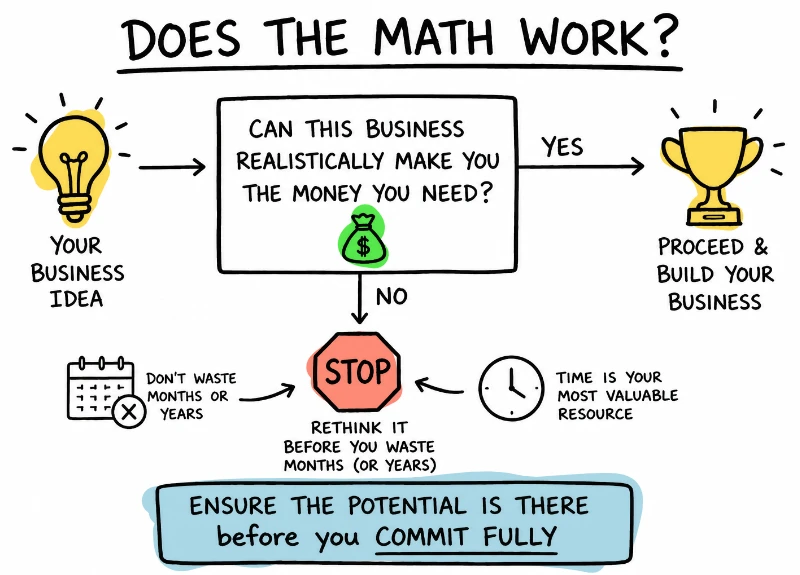
If it doesn't, why would you waste years on this idea?
Here's the simple math that tells you if your idea is viable:
1. Annual income you need: $
2. Revenue needed (income ÷ 0.30 profit margin): $
Example: Need $75K? You need $250K in revenue.
3. Your price per sale: $
4. Sales needed (revenue ÷ price): sales/year
That's sales/month or sales/day
5. Purchases per customer per year:
6. Total customers needed:
7. Size of your target market:
8. Can you realistically get that many customers? YES / NO
Math Works
Math Broken
Don't panic. You have options:
Even if the business has great potential, do you have the capital to build it, launch it, and survive the first 6-12 months?
One-time startup costs: $
(Legal, website, inventory, branding, initial marketing)
Monthly operating costs: $
(Rent, software, marketing, supplies)
Personal living expenses per month: $
Months of runway needed:
TOTAL CAPITAL NEEDED: $
Do you have access to this money? YES / NO
Both must be YES to proceed:
Why would someone choose you over existing options?
Competition is good—it proves demand exists. But you need a clear answer to: "Why would someone choose you?"
My top competitor:
What they charge:
What customers love about them:
What customers complain about:
My advantage:
Not "better" or "cheaper"—be specific.
Warning signs:
Every successful business has a DIFFERENTIATOR that distinguishes them from the competition in the customer's mind.
Either you're different due to quality, price, speed, ease of use, customer service, status, or something else you've promoted with your brand that customers identify with and like. If you can't clearly identify your differentiator, how will a customer understand why you're different than everyone else, and decide to buy from you?
Study the competition and figure out where you can carve out your own differentiator - and how you'll communicate that to the customer - in order to stand out.
Can your target market support your revenue goals?
Do the math: Will capturing a small percentage of the available market be enough for you to build a strong business?
Total potential customers:
Percentage you can realistically reach (2-10% typical): %
Reachable customers:
Customers needed (from Chapter 2):
Does this work? YES / NO
Healthy Market
Too Small
The best product fails without distribution.
Distribution is everything
Where do your customers actually spend time?
5 places my customers gather:
1.
2.
3.
4.
5.
My customer acquisition strategy:
(SEO, paid ads, partnerships, direct outreach, content marketing, social media)
Estimated cost to acquire one customer: $
Customer lifetime value: $
Does LTV exceed CAC by 3x or more? YES / NO
Figure out if your business can make you the profit you need to survive - before you go all in.
Don't start without a strong revenue plan
Price per sale: $
Cost per sale (materials + labor + overhead): $
Profit per sale: $
Profit margin (profit ÷ price × 100): %
Target margins for small businesses:
Don't panic. You have options:
Your skills, resources, risks, and how a new business will fit in your life all need consideration
Skills this business requires:
Skills you have:
Skills you need to learn/hire:
Can you realistically acquire them? YES / NO
Biggest risk:
How to mitigate it:
If you don't have the needed finances to get the business off the ground, stop. Freeze. You'll need to figure this out before you proceed. Every business needs at least a little money to get off the ground.
Skills, risks, available time, capital - be honest with yourself: Do you have what it will take to make this work? If not, you can get help, or revise your plan - but starting a new business without strongly considering these things is foolish.
Your GO, PIVOT, or PARK IT decision.
Count how many of the 9 chapters you passed (Chapters 1-9):
8-9 Pass: GO
Your idea has strong fundamentals. The math works, demand exists, and you can reach customers.
Next step: Move to validation. Test with real customers before building the full product.
Download Guide 2: Test Your Business Idea Before You Build
5-7 Pass: PIVOT
You have a foundation, but critical gaps remain. Don't ignore them.
Fix the areas you failed:
Reassess after making changes.
0-4 Pass: PARK IT
Be brutally honest: This idea can't support your life in its current form.
Your options:
This is a win, not a failure. You just saved 6-12 months of wasted effort.
If you scored GO: Download the complete Guide 2: Test Your Business Idea Before You Build and start validation with real customers.
If you scored PIVOT: Pick your weakest area and spend this week fixing it. Then reassess.
If you scored PARK IT: Take what you learned here and apply it to your next idea. You're now better at validation than 95% of founders.
Want the Complete Assessment Workbook?
The full guide goes deeper on every chapter — with exercises, worksheets, and real decision frameworks.
→ Read the Full Guide (complete deep-dive with worksheets and examples)
Complete guide series available at StartABusiness.Center
© 2026 StartABusiness.Center | All Rights Reserved
