How To Find Your First Customers
A Step-by-Step Marketing Guide for New Business Owners
A practical, step-by-step guide to creating finding your market and your customers
Tim Donahue | StartABusiness.Center
Introduction:
You've Validated. Now What?
Wait - you DID validate right?
You must validate. If you haven't yet please go back to Guide 2 - 'Test Your Business Idea Before You Build' to ensure that you've found the market for your business idea.
Ok, moving on: You've proven people want what you're selling. Maybe you've got 10 customers, maybe 20.
But you're stuck.
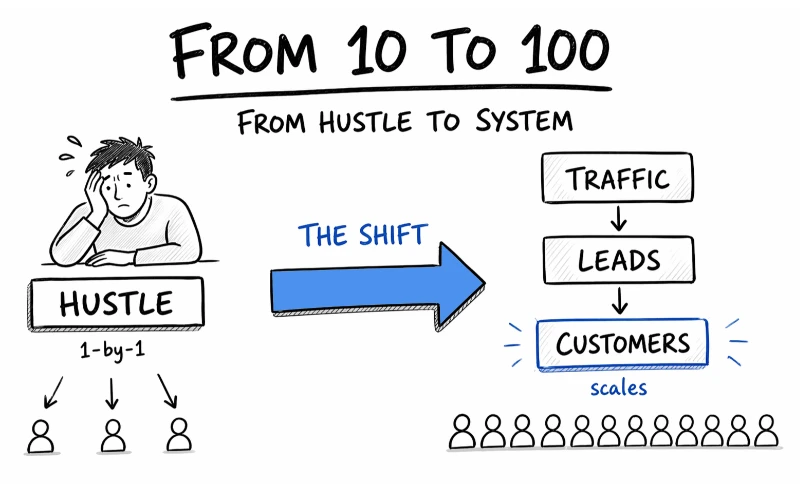
Every new customer feels like climbing a mountain. You're hustling, posting on social media, telling everyone you know. But growth is slow. You need a system that scales beyond your personal network.
Here's the truth: What got you to 10 customers won't get you to 100. Early customers came from friends, favors, and hustle. The next 90 require marketing systems that work whether you're awake or asleep.
This guide is about making that shift.
What You'll Learn
This is a practical marketing roadmap for founders who've validated their business and are ready to scale. You'll learn:
- How to craft messaging that converts strangers into customers
- Which marketing channels deserve your limited time and budget
- How to build systems that generate customers consistently
- The difference between tactics that work and vanity metrics that waste time
- How to measure what matters and double down on what's working
Who This Guide Is For
This guide is for founders who have validated their idea and need to scale systematically.
If you're still figuring out whether anyone wants your product, go read Guide 2 in this series. If you've made sales and you're ready to turn "10 customers" into "100+ customers," you're in the right place.
How to Use This Guide
Work through it sequentially. Each chapter builds on the last.
Do the exercises. Fill in the worksheets. Marketing is not theory—it's execution.
By the end, you won't just understand marketing channels. You'll have a repeatable system for acquiring customers at scale.
Chapter 1:
How To Find Your First 5-10 Customers
The scrappy, manual hustle that gets you started.
The 3 things you must take away from this chapter
- Your first customers come from hustle, not systems. Direct outreach, personal conversations, and your network—not ads or SEO.
- Make it easy to say yes. Remove friction, offer guarantees, start with small commitments. Lower the barrier to that first sale.
- Don't wait for perfection. Launch with a "good enough" MVP. Your first customers want results, not polish.
Your First Customers Won't Come From Marketing Systems
Your first customers won't come from marketing systems. They'll come from hustle.
Before you worry about ads, SEO, or content marketing, you need to prove real people will pay you real money. That happens through direct, personal, often uncomfortable outreach.
You're not building a marketing funnel yet. You're having conversations. You're reaching out to people one by one. You're asking for the sale directly.
This doesn't scale. And that's okay. You're not trying to scale yet. You're trying to prove people will pay you.
Where Your First Customers Come From
- Your Network: Friends, family, former colleagues, LinkedIn connections. Tell everyone what you're building.
- Direct Outreach: Email, DM, or call people who fit your customer profile. Personalized, one-to-one messages.
- Community Engagement: Join forums, Facebook groups, Slack channels where your customers hang out. Help first, sell second.
- Local Events: Networking events, meetups, conferences. Real conversations that build trust.
- Your Validation Interviews: People you talked to during validation are warm leads. Follow up with them.
People you know - your network - are your first customers: You must alert everyone you know about your new business. Don't be shy! It's OK! Typically these will be your first 5-10 customers.
The First Customer Script
Don't overthink it. Keep it simple and direct:
"Hey [Name], I'm launching [product/service] that helps [target customer] [solve problem]. Based on our conversation, I thought you might be interested. Would you be open to a quick call to see if it's a fit?"
That's it. No fancy funnel. No 10-email sequence. Just a direct, personal ask.
Pro tip: Offer your first 5-10 customers a special "founding member" discount or bonus in exchange for detailed feedback.
Make It Easy to Say Yes
Your first customers are taking a risk on you. Make it as easy as possible for them to say yes:
- Remove friction: Simple checkout, flexible payment terms, personal onboarding call.
- Offer a guarantee: Money-back if they're not satisfied. Remove the risk.
- Start small: Trial period, pilot project, minimum commitment. Let them test before going all-in.
- Be available: Respond fast, over-deliver on support. Show them you care.
The easier you make it to say yes, the more yeses you'll get.
What Not To Do
Don't wait for perfection. Launch with a "good enough" MVP. Your first customers want results, not polish. You can improve as you go.
Don't hide behind your website. Direct conversations convert better than landing pages at this stage. Pick up the phone. Send the DM. Have the conversation.
Don't skip the ask. Many founders talk about their product but never actually ask for the sale. You have to ask. "Are you interested in trying this?" "Can I sign you up?" Make the ask.
Your First 10 Customer Plan
1. List 20 people in your network who fit your customer profile:
2. Which 3 communities (online or offline) do your customers spend time in?
3. What's your "founding member" offer? (discount, bonus, special access)
4. When will you start outreach? (Pick a date. Today is best.)
Goal: Get 5-10 paying customers in the next 30 days through direct outreach.
Once you have those first customers, then you can start thinking about marketing systems. But first, prove people will pay you.
Chapter 2:
From 10 to 100: Systematic Customer Acquisition
Your first 10 customers came from hustle. The next 90 come from systems.
The 3 things you must take away from this chapter
- What got you to 10 won't get you to 100. Personal hustle, friends and colleagues doesn't scale. You need repeatable marketing systems.
- Marketing is a numbers game. Track everything. More traffic + better conversion = predictable growth.
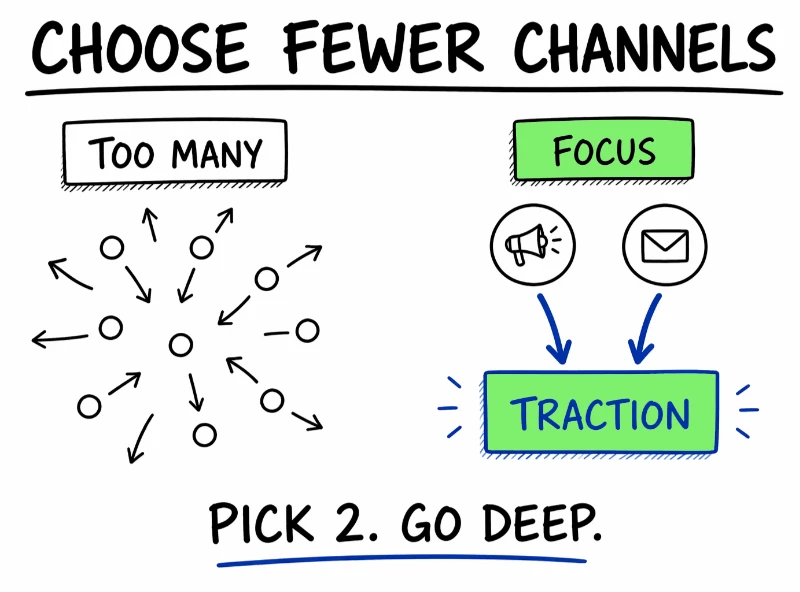
- Pick 2 channels and go deep. Dabbling in 10 channels gets mediocre results everywhere. Mastery in 2 channels wins.
The Problem With Early-Stage Marketing
Your first customers probably came from your personal network. Friends. Family. LinkedIn connections. Word of mouth from people who already trusted you.
That's normal. That's how it works.
But at some point, you run out of warm leads. Your network taps out. And suddenly, growth stalls.
You post on Instagram. Crickets. You send cold emails. No replies. You try Facebook ads and burn $200 with zero sales.
Here's why: Marketing to strangers requires a different playbook than marketing to friends.
The Shift: From Hustle to Systems
Early-stage marketing is personal. You text people. You meet for coffee. You personally onboard every customer.
That's exhausting. And it doesn't scale.
Systematic marketing means building processes that generate customers predictably, whether you're working or sleeping.
Here's what that looks like:
- Content that drives traffic automatically (blog posts ranking on Google, YouTube videos that get views 24/7)
- Ads that convert reliably (you know if you spend $100, you get 3 customers worth $400)
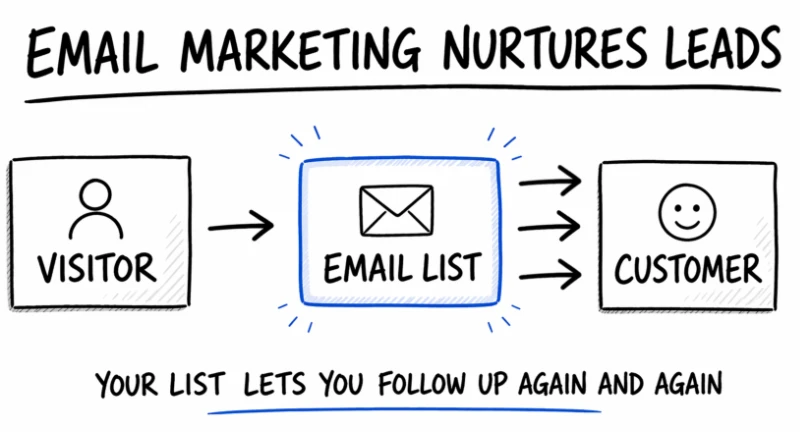
- Email sequences that nurture leads (automated follow-up that turns lukewarm interest into sales)
- Referral systems that turn customers into your sales team (happy customers bring you more customers)
This is the shift from founder-led hustle to scalable marketing.
Marketing Is a Numbers Game
Here's the formula that drives every marketing channel:
Traffic × Conversion Rate = Customers
If 1,000 people visit your site and 2% buy, you get 20 customers. If you improve your conversion rate to 4%, you get 40 customers from the same traffic. If you double traffic to 2,000 and keep the 4% conversion rate, you get 80 customers.
This is how you scale. You track the numbers. You test. You improve what's working. You kill what's not.
Your Current Marketing Math
1. How many people saw your offer last month? (website visits, social media impressions, email opens)
2. How many took action? (clicked, signed up, messaged you)
3. How many became paying customers?
4. What's your conversion rate? (paying customers ÷ people who saw your offer × 100) %
If you don't know these numbers, you're flying blind. Start tracking today.
Why Most Founders Fail at Marketing
They spread themselves too thin.
They try every channel at once. Instagram. TikTok. LinkedIn. Google Ads. Facebook Ads. SEO. Email. Podcasts. YouTube.
They post sporadically. They burn out. They give up after two weeks because "marketing doesn't work."
Here's the truth: Marketing works. But only if you commit.
Pick 2 channels. Go deep for 90 days.
Track everything. Double down on what works. Kill what doesn't.
The rule: Focus beats dabbling. Master 2 channels before adding a third.
The Marketing Channels That Actually Work
There are dozens of ways to market your business. But most new founders should start with one of these proven channels:
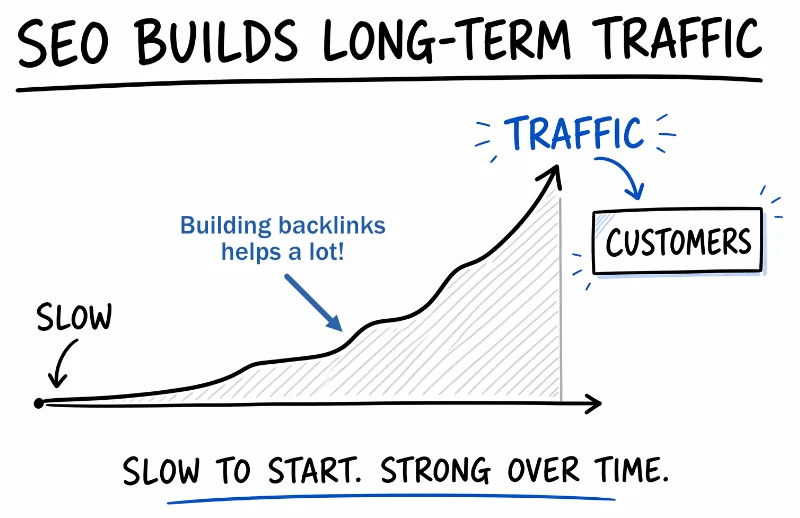
- SEO + Content Marketing: Write blog posts that rank on Google. Slow to start, but compounds over time.
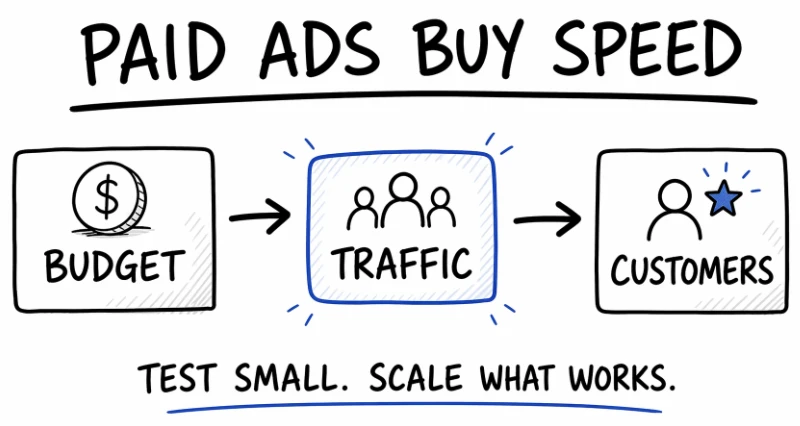
- Paid Ads (Google/Facebook): Fast results. Costs money. Requires testing and optimization.
- Email Marketing: Highest ROI of any channel. But you need an audience first.
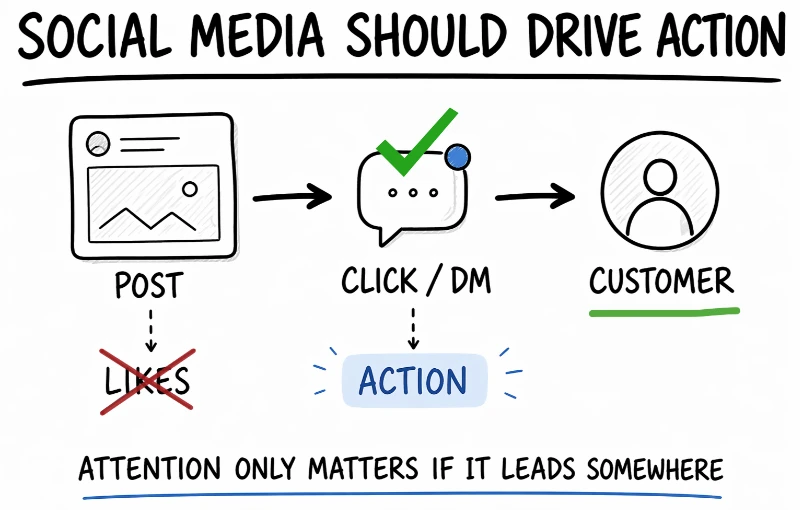
- Social Media (organic): Free, but time-intensive. Requires consistent posting and engagement.
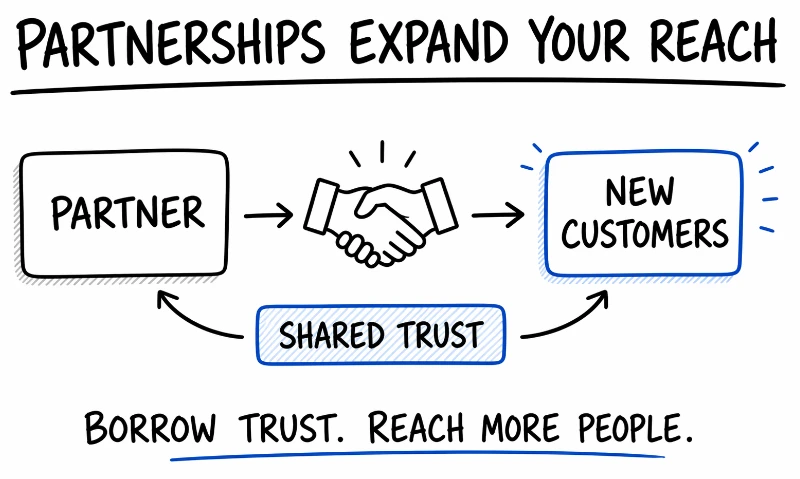
- Partnerships & Collaborations: Borrow someone else's audience. Great for B2B and local businesses.
- Direct Outreach (cold email, LinkedIn DMs): High effort, but works for service businesses and B2B.
Which One Is Best For My Business?
No clear answer here. It depends on your audience and your type of business/product. Sorry for the cop-out answer, but for some, partnerships are the fastest way to build customer base. Paid ads could be best for others. TikTok is perfect for younger audiences and product trends. LinkedIn is wonderful for established B2B and business customers. Take some time to explore which seem best for your audience and product.
In the coming chapters, we'll break down exactly how to execute on each channel.
How Long Does Marketing Take?
This is the question everyone asks. The answer: It depends on the channel.
- Paid ads: Results in days. Profitability in 30-90 days if you optimize.
- SEO: 12-18+ months for new websites before you see meaningful traffic. (Remember: You'll need backlinks to see any meaningful traffic)
- Email marketing: Immediate returns if you have a list. Takes 3-6 months to build a responsive audience.
- Social media: 90 days of daily posting before you see traction.
- Partnerships: 30-60 days to negotiate and launch, but can deliver customers for years.
The biggest mistake founders make is quitting too early. They run ads for two weeks, get zero sales, and decide "Facebook ads don't work."
Marketing takes time. Commit to 90 days minimum before judging results.
The non-negotiable rule: You cannot judge a marketing channel in two weeks. Commit to 90 days of consistent execution or don't start.
Chapter 3:
Your Marketing Message: What To Say (And Where To Say It)
Great marketing starts with a message that makes strangers stop scrolling and pay attention.
The 3 things you must take away from this chapter
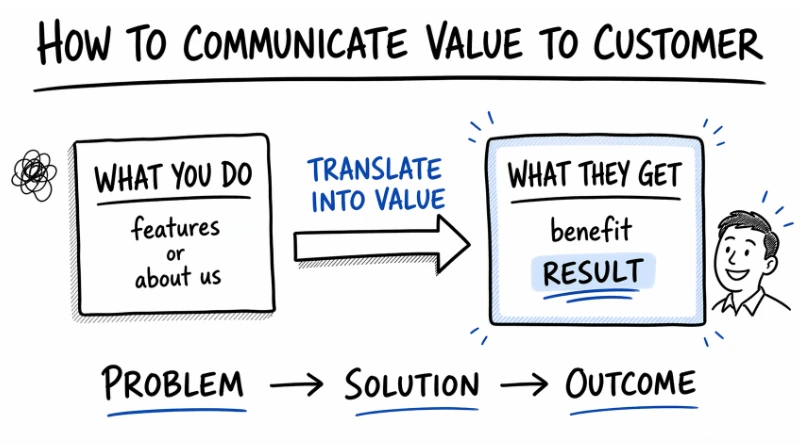
- Your message is not about you. It's about what your customer gets. It's about TRANSFORMING the customer from pain, to solution. It's about benefits, not features.
- Speak to pain or desire—ideally both. Show them what they're losing by not acting, and what they'll gain if they do.
- Use their words, not yours. Read reviews, Reddit threads, customer emails. Mirror their language back to them.
The Biggest Messaging Mistake Founders Make
They talk about their business instead of what the customer gets.
Your homepage says: "We're a next-generation AI-powered platform revolutionizing the way teams collaborate."
Your customer hears: "I have no idea what this does or why I should care."
The customer wants to be TRANSFORMED from where they are NOW, to where they WANT TO BE. You have to communicate that vision to them, and convince them that you can provide that transformation that they desperately seek.
Here's the shift:
**Stop talking about yourself. Start talking about what the customer gets.**
Bad: "Our platform leverages cutting-edge technology to optimize workflows."
Good: "Cut your team's meeting time in half and get projects done faster."
See the difference? The bad version talks about the company. The good version talks about the customer's life.
The 3-Part Messaging Formula
Every great marketing message follows this structure:
- Problem: Name the pain point in the customer's own words.
- Solution: Explain how your product solves that exact problem.
- Outcome: Paint a picture of what their life looks like after they buy.
Example: Meal Prep Delivery Service
Problem: "You're exhausted after work and the last thing you want to do is cook. So you order takeout again. It's expensive, unhealthy, and you feel guilty."
Solution: "Our meal prep service delivers chef-made, healthy dinners to your door every Sunday. Heat and eat in 5 minutes."
Outcome: "Eat healthy dinners every night without cooking. Save $200/month on takeout. Feel energized instead of sluggish."
Speak to Pain or Desire (Ideally Both)
People buy for two reasons:
- To avoid pain (I'm wasting time, losing money, feeling stressed)
- To gain something they want (more freedom, more money, better health, status)
The best marketing messages hit both.
Pain + Desire Example
Pain: "Stop wasting 10 hours a week on manual invoicing."
Desire: "Get paid faster and spend your time growing your business instead."
Use Their Words, Not Yours
Here's a secret weapon: Use the exact language your customers use.
Read Amazon reviews of competitor products. Scroll Reddit threads. Read your customer support emails. What words do they use to describe their problems?
When you reflect their own words back at them in your marketing, it feels like mind-reading.
Find Your Customers' Words
1. Go to Amazon/Yelp and find competitor products. Read 10 negative reviews.
What do customers complain about?
2. Go to Reddit. Search for your industry + "problem" or "frustration."
What phrases do people use?
3. Look at your own customer emails or conversations.
How do they describe the problem you solve?
4. Write your marketing message using their exact words.
The 10 Psychological Triggers That Make People Buy
Great marketing leverages proven psychological principles. Here are the 10 most powerful triggers:
- Loss Aversion: People work harder to avoid loss than to gain something. ("Stop wasting $500/month on takeout.")
- Scarcity: Limited spots, time-sensitive offers. ("Only 5 spots left this month.")
- Social Proof: Others are doing it, so it must be safe. ("Join 10,000 happy customers.")
- Authority: Credibility from experts, certifications, media mentions. ("Featured in Forbes.")
- Reciprocity: Give first, and people feel compelled to give back. (Free guide, free consultation.)
- Commitment & Consistency: Small yeses lead to bigger yeses. (Free trial → paid plan.)
- Identity: Speak to who they want to be. ("For ambitious entrepreneurs who refuse to settle.")
- Simplicity: The easier it is to understand, the easier it is to buy. (One-click checkout.)
- Curiosity: Open loops that demand closure. ("The one mistake that's costing you customers.")
- Urgency: Act now or miss out. ("Offer ends Sunday.")
You don't need to use all 10. But every strong marketing message uses at least 2-3 of these triggers.
The Marketing Levers You Can Pull When Describing Your Value To The Customer
When you're trying to describe your value proposition, you need to choose which lever you're pulling. These are the time-tested ways businesses differentiate themselves:
1. Speed — "Get it faster than anywhere else."
Examples: Same-day delivery, 24-hour turnaround, instant results.
Works when: Your customers are in a hurry and will pay to skip the wait.
2. Quality — "Get the best version, not the cheapest."
Examples: Premium materials, expert craftsmanship, superior results.
Works when: Your customers care more about excellence than price.
3. Cost — "Get it cheaper than anywhere else."
Examples: Budget options, bulk pricing, no-frills service.
Works when: Your customers are price-sensitive and comparison shopping.
4. Convenience — "Get it with zero friction."
Examples: One-click ordering, all-in-one solution, done-for-you service.
Works when: Your customers value their time more than money.
5. Scarcity — "Get it before it's gone."
Examples: Limited spots, seasonal offerings, exclusive batches.
Works when: Your product genuinely has limited availability.
6. Exclusivity — "Get access others can't."
Examples: Members-only, invite-only, high-end positioning.
Works when: Your customers want status or insider access.
7. Customization — "Get exactly what you want."
Examples: Personalized service, bespoke products, tailored solutions.
Works when: One-size-fits-all doesn't work for your market.
8. Trust — "Get it from someone you can rely on."
Examples: Guarantees, certifications, track record, transparency.
Works when: Your industry has trust issues or high-risk purchases.
The rule: Pick 1-2 levers and go all-in. Trying to compete on everything makes you forgettable. Own one thing and make it obvious.
Example: Meal Prep Service
Speed lever: "Fresh dinners delivered Sunday, ready in 5 minutes."
Quality lever: "Chef-crafted meals with organic ingredients."
Convenience lever: "No planning, no shopping, no cleanup."
This business is competing on speed + convenience, not price. That's their positioning.
Find Your Lever
1. Which lever(s) can you realistically compete on?
2. Which lever matters most to your target customer?
3. Rewrite your value proposition emphasizing that lever:
Most founders try to compete on everything. "We're fast AND cheap AND high-quality AND exclusive!" That's not differentiation. That's confusion.
Pick your lever. Own it. Make it your headline.
Where to Use Your Messaging
Once you've nailed your core message, use it everywhere:
- Homepage headline (the first thing people see)
- Facebook/Instagram ads (stop the scroll)
- Email subject lines (get opens)
- Social media bios (tell strangers what you do)
- Cold outreach emails (get replies)
Consistency is key. If your homepage says one thing and your Instagram bio says another, you're confusing people.
The rule: If a stranger can't understand what you sell and why it matters in 7 seconds, your messaging is too complicated. Simplify until a 12-year-old could explain it.
Chapter 4:
Your Homepage Is Your 7-Second Sales Pitch
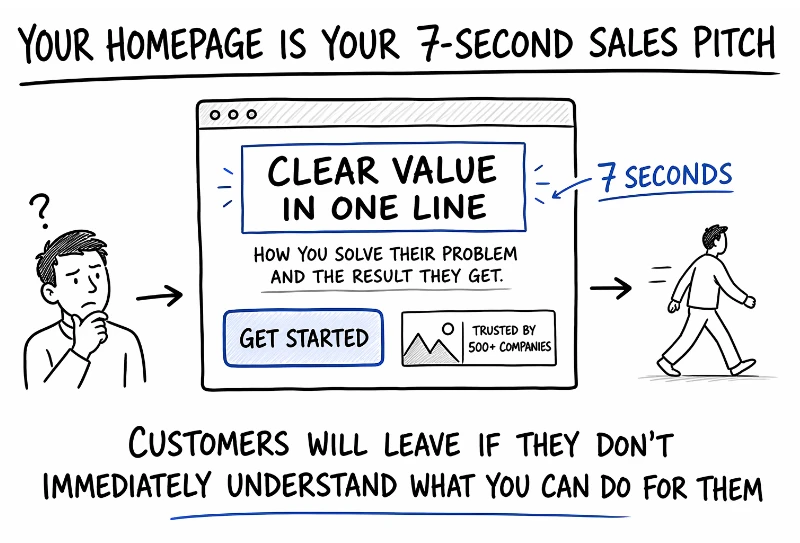
You have 7 seconds (or less!) to convince a stranger to stay. Most founders waste it.
The 3 things you must take away from this chapter
- Your homepage is not about you. It's about what your visitor gets. Answer "What's in it for me?" immediately.
- Above the fold: headline, subheadline, CTA. If visitors have to scroll to understand what you do, you've already lost them.
- Design matters - good design builds TRUST. Professional, clean, fast-loading. If your site looks cheap, people assume your product is too.
The 7-Second Rule
When someone lands on your homepage, they make a snap judgment in 7 seconds or less. (it's often about 3 seconds!)
- What does this company do?
- Is this what I was hoping to find?
- Do I trust them?
If they can't answer those questions immediately, they leave.
And here's the brutal truth: Most founder homepages fail this test.
The Biggest Homepage Mistakes
- Talking about the company instead of the customer. ("We're a leading provider of…") Nobody cares. Tell me what I get.
- Burying the value proposition below the scroll line. If I have to scroll to understand what you do, I won't.
- Using jargon instead of plain language. "AI-powered SaaS platform leveraging machine learning" = instant confusion.
- No clear call to action. What am I supposed to do next? If it's not obvious, I leave.
- Slow loading speed. If your site takes more than 2 seconds to load, 40% of visitors bounce immediately.
- Looks unprofessional. Cheap design, blurry images, typos. If your site looks bad, I assume your product is bad too.
The Homepage Formula That Converts
Here's what every high-converting homepage includes:
- Hero Headline (H1): State the outcome your customer gets in 10 words or less.
- Subheadline (H2): Clarify who it's for or how it works.
- Clear CTA button: One action you want them to take. (Start Free Trial, Get a Quote, Book a Call)
- Social proof: Testimonials, customer logos, "Join 5,000 customers" stat.
- Visual: Product screenshot, demo video, or hero image showing the product in action.
- Benefits (not features): 3-5 bullet points explaining what they get.
Bad Headline: "Welcome to Acme Corp, your trusted partner in business solutions."
Good Headline: "Cut your invoicing time in half and get paid faster."
Above the Fold: The Most Important 500 Pixels
"Above the fold" means the part of your website visitors see before scrolling. This is your most valuable real estate.
What must be above the fold:
- Headline (H1)
- Subheadline (H2)
- CTA button
- Hero image or product screenshot
If visitors have to scroll to understand what you do, most won't.
The "What's In It For Me?" Test
Show your homepage to 5 strangers. Ask them:
- "What does this company do?"
- "Who is this for?"
- "What would you get if you signed up?"
If they can't answer immediately, rewrite your homepage.
Homepage Audit Checklist
☐ Headline states the outcome (not the company)
☐ Subheadline clarifies who it's for
☐ CTA button is above the fold and stands out visually
☐ Social proof is visible (testimonials, logos, stats)
☐ Benefits are listed (not just features)
☐ Loads in under 2 seconds
☐ Looks professional on mobile and desktop
☐ Zero typos or grammar errors
Design Elements That Build Trust
Your homepage design signals whether you're legit or sketchy. Here's what builds trust:
- Clean, minimal design. Use no more than 3 colors and 3 fonts.
- Professional images. No blurry photos. No generic stock images. Real product screenshots or real customer photos.
- Clear layout with breathing room. White space around elements. Aligned grid. Not cluttered.
- Fast loading speed. Compress images. Use a good hosting provider. Test with Google PageSpeed Insights.
- Mobile responsive. 60% of traffic is mobile. If your site looks broken on phones, you lose 60% of visitors.
- Easy contact. Phone number, Contact Us button, etc.
- Trust signals. SSL certificate (https://). Privacy policy link. Contact info visible.
- About page. About Us page that assures customers there are real people behind the website.
The CTA: Tell Them What To Do Next
Your call to action (CTA) is the single most important button on your homepage.
Bad CTAs:
- "Learn More" (too vague)
- "Submit" (too generic)
- "Click Here" (tells me nothing)
Good CTAs:
- "Start Your Free Trial"
- "Get Your Custom Quote"
- "Book a Free Consultation"
- "Download the Free Guide"
Make it specific. Make it actionable. Make it low-risk (free trial, no credit card required).
The rule: If a stranger lands on your homepage and doesn't know what to do next, your CTA isn't clear enough. One button. One action. Make it impossible to miss.
Chapter 5:
Content Marketing: Teaching Your Way To Customers
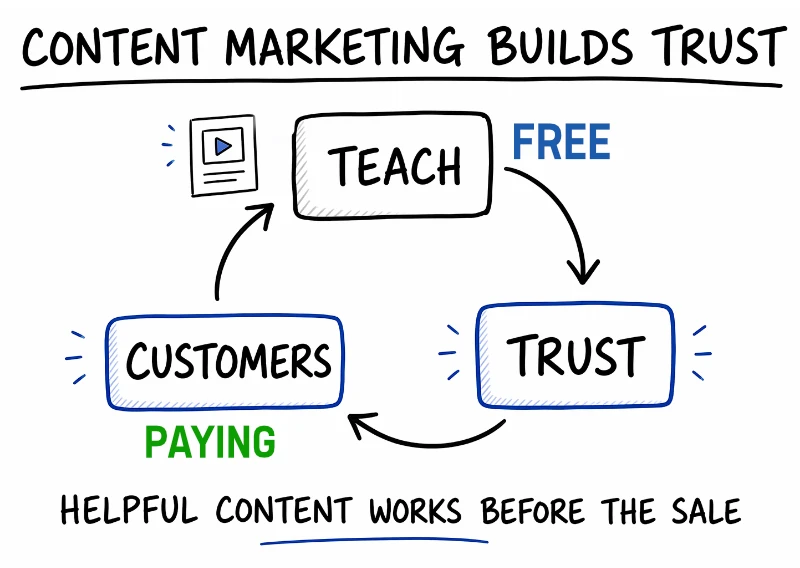
Content builds trust before the sale. Trust drives conversions.
The 3 things you must take away from this chapter
- Content marketing is the long game. Write blog posts that rank on Google, and you'll get free traffic for years.
- Answer the questions your customers are already asking. Google "your industry + how to" and write content around those searches.
- Content builds trust before the sale. People buy from brands they trust. Teaching builds that trust.
Why Content Marketing Works
Content marketing means creating valuable content (blog posts, videos, guides) that attracts your ideal customer.
Instead of interrupting people with ads, you earn their attention by teaching them something useful.
Here's why it works:
- Builds trust before the sale. When you teach people for free, they trust you more when it's time to buy.
- Compounds over time. One blog post can drive traffic for years. Ads stop the second you stop paying.
- Attracts high-intent customers. People searching "how to X" are actively looking for a solution. They're ready to buy.
- Positions you as an authority. When you consistently publish helpful content, you become the go-to expert in your niche.
The Content Marketing Flywheel
Here's how it works:
- Publish valuable content (blog posts, videos, guides) that answers your customer's questions.
- Google indexes your content and ranks it for relevant searches.
- People find your content, read it, and trust you.
- Some percentage sign up for your email list or buy your product.
- You repeat the process, publishing more content and capturing more customers.
This is the long game. It takes 12-18+ months for new websites before you see meaningful traffic. But once it starts working, it compounds.
How To Find Content Ideas
The best content answers the questions your customers are already asking. Here's how to find those questions:
- Google "your industry + how to" and look at autocomplete suggestions.
- Use AnswerThePublic.com to see what questions people are typing into Google.
- Read Reddit threads in your niche. What are people asking about?
- Look at competitor blog content. What's ranking for them?
- Check your customer support emails. What questions do customers ask most often?
Generate 10 Content Ideas
List 10 questions your ideal customer is already searching for:
1.
2.
3.
4.
5.
(Continue for 10 total)
How To Write Content That Ranks
Writing blog posts is easy. Writing blog posts that rank on Google requires following a few SEO basics:
- Use your target keyword in the headline. If you're targeting "how to start a podcast," make that your H1.
- Write at least 1,000 words. Google favors comprehensive content. Longer posts tend to rank higher.
- Use subheadings (H2, H3). Break content into scannable sections.
- Link to other pages on your site. Internal linking helps Google understand your site structure.
- Add images with alt text. Helps with accessibility and SEO.
- Include a clear CTA. Every blog post should have a next step (sign up, download, buy).
Content Formats That Work
Blog posts aren't the only option. Here are other content formats that attract customers:
- How-to guides: Step-by-step instructions for solving a specific problem.
- Case studies: Show how you helped a customer get results.
- Comparison posts: "Product A vs Product B" (great for capturing high-intent searches).
- Ultimate guides: Comprehensive resources (2,000+ words) that cover everything about a topic.
- Video tutorials: Record your screen and walk people through a process. Upload to YouTube.
- Templates & checklists: Give away a free resource in exchange for an email address.
The Publishing Schedule That Works
Consistency beats perfection. Publish one piece of content per week for 6 months. That's 24 pieces of content working for you.
If you can do more, great. But start with one per week.
The rule: Content marketing is the long game. You won't see traffic in week 1. Or week 4. Commit to 6 months of consistent publishing before judging results. The compound effect is real—but only if you stick with it.
Chapter 6:
Social Media That Actually Drives Business
Most founders waste time on social media. Here's how to make it work.
The 3 things you must take away from this chapter
- Pick one platform and go deep. You don't need to be everywhere. Master one platform before adding a second.
- Post consistently, not constantly. 3-5 posts per week beats 20 posts per week that you can't sustain.
- Engagement > followers. 1,000 engaged followers who comment and buy beat 10,000 ghost followers.
Why Most Founders Waste Time on Social Media
They post sporadically. They chase followers instead of engagement. They copy what other brands do without understanding why it works.
Here's the truth: Social media can drive real business—but only if you approach it strategically.
Which Platform Should You Choose?
Don't try to be on every platform. Pick one platform where your customers are and master it.
- Instagram: Visual products, lifestyle brands, B2C.
- LinkedIn: B2B, professional services, corporate sales.
- TikTok: Younger audience, trend-driven, educational or entertainment content.
- Facebook: Older audience, local businesses, community building.
- Twitter/X: Thought leadership, real-time engagement, tech/startup founders.
- YouTube: Long-form tutorials, educational content, evergreen traffic.
Ask yourself: Where does my ideal customer spend their time? Start there.
The Social Media Posting Formula
Post 3-5 times per week. Consistency beats volume.
Mix these content types:
- Educational: Teach something useful. (How-to tips, industry insights, hacks)
- Promotional: Sell your product. (Limited-time offer, new product launch, testimonials)
- Community: Engage your audience. (Ask questions, share customer wins, behind-the-scenes)
The 80/20 rule: 80% value, 20% selling. Most of your content should help people. Only 1 in 5 posts should directly sell.
How To Make Time For Social Media
It's hard to find time to create and engage in social media. Time blocking is the solution. Schedule Monday afternoons for ideation and planning and Thursday mornings for content creation for example - otherwise you'll never get around to a consist posting routine.
How To Actually Grow Your Following
Growing an engaged audience takes time. Here's what works:
- Post consistently. Daily is ideal. 3-5x per week is realistic.
- Engage with others. Comment on 10-20 posts in your niche every day. Real engagement, not spam.
- Use hashtags strategically. Mix popular and niche hashtags. Research what your competitors use.
- Collaborate with others. Guest posts, shout-outs, joint lives. Borrow someone else's audience.
- Run giveaways. "Follow + tag a friend for a chance to win." Grows your audience fast (but quality varies).
- Repost user-generated content. Share customer photos and tag them. Builds community and social proof.
Your 30-Day Social Media Plan
Platform:
Posting frequency: times per week
Content mix:
- Educational posts: per week
- Promotional posts: per week
- Community posts: per week
Engagement goal: Comment on posts per day
Metrics That Actually Matter
Forget vanity metrics (followers, likes). Track these instead:
- Engagement rate: (Likes + comments + shares) ÷ followers. A high engagement rate means people care.
- Website clicks: How many people click your bio link? Track with UTM parameters.
- DMs and inquiries: Are people messaging you to ask about your product?
- Conversions: How many social media visitors become customers?
1,000 engaged followers who buy > 10,000 followers who never interact.
The rule: If you're posting but not engaging with others, you're wasting your time. Social media is a two-way conversation. Comment, reply, DM. Build relationships, not just a follower count.
Chapter 7:
Email Marketing: Building & Nurturing Your List
Email has the highest ROI of any marketing channel. Here's how to do it right.
The 3 things you must take away from this chapter
- Your email list is your most valuable asset. You own it. Platforms can ban you. Email can't be taken away.
- Grow your list with a lead magnet. Give something valuable for free in exchange for an email address.
- Nurture, don't spam. Send value first. Sell second. Most emails should teach, not pitch.
Why Email Marketing Works
Email marketing has the highest ROI of any marketing channel. For every $1 spent, the average return is $42.
Here's why:
- You own your list. Instagram can ban you. Google can change the algorithm. Your email list? Yours forever.
- Direct access to your audience. When you send an email, it lands in their inbox. No algorithm deciding who sees it.
- Higher conversion rates. People on your email list have already raised their hand and said "I'm interested." They're warmer leads.
- Automation scales you. Set up an email sequence once, and it nurtures leads on autopilot.
How To Build Your Email List
Nobody gives you their email for free. You need to offer something valuable in exchange.
This is called a lead magnet. Examples:
- Free PDF guide ("The Ultimate Guide to X")
- Checklist or template ("10-Step Launch Checklist")
- Free course or video series ("5-Day Email Course")
- Discount code ("Get 20% off your first order")
- Free consultation ("Book a Free 15-minute strategy call")
The lead magnet should solve one specific problem your customer has.
Create Your Lead Magnet
1. What problem does your customer have?
2. What could you create (PDF, checklist, template) that solves that problem?
3. What's a compelling headline for your lead magnet?
Where To Promote Your Lead Magnet
Once you've created a lead magnet, promote it everywhere:
- Homepage pop-up: Offer it to visitors after 10 seconds.
- Exit-intent pop-up: Trigger when they're about to leave your site.
- Blog post CTAs: Add a sign-up box at the end of every blog post.
- Social media bio: Link to your lead magnet in your Instagram/LinkedIn bio.
- Facebook/Instagram ads: Run ads promoting your free guide.
Email Sequences That Convert
Once someone joins your list, don't waste the opportunity. Set up an automated email sequence (sometimes called a "drip") that nurtures them toward a purchase.
Here's a proven 5-email welcome sequence:
- Email 1 (Day 0): Deliver the lead magnet. Welcome them. Set expectations for what's coming.
- Email 2 (Day 2): Provide more value. Share a helpful tip or case study.
- Email 3 (Day 4): Tell your story. Why did you start this business? Build connection.
- Email 4 (Day 6): Introduce your product/service. Soft pitch with a special offer.
- Email 5 (Day 8): Social proof + urgency. Share testimonials and create a deadline (offer expires soon).
This sequence runs on autopilot. Every new subscriber gets nurtured automatically.
Sales Drip Email vs. Nurture Drip Email
When you have a new potential customer, you're probably sending them a sales drip sequence designed to build awareness of your product, build trust, and ask for the sale. Your email sequence is spaced every couple days.
When you have a potential customer you're just keeping in contact with, that's called nurturing. A nurturing drip sequence is spaced every couple of months perhaps. It's designed to keep the customer awareness of your solution in mind.
How Often Should You Email Your List?
There's no perfect frequency, but here are guidelines:
- Weekly newsletter: Most common. Keeps you top of mind without overwhelming people.
- 2-3x per week: Works if your content is valuable and relevant. Less frequency is OK based on your product/business type
- Daily: Only if you're a media brand or have something truly valuable to share daily.
The key: Provide value in every email. If people dread seeing your name in their inbox, you're doing it wrong.
Good emails provide information and VALUE to the reader. Nobody wants to read a sales pitch, they want to know things, learn things that may help them, and gain awareness of solutions you might help with.
What To Write In Your Emails
Mix these email types:
- Educational: Teach something useful. Share tips, insights, how-tos.
- Promotional: Sell your product. Limited-time offers, new launches, discounts.
- Personal: Share your journey, behind-the-scenes stories, lessons learned.
- Social proof: Share customer wins, testimonials, case studies.
The 80/20 rule applies here too: 80% value, 20% selling.
The rule: If every email is a sales pitch, people unsubscribe. Provide value first. Sell second. When your emails are genuinely helpful, people look forward to them—and they buy when you do pitch.
Chapter 8:
Paid Advertising: Google, Facebook & Where To Start
Paid ads are the fastest way to get customers—if you know what you're doing.
The 3 things you must take away from this chapter
- Paid ads get you customers fast—but cost money to learn. Budget $300-$500/month minimum for meaningful testing.
- Start with one platform. Google Ads for high-intent searches. Facebook/Instagram for visual products and targeting.
- Test, measure, optimize. Your first ads will lose money. The goal is to learn what works and improve.
Why Paid Ads Work (And Why They're Hard)
Paid ads are the fastest way to get customers. Launch a campaign today, get traffic tomorrow.
But here's the catch: Most founders waste money on ads.
They run ads for a week, get zero sales, and conclude "ads don't work." The reality: Ads work—but they require testing, optimization, and budget.
DANGER ALERT ! ! Go SLOWLY with paid ads!
Most people waste tons of money the first time they buy ads. You MUST run small campaigns and learn to track, adjust and improve them before risking larger budgets!!!
Google Ads vs. Facebook Ads: Which Should You Choose?
**Google Ads** (search ads):
- Best for: High-intent searches. People actively looking for a solution.
- Example: Someone searches "meal prep delivery Chicago" → sees your ad → clicks → buys.
- Pros: High intent. People are ready to buy.
- Cons: Competitive and expensive. Cost-per-click can be $5-$20+ depending on industry.
**Facebook/Instagram Ads:**
- Best for: Visual products, targeting specific demographics, brand awareness.
- Example: Target women ages 25-40 interested in fitness → show ad for your meal prep service.
- Pros: Cheaper cost-per-click. Great for discovery and retargeting.
- Cons: Lower intent. People aren't actively searching. You're interrupting them.
**Which to start with?**
- If people are actively searching for your solution: Google Ads.
- If your product is visual or targets a specific demographic: Facebook/Instagram Ads.
How Much Budget Do You Need?
Here's the reality: You need $300-$500/month minimum to run meaningful tests.
Why? Because you need enough data to know what's working. If you spend $50 and get 10 clicks, you can't draw conclusions. But if you spend $300 and get 200 clicks with zero conversions, you know your offer or landing page is the problem.
Educate yourself FIRST! Spend many hours on YouTube with beginner paid ad videos. Learn as much as you can before spending any $$ on live ads.
The 3-Phase Paid Ads Strategy
Phase 1: Testing (First 30 days)
Your goal: Figure out what works. Test different headlines, images, audiences, offers.
- Run 3-5 ad variations.
- Track clicks, conversions, cost per conversion.
- Expect to lose money. You're buying data.
Phase 2: Optimization (Days 31-90)
Your goal: Double down on what works. Kill what doesn't.
- Keep the winning ads. Turn off the losers.
- Test small tweaks (new images, better headlines, different CTAs).
- Your cost per conversion should start improving.
Phase 3: Scaling (After 90 days)
Your goal: Increase budget on winning campaigns.
- Once you know your cost per customer, scale up slowly.
- If you're profitable at $10/day, try $20/day.
- Keep testing new audiences and creatives to avoid ad fatigue.
How To Write Ads That Convert
Great ad copy follows this formula:
- Hook: Stop the scroll. Call out the pain or desire.
- Benefit: What do they get?
- Proof: Why should they believe you?
- CTA: What should they do next?
Example: Meal Prep Ad
Hook: "Tired of cooking every night?"
Benefit: "Get chef-made, healthy dinners delivered to your door. Heat and eat in 5 minutes."
Proof: "Join 5,000 busy professionals who save 10 hours/week."
CTA: "Order your first week for 50% off →"
Metrics To Track
Don't just look at clicks. Track the full funnel:
- Impressions: How many people saw your ad?
- Click-through rate (CTR): % of people who clicked. (Good: 1-2%+)
- Cost per click (CPC): What you pay per click.
- Conversion rate: % of clicks that become customers.
- Cost per conversion: What you pay to acquire one customer.
- Return on ad spend (ROAS): Revenue ÷ ad spend. (Goal: 3x or higher)
If you're getting clicks but no conversions, the problem is your landing page or offer—not the ad.
The rule: Your first ads will lose money. That's normal. The goal is to learn what works. Budget for 90 days of testing before expecting profitability. If you quit after two weeks, you wasted money. If you optimize for 90 days, you build a system that prints money.
Chapter 9:
Partnerships & Collaborations That Grow Your Reach
Borrow someone else's audience and turn it into your customers.
The 3 things you must take away from this chapter
- Partnerships let you borrow trust and attention. If someone your audience trusts recommends you, they're far more likely to buy.
- Look for complementary, not competitive, partners. Target the same customer but offer different solutions.
- Make it easy and mutually beneficial. Offer value first. Make the partnership a no-brainer for them.
Why Partnerships Work
Building an audience from scratch takes years. Borrowing someone else's audience takes weeks.
When someone your target customer already trusts recommends you, you inherit that trust. That's powerful.
Partnerships let you reach thousands of potential customers without paying for ads or waiting for SEO to kick in.
Types of Partnerships
- Cross-promotion: Two businesses promote each other to their audiences. (Email swap, social media shout-outs)
- Affiliate partnerships: Someone promotes your product and earns a commission on sales. (Influencers, bloggers, YouTubers)
- Co-marketing campaigns: Create something together. (Joint webinar, co-branded guide, bundled offer)
- Referral programs: Offer incentives for customers or partners to refer new business.
- Retail partnerships: Get your product into local shops or online marketplaces.
How To Find The Right Partners
The best partners have three qualities:
- Same audience, different solution. They serve your ideal customer but don't compete with you.
- Similar values and quality standards. Their brand aligns with yours.
- Engaged audience. A partner with 500 engaged followers beats a partner with 10,000 ghosts.
Example: Meal Prep Partnership
You run a meal prep delivery service. Your ideal customer: busy professionals who want to eat healthy.
Good partners:
- Local gym or fitness studio (same customer, different solution)
- Wellness coach or nutritionist (complementary services)
- Co-working space (access to busy professionals)
Bad partners:
- Another meal prep company (direct competitor)
- Fast food restaurant (conflicting values)
How To Pitch a Partnership
Cold outreach works, but you need to make it about them, not you.
Bad pitch: "Hey, I have a meal prep business. Want to promote me to your audience?"
Good pitch: "Hey [Name], I run a meal prep service for busy professionals. I noticed you serve the same audience with your fitness coaching. I'd love to offer your clients an exclusive discount—and I'm happy to promote your coaching to my audience in return. Would you be open to a quick call?"
**Key elements:**
- Show you've done research (mention their business specifically)
- Offer value first (discount for their audience, free samples)
- Make it mutually beneficial (cross-promotion, revenue share)
- Keep it short and specific
Partnership Ideas That Work
- Provide a benefit to their audience/customers: Host a monthly "How To" seminar for their customers for example
- Guest blog posts: Write for a blog your audience reads. Include a CTA to your product.
- Joint webinar or workshop: Host an event together. Each promote to your audiences.
- Product bundles: Package your products together. ("Buy our meal prep + their fitness plan and save 20%")
- Referral programs: Offer $50 credit for every customer they send your way.
- Local shop placement: Get your product into local boutiques, cafes, co-working spaces.
- Influencer collaborations: Send free product to micro-influencers (5K-50K followers) in exchange for honest reviews.
How To Make Partnerships Last
The best partnerships become long-term relationships. Here's how to keep them strong:
- Deliver on your promises. If you say you'll promote them, do it.
- Track results and share them. "Our partnership drove 50 new customers last month—thanks!"
- Keep communication open. Check in regularly. Look for new collaboration opportunities.
- Make it easy for them. Provide pre-written social posts, graphics, discount codes.
The rule: Partnerships work when both sides win. If you're taking more than you're giving, the partnership won't last. Offer value first. Make it easy. Make it mutually beneficial.
Chapter 10:
SEO: The Long Game of Organic Traffic
SEO is slow. But once it works, you get free customers for years.
The 3 things you must take away from this chapter
- SEO takes 12-18+ months to show meaningful results for new websites IF you're publishing consistently, targeting realistic keywords, and building backlinks. The timeline depends heavily on your niche competition and effort level.
- Target long-tail keywords your customers are searching for. Don't compete with Wikipedia. Win the specific, high-intent searches.
- Publish consistently and build backlinks. Google rewards sites that publish quality content regularly and are linked to by other sites.
What Is SEO (And Why It Matters)
SEO stands for Search Engine Optimization. It's the process of getting your website to rank on Google for searches your customers are making.
When someone searches "meal prep delivery Chicago," do you show up on page 1? If not, you're invisible.
Here's why SEO matters:
- Free traffic. Ads stop when you stop paying. SEO keeps working.
- High-intent visitors. People searching for solutions are ready to buy.
- Compounds over time. One blog post can drive traffic for years.
- Builds authority. Ranking on page 1 makes you look credible.
What "Doing SEO" Actually Means
Before we talk timelines, let's be clear about what SEO actually requires. Many founders hear "free traffic" and think they can write a few blog posts and wait. That's not how it works.
When we say "do SEO," here's what that requires:
- Write 1,500+ word blog posts targeting specific keywords (not 300-word fluff)
- Optimize every post: title tags, meta descriptions, H2/H3 headers, internal links, alt text on images
- Build 2-3 quality backlinks per month through guest posts, partnerships, or PR outreach
- Fix technical issues: site speed under 2 seconds, mobile optimization, SSL certificate, clean URL structure
- Publish consistently: 1x per week minimum (ideally more)
- Target realistic keywords: long-tail, low-to-medium competition (not trying to beat Wikipedia)
If you're not doing ALL of this, your results will be slower or nonexistent. SEO is "free" in that you don't pay for clicks, but it requires 5-10 hours per week of work OR $2,000-$5,000 per month to outsource to professionals.
Reality check: Most new business owners never see meaningful SEO results because they don't commit to the volume and quality needed. One post per month won't cut it. Thin content won't rank. No backlinks means no authority. Be honest about whether you can commit to real SEO before betting your customer acquisition on it.
The SEO Timeline
Here's the reality: SEO is slow.
This timeline assumes you're publishing 1 high-quality blog post per week (1,500+ words), optimizing for low-to-medium competition keywords, and doing basic backlink outreach. If you're publishing less frequently or competing in a crowded niche, add 6-12 months to this timeline.
- Months 0-3: Google "sandbox" period for new sites. You publish content, Google indexes it, but new sites barely rank.
- Months 3-6: First indexing improvements. Some posts start ranking for low-competition keywords. Minimal traffic.
- Months 6-12: Gradual improvement. Some page 2-3 rankings. Traffic trickles from long-tail keywords.
- Months 12-18: More consistent rankings. Some posts hit page 1. Traffic starting to compound.
- After 18-24 months: You have a library of content driving steady organic traffic.
This is the long game. If you need customers this month, focus on ads or outreach. But if you want to build a traffic engine that works for years, start SEO now.
How To Find Keywords Your Customers Are Searching
SEO starts with keyword research. You need to know what people are typing into Google.
Tools to use:
- Google autocomplete: Start typing a phrase and see what Google suggests.
- AnswerThePublic.com: Shows questions people are asking.
- Ubersuggest or Ahrefs: Keyword research tools that show search volume and competition.
Focus on long-tail keywords. These are longer, more specific searches with lower competition.
Bad keyword: "meal prep" (too broad, impossible to rank)
Good keyword: "healthy meal prep delivery for busy professionals in Chicago" (specific, less competition, high intent)
How To Optimize Your Content For SEO
Once you've chosen a keyword, here's how to optimize your content:
- Include the keyword in your H1 headline. This tells Google what your page is about.
- Use the keyword naturally in the first 100 words. Don't force it—make it flow.
- Add the keyword to your URL. (yoursite.com/healthy-meal-prep-delivery-chicago)
- Use related keywords in H2 and H3 subheadings. Google looks for semantic relevance.
- Write at least 1,000 words. Longer, comprehensive content tends to rank higher.
- Add internal links. Link to other pages on your site to help Google understand your structure.
- Add external links. Link to high-authority sites when relevant (studies, research, trusted sources).
- Optimize images. Add alt text describing what's in the image. Use descriptive file names.
Backlinks: The Secret To Ranking Higher
Google treats backlinks (links from other websites to yours) as votes of confidence. The more high-quality sites link to you, the more Google trusts you.
How to get backlinks:
- Guest post on other blogs. Write for sites your audience reads and link back to your site.
- Get featured in press. Reach out to journalists and pitch your story (HARO.com is a great resource).
- Create shareable content. Infographics, research, ultimate guides. People naturally link to valuable resources.
- Partner with complementary businesses. Exchange links on each other's sites.
Quality > quantity. One link from a high-authority site (Forbes, New York Times, industry blog) beats 100 links from low-quality sites.
Technical SEO Basics
Google cares about user experience. Make sure your site meets these technical standards:
- Fast loading speed. Under 2 seconds. Use tools like Google PageSpeed Insights.
- Mobile-friendly. Most traffic is mobile. If your site looks broken on phones, you won't rank.
- HTTPS (SSL certificate). Secure sites rank higher.
- Clean URL structure. Use descriptive URLs (yoursite.com/about, not yoursite.com/page?id=123).
- XML sitemap. Submit your sitemap to Google Search Console so Google can index your pages.
The rule: SEO is a marathon, not a sprint. Publish one COMPREHENSIVE, optimized blog post per week for 12 months (not 300-word posts—we're talking 1,500-2,000 word guides). Build 2-3 quality backlinks per month. Target long-tail, low-competition keywords. By month 18-24, you'll have a traffic engine working for you 24/7—IF you stay consistent. Start today because the clock starts when you publish.
Chapter 11:
Choosing Your Channels: Where To Focus Your Limited Time
You can't do everything. Here's how to pick the 2 channels that will actually work.
The 3 things you must take away from this chapter
- Pick 2 channels and commit for 90 days. Trying 10 channels gets you mediocre results everywhere. Mastery in 2 wins.
- Pair a fast channel with a slow channel. Ads get you customers today. SEO gets you customers in a year. Do both.
- Track everything and double down on what works. Marketing is a numbers game. Measure, optimize, scale.
The Problem With Trying Everything
You've read 9 chapters about marketing channels. You're probably thinking: "I need to do all of this."
You don't.
Here's the truth: Trying to do everything guarantees mediocre results everywhere.
You post on Instagram twice a month (not enough to build momentum). You write one blog post and never follow up (Google ignores you). You run Facebook ads for a week (not enough data to optimize). You give up on email marketing after sending two newsletters.
This is why most founders fail at marketing. Not because marketing doesn't work. Because they spread themselves too thin.
The 2-Channel Strategy
Pick two marketing channels. Commit to 90 days of consistent execution. Track the numbers. Double down on what works.
That's it. That's the strategy.
Why only 2? Because focus beats dabbling. Going deep on 2 channels gives you real traction. Dabbling in 10 channels gets you nowhere.
How To Choose Your 2 Channels
Ask yourself these 3 questions:
- Where does my customer already spend time? If your customer is on LinkedIn, don't start a TikTok account. Go where they are.
- What can I realistically commit to? If you have $500/month and 10 hours/week, that's your constraint. Pick channels that fit.
- What plays to my strengths? Hate writing? Don't pick blogging. Love video? Try YouTube or Instagram Reels.
Channel Decision Matrix
Rate each channel from 1-5 on these criteria:
Channel:
1. My customers are there: / 5
2. I can afford it (time or money): / 5
3. It matches my skills: / 5
Total score: / 15
Repeat for 5 channels. Pick the 2 highest scores.
Pair a Fast Channel With a Slow Channel
Here's the smartest move: Pick one channel for quick wins and one for long-term growth.
Fast channels:
- Paid ads (Google, Facebook, Instagram)
- Direct outreach (cold email, LinkedIn DMs)
- Partnerships (borrow someone's audience today)
Slow channels:
- SEO + content marketing (12-18+ months to payoff for new websites)
- Email list building (3-6 months to build a responsive list)
- Organic social media (90 days to build momentum)
**Example winning combinations:**
- Google Ads + SEO/Blogging
- Instagram Ads + Email Marketing
- LinkedIn Outreach + Content Marketing
- Partnerships + Organic Social Media
This prevents two common mistakes:
- Picking 2 slow channels and running out of cash before you see results
- Picking 2 fast channels and burning your budget with no long-term asset
How Much Time Should This Take?
Honest answer: marketing should take 20-75% of your working hours, depending on where your business is. If you're established and customers are coming in steadily, you can maintain momentum with 20-30% of your time (5-10 hours per week).
If
you're just starting out or struggling to get traction, you need to spend 50-75% of your time on marketing and customer
acquisition (20-30 hours per week). Most founders fail because they flip this—they spend 90% of their time building, tweaking,
and perfecting their product, and 10% finding customers. That's backwards. Without customers, your business doesn't exist.
Learn to time block. Put your marketing activities on your calendar like they're client meetings—because they are. Block 2 hours
every morning for outreach. Block Friday afternoons for content creation. Block Monday mornings for follow-ups. If marketing
isn't on your calendar, it won't happen. And if it doesn't happen consistently, neither will your customer growth. Treat customer
acquisition like the most important job in your business—because it is.
The 90-Day Commitment
Marketing takes time. You cannot judge a channel in 2 weeks.
Commit to 90 days of consistent execution before making a decision:
- SEO: Publish 1 blog post per week for 12 weeks. By month 6, you'll see traction.
- Paid ads: Run ads daily for 90 days. The first 30 days are learning. Days 31-90 are optimization.
- Social media: Post 3-5x per week for 90 days. Build momentum before judging results.
- Email marketing: Send weekly emails for 90 days. Build a responsive list before scaling.
If you quit after 2 weeks, you wasted 2 weeks. If you commit to 90 days, you build a system.
Track Everything
You can't improve what you don't measure. Track these metrics for every channel:
- Traffic/Reach: How many people saw your content?
- Clicks/Engagement: How many people took action?
- Conversions: How many became customers?
- Cost per conversion: What did you spend to get one customer?
- Revenue per customer: What's a customer worth?
Every Friday, review your numbers and ask:
- What's working? (Do more of this.)
- What's not working? (Kill it or fix it.)
- What's one test I can run next week?
Make one small change per week. Test. Measure. Repeat.
When To Pivot vs. When To Persist
After 90 days, evaluate your results:
Keep going if:
- You're seeing growth (even if it's slow)
- You're getting engagement (clicks, replies, comments)
- Your metrics are improving week over week
Pivot if:
- After 90 days and multiple tests, you're seeing zero traction
- Your audience clearly isn't on this channel
- The economics don't work (cost per customer > customer lifetime value)
But don't pivot after 2 weeks. Give it time to work.
The final rule: Pick 2 channels. Commit for 90 days. Track everything. Double down on what works. This is how you go from 10 customers to 100.
Closing:
You Have the Roadmap — Now Execute
You've learned the marketing channels that actually work. You know how to craft a message that converts. You understand the difference between tactics that scale and vanity metrics that waste time.
Now it's time to execute.
The 30-Day Action Plan
Week 1: Messaging & Channel Selection
- Audit your homepage. Does it pass the 7-second test?
- Write your core marketing message (Problem → Solution → Outcome)
- Choose your 2 marketing channels using the decision matrix
- Set your budget (time and money) and commit to 90 days
Week 2: Setup & Launch Prep
- Set up tracking (Google Analytics, UTM links, conversion pixels)
- Create your lead magnet (PDF guide, checklist, discount code)
- Write your first 5 pieces of content (blog posts, social posts, ads)
Week 3: Launch Channel 1
- Launch your first marketing channel (ads, content, outreach)
- Monitor daily. Track clicks, conversions, engagement.
- Make small adjustments based on what you see
Week 4: Launch Channel 2 & Systemize
- Launch your second marketing channel
- Build your first system (email automation, content calendar, ad templates)
- Review Week 1-4 metrics. What's working? What's not?
What Success Looks Like After 90 Days
- You have 10-20 new customers (or solid leads)
- You know which channels drive conversions
- You have systems running on autopilot (email sequences, content calendar, retargeting ads)
- You're spending less time hustling, more time optimizing
If You Didn't Get Traction Yet
Review your messaging. Most failures happen because the OFFER isn't compelling, you're not clearly communicating what the customer will get from you, or the funnel is broken - not because the channel is wrong.
If you're SURE you're clearly and immediately communicating your value to the customer, then you're not finding enough customers to hear your message. Revisit your traffic strategy to get in front of more high-intent customers.
Go back to Chapter 2 (messaging) and Chapter 3 (homepage). Test new headlines. Simplify your offer. Make it easier to say yes.
Final Thought
Most founders give up on marketing after 2 weeks.
Don't be that founder.
Marketing is a marathon, not a sprint. Give it 90 days of real effort. Track the numbers. Adjust based on data. You'll break through.
The customers are out there. You just need to show up where they are, say the right thing, and make it easy to say yes.
Now go execute.
About the Author
Tim Donahue is the founder of StartABusiness.Center, a resource hub for new entrepreneurs navigating the messy early stages of building a business.
With hundreds of articles, tools, and guides, StartABusiness.Center helps founders validate ideas, find customers, and build sustainable businesses without burning out or going broke.
Tim believes the best business advice is practical, actionable, and gets straight to the point—no fluff, no motivational speeches, just what works.
Other Books in This Series
- Guide 1: How To Assess the Strength Of Your Business Idea — Before You Commit To It
- Guide 2: [Validation-focused customer guide title]
- Guide 3: How To Build a Website That Actually Works for Your Business — A Non-Technical Guide
Resources & Links
- StartABusiness.Center — Free articles, templates, and tools for new business owners
- Free Marketing Plan Template — Download at StartABusiness.Center to map out your next 90 days
Connect With Tim
Follow StartABusiness.Center on social media for more practical business advice:
- Twitter/X: @StartABusinessC
- LinkedIn: StartABusiness.Center
- Instagram: @StartABusinessCenter
Have questions? Email: tim@startabusiness.center
© 2026 StartABusiness.Center | All rights reserved