A practical guide to defining what you sell, deciding what to charge, and building an offer customers actually want
You’ve assessed your business idea. You’ve validated that real demand exists. You’ve set up your legal structure and built a website.
And now you’re staring at the screen, trying to answer two questions that feel impossibly hard:
Here's your big goal:
“What exactly am I selling?”
“How do I solve my specific customer's pain point?”
“What do I charge for it?”
These aren’t abstract marketing questions. They’re the bridge between having a business idea and actually making money. And most new founders get stuck right here.
You know what problem you solve. You know who you’re helping. But translating that into a concrete, sellable offer — with a clear scope, a specific deliverable, and an actual price — feels like stepping off a cliff.
What if you price it wrong? What if people think it’s too expensive? What if you undercharge and can’t make a profit? What if you overcomplicate it and nobody buys?
These fears are normal. Every founder feels them. But here’s the truth: you can’t sell what you haven’t defined, and you can’t define it perfectly before you test it.
This guide will help you create your first offer — not a perfect one, but a real one that you can put in front of customers and start learning from.
By the end of this guide, you’ll have a clear, concrete offer with a price you feel confident charging. You’ll know how to present it, how to handle objections, and how to refine it based on what you learn from real customers.
Specifically, you’ll know how to:
This guide sits between “I have a validated idea” and “I’m ready to find customers.” Without a clear offer and a price, you can’t market effectively. You can’t sell. You can’t even have a real sales conversation.
Your offer is the foundation of everything that comes next. Get this right, and the rest gets easier.
Let’s build it.
Let’s reframe what you’re selling — because it’s not a product or service, it’s a transformation.
The 3 things you must take away from this chapter
Most new business owners describe their offer in terms of what they do.
“I build websites.”
“I offer bookkeeping services.”
“I sell meal-prep kits.”
That’s not wrong. But it’s incomplete. And it makes pricing, positioning, and selling ten times harder than it needs to be.
Here’s the shift: customers don’t buy what you do. They buy the result of what you do.
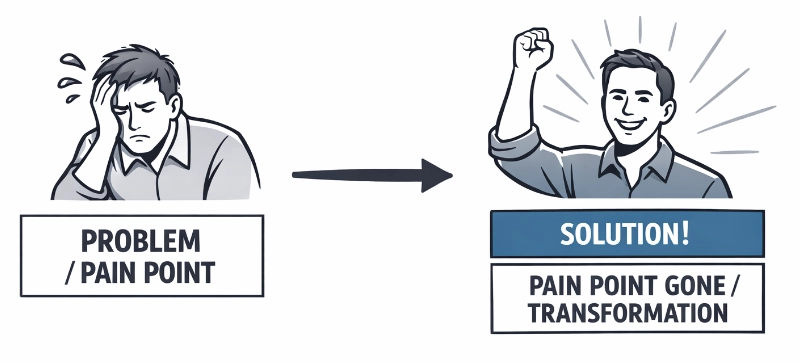
Every customer comes to you with a problem, pain, a frustration, or an unmet need. That’s their before state — where they are right now.
They also have a desired outcome — a future version of their life or business where the problem is solved. That’s the after state — where they want to be.
Your offer is the bridge between those two states - from PAIN to SOLUTION (relief).
When someone hires you to build a website, they’re not buying HTML and CSS. They’re buying the ability to reach more customers, look professional, or sell products online. That’s the transformation.
When someone buys meal-prep kits, they’re not buying chicken and vegetables in a box. They’re buying more time with their kids, less guilt about feeding their family junk food, and freedom from the 5pm scramble. That’s the transformation.
A transformation doesn't HAVE to be pain to relief. It can be more subtle. Elevating the customers feeling of self-worth or importance can be the transformation - same as helping them go solve a really tangible problem can be.
When you think about your offer as a transformation, three things change:
1. Pricing becomes easier. Features are commodities — anyone can build a website or prep a meal. Transformations are unique. The value isn’t in the hours you work or the ingredients you use. It’s in the result you deliver.
2. Differentiation becomes clearer. Two web designers might charge the same hourly rate, but one sells “website design” and the other sells “a digital storefront that turns visitors into paying customers.” Guess who wins the client?
3. Marketing becomes simpler. When you know the transformation, you know what to say. You speak directly to the before state (“Tired of losing customers because your website looks outdated?”) and the after state (“Imagine having a site that books clients while you sleep”).
Start by answering these three questions for your target customer:
1. Where are they now? (Before state — the problem, pain, or frustration)
2. Where do they want to be? (After state — the desired outcome or result)
3. What’s your role in getting them there? (Your offer as the bridge - the solution to their pain)
Let’s see this in action with our running example: the meal-prep kit business.
1. Where are they now? (Before state)
Overwhelmed at dinnertime. Spending $60–80/week on takeout they feel guilty about. Tried HelloFresh (too complicated), frozen meals (kids hate them), batch cooking (can’t sustain it). Exhausted and stuck.
2. Where do they want to be? (After state)
Feeding their family healthy, home-cooked meals without the stress. More time with their kids instead of standing over a cutting board. Less guilt, more energy, better nutrition.
3. What’s your role in getting them there? (Your offer)
Pre-portioned meal kits with simple recipes (under 20 minutes). Designed by a dietitian so they know it’s healthy. Delivered weekly so there’s no planning required. Under $8/serving so it’s cheaper than takeout.
Notice how the offer isn’t just “meal kits.” It’s freedom from dinnertime stress and guilt, delivered in a box. That’s what they’re buying.
Once you’ve defined the transformation, distill it into a single sentence. This becomes the core of how you talk about what you sell.
Template: I help [target customer] go from [before state] to [after state] by [your method/offer].
The second version sells the transformation. That’s what people pay for.
From this point forward, every decision you make about your offer should be filtered through this lens: Does this help deliver the transformation?
If a feature, service, or add-on doesn’t move the customer closer to the after state, cut it. If it does, emphasize it.
Your offer isn’t what you do. It’s the result you deliver. Nail that, and everything else — pricing, packaging, marketing — gets easier.
Let’s figure out your minimal viable offer — the simplest version that delivers the transformation.
The 3 things you must take away from this chapter
You probably have ten ideas for things you could sell. Different packages, add-ons, service tiers, product variations. Your instinct is to offer all of them so you don’t miss out on a sale.
Resist that instinct.
The more options you offer, the harder it is for customers to choose. And the harder it is for you to deliver consistently, price confidently, or explain what you do.
Your goal right now isn’t to build a full product catalog. It’s to nail one offer that solves the core problem for your target customer. Everything else can wait.
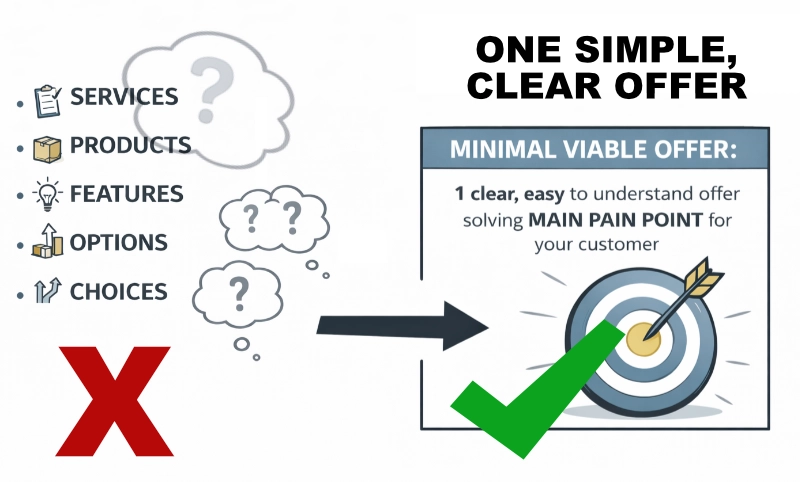
Your minimal viable offer (MVO) is the simplest version of your business that delivers the transformation you defined in Chapter 1.
It’s not bare-bones. It’s not cheap. It’s just focused. One clear deliverable. One clear price. One clear outcome.
Ask yourself: what’s the smallest thing I can sell that still moves the customer from the before state to the after state?
For the meal-prep kit business, the MVO isn’t a full menu of 50 recipes with customizable options for every dietary preference. It’s one weekly box with three dinners for a family of four. That’s it. It solves the problem. You can expand later.
Before you define your MVO, you need to decide what type of offer you’re building. The three main models are:
1. Service-based — You do the work for the customer (consulting, freelancing, done-for-you services).
2. Product-based — You sell a physical or digital product the customer uses themselves.
3. Hybrid — A mix of both (productized service, subscription with support, course + coaching).
Which one is right for you? It depends on three factors:
1. What are you good at? (Skills, expertise, what you enjoy)
2. How much capital do you have? (Products require upfront investment; services don’t)
3. How do you want to spend your time? (Client calls vs. building systems)
Let’s look at real examples of minimal viable offers across different business types:
Web Designer (Service): One-page website for service-based businesses. Fixed scope, fixed price. Includes copywriting, design, and launch. No revisions beyond two rounds. $2,500.
Bookkeeper (Service): Monthly bookkeeping for businesses under $500K in revenue. Monthly P&L, reconciliation, and quarterly tax prep support. $500/month.
Course Creator (Product): Self-paced video course teaching beginner photographers how to shoot in manual mode. 10 lessons, downloadable cheat sheets. $197 one-time.
Meal Kit Business (Product): Weekly meal kit with three dinners for a family of four. Dietitian-designed recipes under 20 minutes. $79/week, cancel anytime.
SEO Consultant (Hybrid): Monthly SEO retainer: keyword research, on-page optimization, monthly performance report, and 30-minute strategy call. $1,200/month.
Notice what they all have in common: one clear deliverable, one clear price, one clear outcome. No endless options. No confusion.
Resist the urge to add everything you can think of. Your first offer should not include:
You can always expand later. Right now, simple wins.
Now it’s your turn. Based on what you’ve learned, define your first offer in one sentence.
My minimal viable offer is:
It delivers this transformation:
The deliverable is:
Once you can state it clearly in three lines, you’re ready to move on to pricing.
Let’s figure out what to charge — using frameworks that work in the real world.
The 3 things you must take away from this chapter
Pricing feels like the hardest decision you’ll make. And in some ways, it is — because there’s no formula that spits out the “right” answer.
But here’s the truth: pricing isn’t a mystery. It’s a decision based on three inputs: your costs, your market, and the value you deliver.
This chapter will give you three frameworks to choose from. You’ll pick the one that fits your business, set a starting price, and test it. That’s how pricing actually works — not by finding perfection, but by learning from reality.
Before we dive into the frameworks, let’s acknowledge why this is so uncomfortable.
Pricing forces you to put a number on your worth. It exposes you to rejection (“That’s too expensive”). It requires you to make a judgment call without all the data. And if you get it wrong, you either leave money on the table or scare customers away.
That’s all normal. Every founder feels this. But here’s what helps: your first price isn’t permanent. You’re not carving it in stone. You’re testing a hypothesis.
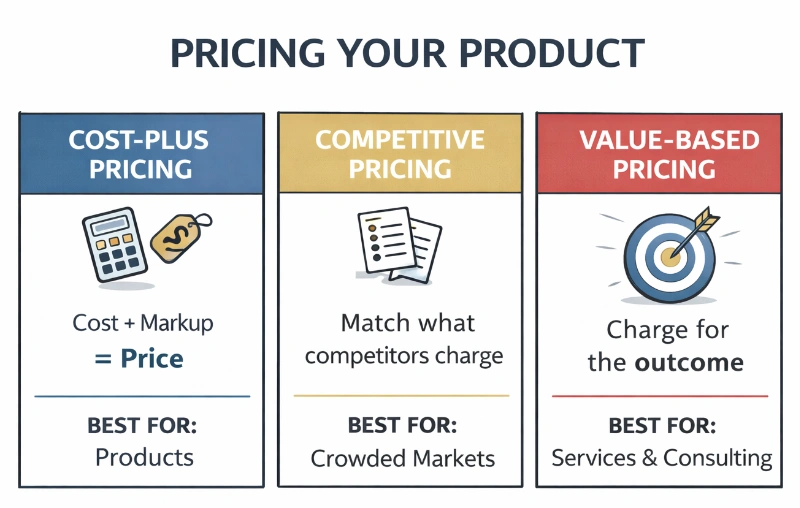
How it works: Calculate your costs (materials, labor, overhead) and add a markup to cover profit.
When to use it: Product-based businesses with clear cost of goods sold (COGS). Service businesses where you’re selling time.
The formula:
Example: You’re selling meal-prep kits. Each kit costs you $40 in ingredients and packaging. Your overhead (kitchen rental, labor, delivery) adds $15 per kit. You want a 40% profit margin. Your price: $40 + $15 = $55 × 1.4 = $77/kit.
Pros: Simple. Ensures you cover costs and make a profit.
Cons: Ignores what customers are willing to pay. Doesn’t reward efficiency (if you get faster, you make less).
How it works: Research what competitors charge and price in the same range.
When to use it: Established markets with clear competitors. Service businesses where customers compare quotes.
How to research:
Example: You’re a bookkeeper. Most bookkeepers in your area charge $400–700/month for small businesses. You price at $500/month (mid-range to start).
Pros: Safe. You know customers are already paying this amount.
Cons: You’re competing on price, not value. Hard to differentiate. Tends to drive prices down over time.
How it works: Price based on the value you deliver to the customer, not your costs or the competition.
When to use it: When you can quantify the outcome (revenue generated, costs saved, time saved). When you have unique expertise or results.
How to calculate:
Example: You’re a conversion rate optimizer. Your client’s website gets 10,000 visitors/month with a 1% conversion rate (100 sales). You increase it to 2% (200 sales). Their average sale is $50. You just added $5,000/month in revenue ($60K/year). You charge $3,000 for the project — a fraction of the annual value you created.
Pros: Highest profit margins. Rewards results, not hours. Customers perceive it as fair (they win too).
Cons: Harder to quantify in some industries. Requires confidence and a strong sales conversation.
Most founders use a combination. Here’s how to decide:
Use Cost-Plus When:
Use Market Rate When:
Use Value-Based When:
Now it’s time to pick a number. Use the framework that fits your business best, run the math, and commit to a starting price.
1. Which pricing framework fits my business best?
2. Based on that framework, my starting price is:
3. I can justify this price because:
Once you have a number, move to Chapter 4. We’ll package your offer around that price and make it real.
Let’s turn your offer into a clear, defined package customers can understand and buy.
The 3 things you must take away from this chapter
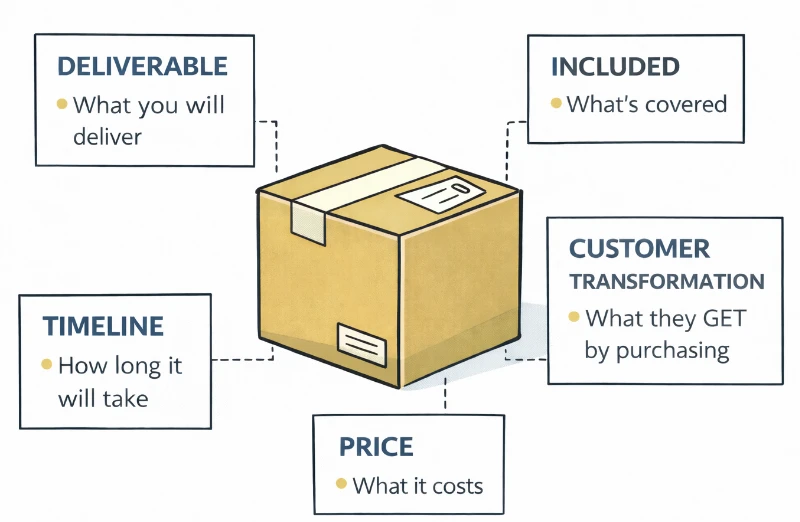
You have an offer. You have a price. Now you need to package it — which means defining exactly what the customer gets for that price.
This is where a lot of founders get vague. They say things like “I offer web design services” or “I help businesses with marketing.” That’s not a package. That’s a job description.
A package is specific. It has clear boundaries. The customer knows exactly what they’re buying, and you know exactly what you’re delivering.
Every package should answer these five questions:
Let’s see this in action with a web design package:
Package: One-Page Website for Service Businesses
The transformation: "Your customers will see your business as a credible, professional business they can trust — instead of wondering if you’re legitimate."
What you get: A professionally designed, mobile-responsive one-page website with custom copy, contact form, and one round of revisions — all focused on positioning you as the obvious choice in your market.
What’s included: Strategy call (to clarify your positioning), copywriting (that speaks to your customers’ needs), design, development, launch, and 30-day post-launch support.
What’s NOT included: Logo design, ongoing maintenance, SEO services, or additional pages beyond the one-page layout. We’re laser-focused on getting you a professional web presence that converts visitors into leads.
Timeline: Two weeks from deposit to launch — so you can start showing up professionally and closing deals faster.
What you provide: Brand assets (logo, colors, images), answers to a project questionnaire, and timely feedback on drafts. Your input helps us nail the message that resonates with your ideal customers.
Price: $2,500
Notice how clear that is. No confusion. No surprises. The buyer knows exactly what they’re getting.
New founders are afraid to set boundaries. They worry that saying “no” to something means losing a sale. So they make everything customizable and end up with no clear offer at all.
Here’s the truth: constraints make your offer stronger.
When you say “this package includes X, Y, and Z — and nothing else,” you’re doing three things:
Maybe. Maybe not.
Some industries benefit from named packages (“The Starter Site” or “The Growth Plan”). Others don’t need it at all. Here’s when to use names:
Name Your Package When:
Skip the Name When:
For most small businesses, clear beats clever. “Monthly Bookkeeping for Small Businesses” works better than “The Profit Protector Package.”
One of the smartest things you can do is define add-ons — things you offer but charge separately for.
This serves two purposes:
Example add-ons for a web design package:
Now when someone says “Can you also design a logo?” you don’t have to scramble or guess. You have a price.
Now define your package. Use the five questions from earlier and be as specific as possible.
1. Main deliverable:
2. What’s included:
3. What’s NOT included:
4. Timeline:
5. What the customer provides:
Once you can fill in those blanks clearly, you have a real offer. You’re ready to present it to customers.
Let’s get tactical about pricing for services, products, and digital offers.
The 3 things you must take away from this chapter
Chapter 3 gave you the frameworks. Now let’s get practical. Depending on whether you’re selling services, physical products, or digital products, pricing works differently.
This chapter breaks down the real-world pricing models for each type of business — with examples, pros and cons, and when to use each one.
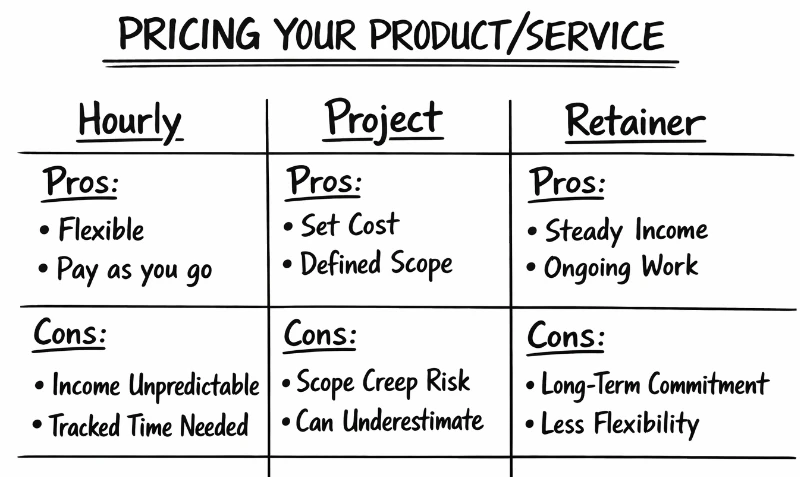
If you’re selling a service (consulting, design, coaching, bookkeeping, etc.), you have three main pricing models:
1. Hourly Pricing
2. Project-Based Pricing
3. Retainer Pricing
If you’re selling physical products (meal kits, handmade goods, retail items), your pricing formula is:
Price = COGS + Overhead + Profit Margin
Let’s break that down:
Example: Meal-prep kit pricing
Price psychology matters:
Digital products (courses, templates, eBooks, software) are different because your production cost is near zero once the product is built.
This means two things:
Common pricing tiers for digital products:
Example: Online course pricing
No matter what you’re selling, the only way to know if your price works is to test it with real buyers.
Here’s how:
Let’s test your price in the real world — before you commit to it.
The 3 things you must take away from this chapter
You’ve set a price. Now comes the scary part: finding out if anyone will actually pay it.
This is where most founders hesitate. They want more data, more validation, more certainty before they put a number in front of a real person. They tweak the price up and down in a spreadsheet, hoping the “right” number will reveal itself.
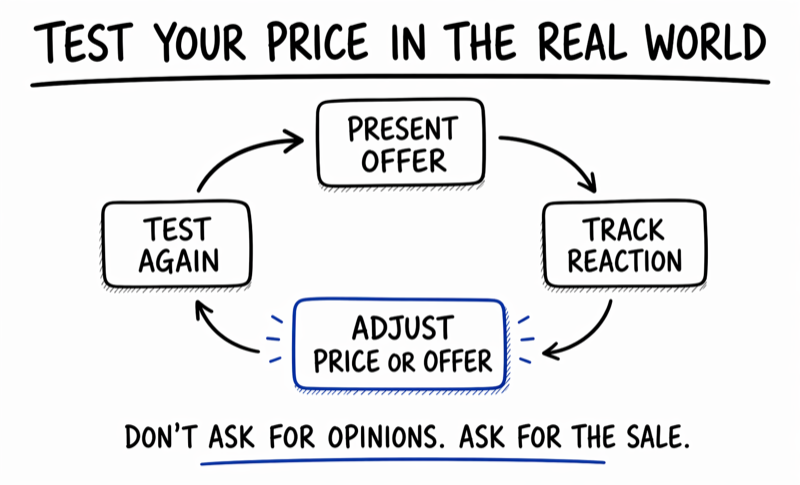
It won’t. The only way to know if your price works is to test it with real buyers in real sales conversations.
Here’s what not to do: don’t send a survey asking “Would you pay $500 for this?” Don’t ask friends and family what they think. Don’t post on social media asking if your price is fair.
People lie when there’s no money on the line.
They’ll say “Yeah, I’d totally pay that” to be supportive. Or they’ll say “That seems expensive” because they’re not your target customer. Either way, you learn nothing useful.
The only signal that matters is this: Do they pull out their wallet?
Here’s the process:
Step 1: Identify 5–10 people in your target market. These should be real potential customers — not friends doing you a favor. Reach out and offer to present your offer.
Step 2: Present the offer clearly. Explain the transformation (Chapter 1), the deliverable (Chapter 2), what’s included (Chapter 4), and the price. Then ask: “Does this sound like something you’d be interested in?”
Step 3: Watch their reaction. You’re looking for one of three responses:
Step 4: Track the pattern. If 8 out of 10 people say yes immediately, test a higher price. If 8 out of 10 say no, either lower the price or strengthen the offer. If it’s split, you’re close — keep testing.
Most new founders underprice. Here are the warning signs:
If you see these signs, raise your price by 20–30% and test again. You’ll be surprised how little resistance you get.
On the flip side, here’s how you know your price is above what the market will bear:
If this happens, don’t panic and slash your price in half. Instead:
Here’s the hardest part of pricing: you have to say the number out loud without flinching.
If you sound uncertain (“It’s, um, $1,200... but we can talk about that”), the customer smells blood in the water. They’ll negotiate. They’ll push back. They’ll assume the price is flexible.
If you sound confident (“The price is $1,200”), they’re more likely to accept it as fair.
How to build pricing confidence:
Use this checklist to validate your price:
1. I’ve presented my offer to at least 5 real prospects. ☐
2. I asked them to buy (not just give feedback). ☐
3. I tracked their reactions (yes, maybe, no, objections). ☐
4. I adjusted based on patterns (not one-off comments). ☐
5. I can say my price out loud without hesitation. ☐
Once you check all five boxes, you’re ready to move forward. Your price is tested. Now you can start packaging it into tiers (Chapter 7) and presenting it confidently (Chapter 8).
Let’s add a low-friction entry point and strategic upsells — without overcomplicating your offer.
The 3 things you must take away from this chapter
In Chapter 2, we built your minimal viable offer — one clear package at one clear price. That’s where you start.
But once you’ve sold that offer a few times and validated the price, you can start thinking strategically about how to serve customers at different price points — and increase your revenue in the process.
This chapter covers three strategies: low-friction entry offers, tiered pricing, and upsells.
Not everyone is ready to buy your main offer on day one. Some people need to test the water before they commit.
That’s where a low-friction entry offer comes in. It’s a smaller, cheaper version of what you do — designed to get someone to say yes, build trust, and lead to a bigger purchase later.
Common entry-level offers:
Why this works: Once someone becomes a customer — even at a low price — they’re far more likely to buy again. You’ve built trust. You’ve proven you deliver. The next sale is easier.
Example: Bookkeeping service with entry offer
Main offer: Monthly bookkeeping retainer, $500/month
Entry offer: One-time financial cleanup and setup, $300
Why it works: Small businesses hesitate to commit to $500/month without knowing you. But $300 for a one-time cleanup feels safe. Once you do great work, they sign up for the retainer.
Once you have your core offer dialed in, you can introduce tiered pricing — offering the same service or product at multiple levels.
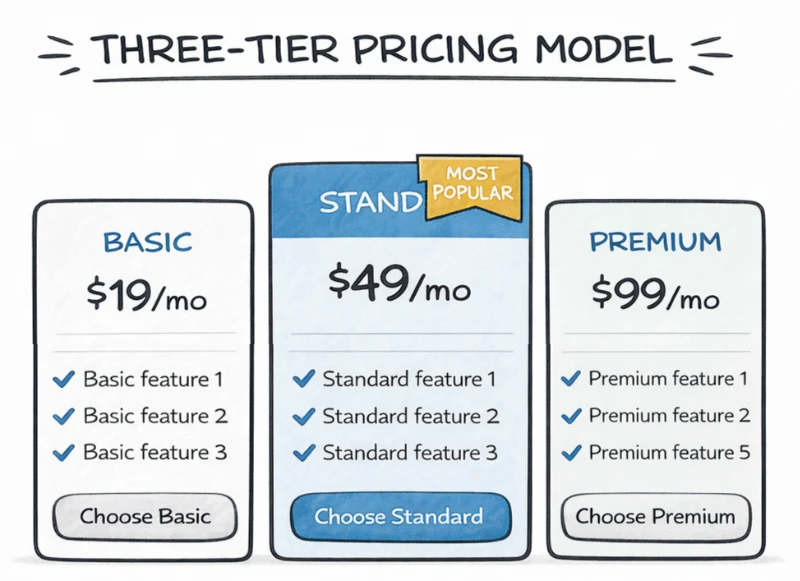
The classic model is three tiers:
Why three tiers work:
Example: Web design tiers
Starter ($1,500): One-page website, template-based design, one revision, two-week delivery.
Professional ($3,000): Custom five-page website, two rounds of revisions, copywriting included, 10-day delivery, 30-day support.
Premium ($5,500): Everything in Professional, plus SEO setup, brand strategy session, priority support, five-day delivery.
Notice how each tier is clearly differentiated. The customer knows exactly what they’re getting at each level.
Tiered pricing only works if the tiers are easy to understand and clearly valuable. Here’s how to do it right:
1. Make the middle tier the obvious choice. Price it so it feels like the best value. Most customers will pick it.
2. Differentiate with speed, support, or scope — not arbitrary limits. Don’t create fake scarcity (“Tier 1 includes 5 emails, Tier 2 includes 10 emails”). That feels cheap. Instead, offer real upgrades (faster delivery, more hands-on support, additional features).
3. Keep it to three tiers. More than three creates decision paralysis. People get overwhelmed and bail.
Good tier differentiation:
Bad tier differentiation:
An upsell is something you offer after the customer buys your main offer. It’s a logical next step that enhances what they already bought.
Good upsells are:
Examples:
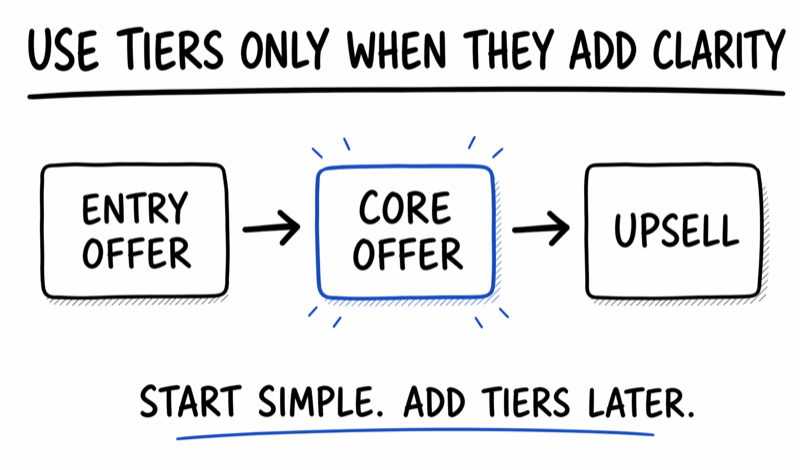
Here’s the important part: don’t launch with all of this on day one.
Start with one offer. Sell it 5–10 times. Get feedback. Then add an entry-level offer or tiers if you see demand for it.
Adding tiers too early creates confusion. Adding them too late leaves money on the table. The sweet spot is after you’ve validated your core offer and understand what customers are asking for.
Let’s write the sales page, proposal, or pitch that makes your offer easy to understand and buy.
The 3 things you must take away from this chapter
You have an offer. You have a price. Now you need to present it in a way that makes someone want to buy.
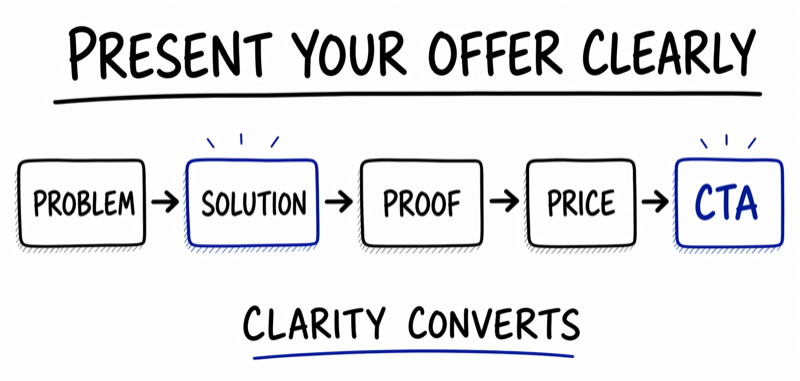
Whether you’re writing a sales page, sending a proposal, or pitching in person, the structure is the same: show them the problem, present your solution, prove it works, and make the price feel fair.
This chapter gives you the framework to do exactly that.
Every great offer presentation follows this sequence:
Let’s walk through each piece.
Don’t start with your credentials or your process. Start with the problem your customer is experiencing right now.
And here’s the key: use their words, not yours.
If you’re selling to busy parents, don’t say “optimize your family nutrition strategy.” Say “You’re exhausted by 5pm and ordering pizza again because you can’t face another night of meal planning.”
Their words = instant recognition. Your words = corporate jargon that doesn’t land.
Example hooks (using customer language):
Once you’ve named the problem, make it clear why it’s costing them (money, time, opportunity, sanity).
This isn’t about fear-mongering. It’s about making the cost of inaction clear.
Example:
“That $80/week on takeout adds up to over $4,000 a year. And your kids are eating the same three things on repeat because you’re too tired to cook anything new.”
Now present your offer as the solution. Frame it as the transformation (Chapter 1), not just the deliverable.
Template: [Your offer] helps you go from [before state] to [after state] without [the thing they hate].
Example:
“Our weekly meal-prep kits give you healthy, home-cooked dinners in under 20 minutes — without the planning, shopping, or guilt.”
Walk through the process or deliverable in 3–5 simple steps. Don’t overwhelm them with details. Just show them it’s easy.
Example:
Skepticism is normal. Overcome it with proof:
Don’t just state the price. Anchor it to value.
Bad: “It’s $79/week.”
Good: “For $79/week, you get three healthy dinners for your family — that’s under $8 per serving, cheaper than takeout, and you get your evenings back.”
End with a clear, simple next step. Don’t make them guess.
Examples:
Here’s a barebones template you can adapt:
[Headline: Name the problem in their words]
[Amplify: Why this problem costs them]
[Your offer] helps you [transformation].
Here’s how it works:
What you get: [List deliverables clearly]
Proof it works: [Testimonial or case study]
Investment: [Price, anchored to value]
Next step: [Clear CTA]
That’s it. You don’t need fancy design or clever copywriting. You need clarity.
Let’s prepare you to handle the most common objections without caving on price.
The 3 things you must take away from this chapter
You present your offer. The customer is interested. And then they hit you with an objection:
“That’s more than I expected.”
“I need to think about it.”
“Can you do it for less?”
Your heart sinks. You start second-guessing your price. You consider dropping it just to close the deal.
Stop.
Objections are normal. They don’t mean your price is wrong or your offer is bad. They mean the customer needs more clarity, more confidence, or more time.
This chapter teaches you how to handle the most common objections without caving.
This is the most common objection, and it almost never means what you think it means.
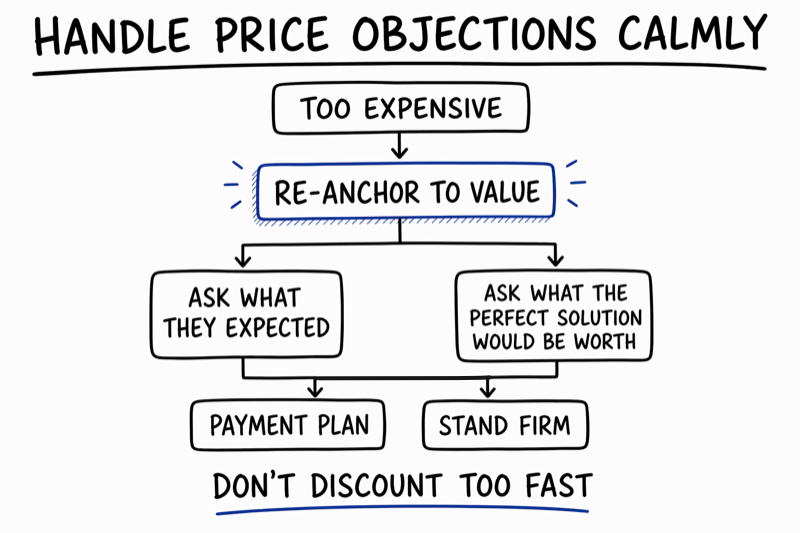
When someone says “too expensive,” they’re usually saying one of three things:
How to respond:
Step 1: Don’t defend the price. Re-anchor to value.
“I understand. What would it would be worth to you if we can solve your specific problem within this timeframe?”
Then restate the transformation and the ROI. Remind them what staying in the before state is costing them.
Example:
“Right now, you’re spending $80/week on takeout — that’s over $4,000 a year. Our meal kits are $79/week, so you’re saving money and feeding your family healthier meals. When you look at it that way, does the price make more sense?”
Step 2: Ask what they were expecting.
“What were you hoping to invest for something like this?”
This reveals whether they have a real budget constraint or just sticker shock. If they say “I was thinking $50,” you know you’re not aligned. If they say “I don’t know, it just feels like a lot,” you can keep selling.
Step 3: Offer a payment plan (if appropriate).
“If the full price upfront is a challenge, I can offer three monthly payments of $350 instead of one $1,000 payment.”
This removes the friction of a big upfront cost without lowering your price.
Translation: “I’m not convinced yet, but I don’t want to say no.”
This objection means one of two things:
How to respond:
“Of course. Before you go, can I ask — is there anything specific you’re unsure about? I want to make sure I’ve answered all your questions.”
If they surface a concern, address it. If they say “I just need to talk to my spouse,” that’s legitimate. Follow up in 2–3 days.
This is a direct negotiation attempt. How you respond depends on the situation.
When to say no:
Response:
“I appreciate you asking, but my pricing reflects the quality and results I deliver. I don’t discount because I want to make sure I can give every client my full attention and best work.”
When to negotiate:
Response:
“I don’t typically discount, but if you commit to six months upfront, I can offer 10% off the total.”
Notice: you’re not just dropping the price. You’re getting something in return (commitment, volume, upfront payment).
Good. Let them go.
If someone is buying on price alone, they’re not your customer. They’ll nickel-and-dime you, leave bad reviews, and demand endless revisions.
How to respond:
“I totally understand. There are definitely cheaper options out there. The difference is [what makes you unique — speed, quality, results, support]. If that’s important to you, I’d love to work together. If price is the main factor, I’m probably not the best fit.”
This does two things: it positions you as premium, and it lets price-shoppers self-select out.
This is a confidence objection. They like the offer but don’t trust that it’ll work for their specific situation.
How to respond:
“What specifically are you concerned about?”
Listen to their answer. Then either:
Not every objection is worth overcoming. Sometimes the answer is to let the customer go.
Walk away when:
Saying no protects your business and your sanity. You’re better off waiting for the right customer than taking a bad deal.
Let’s get someone to say yes — and learn from what happens next.
The 3 things you must take away from this chapter
You’ve done the work. You have an offer, a price, and a way to present it. Now comes the moment that matters: getting someone to say yes.
Your first sale is the most important milestone in your business. Not because of the revenue (though that’s great). But because it proves three things:
This chapter is about making that first sale happen — and what to do after.
Your first customer is probably closer than you think. They’re not a stranger on the internet. They’re someone in your existing network who already knows, likes, and trusts you.
Start here:
Send 5–10 people a short, direct message:
Subject: Can I get your feedback on something?
Hey [Name],
I’m launching [your offer] to help [target customer] [solve problem]. I’m looking for a few people to work with in the first round, and I thought of you because [specific reason they’re a fit].
Would you be open to a quick 15-minute call this week to discuss? Happy to answer any questions.
Thanks!
[Your name]
Notice: you’re not asking for feedback. You’re inviting them to be a customer. The “feedback” framing just lowers the pressure.
On the call (or in person), follow the presentation framework from Chapter 8:
If they say yes: send an invoice or contract immediately. Don’t wait. Momentum matters.
If they hesitate: ask what’s holding them back. Handle the objection (Chapter 9). If they’re still not ready, thank them and move on to the next prospect.
Congratulations. You made a sale. Now the real work begins: delivering an amazing experience.
Your first customer is your foundation. They’re your first testimonial, your first case study, your first referral source. Treat them like gold.
How to deliver a great experience:
Your first customer teaches you more than any business guide ever could. Pay attention to:
This is how you refine. Not by guessing, but by learning from real customers.
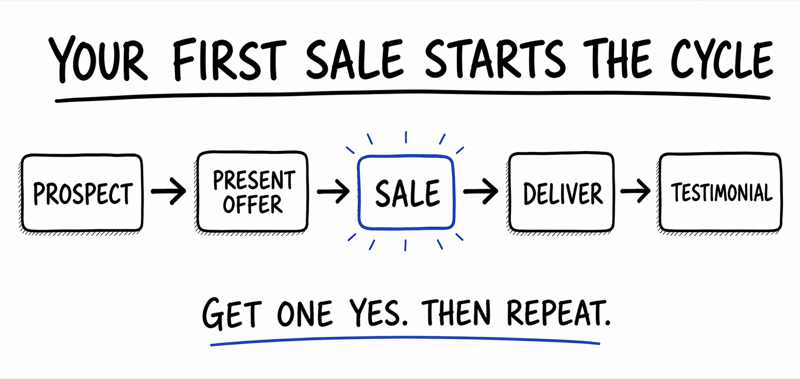
Once you have your first sale, the goal is simple: do it again.
Reach out to the next five people on your list. Use what you learned from the first sale to improve your pitch. Close customer #2. Then #3.
By the time you hit 10 sales, you’ll have a repeatable process. You’ll know your offer works. You’ll have testimonials. You’ll have confidence.
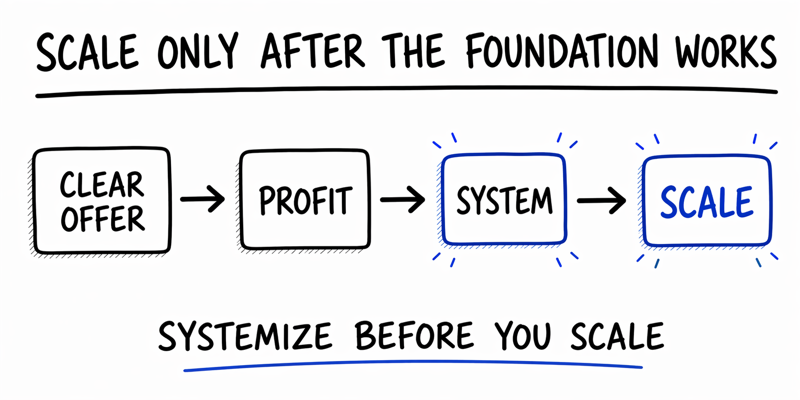
And that’s when you’re ready to scale.
Let’s use real customer feedback to improve your offer, pricing, and delivery.
The 3 things you must take away from this chapter
You’ve sold your offer a few times. You’ve delivered the work. You’ve learned what it actually takes to serve a customer.
And now you’re noticing things:
This is good. This is how you improve.
Your first version of your offer was a hypothesis. Now you have data. This chapter shows you how to refine based on what you’re learning.
Not every piece of feedback requires a change. Some customers will want things that don’t fit your business model. Some will ask for customizations that aren’t scalable.
Here’s when to adjust:
Pricing adjustments should be based on signals, not feelings. Here’s what to watch for:
Raise your price if:
Lower your price (or add value) if:
Don’t change your price based on:
After 5–10 sales, ask yourself these questions:
1. What part of my offer do customers value most?
2. What part takes the most time but gets the least appreciation?
3. What question comes up in every sales conversation?
4. If I could only change one thing about my offer, what would it be?
5. At this price and effort level, is this sustainable?
Your answers will tell you what to keep, what to cut, and what to double down on.
You don’t need to overhaul your entire offer every time you learn something new. Make small, testable adjustments.
Examples:
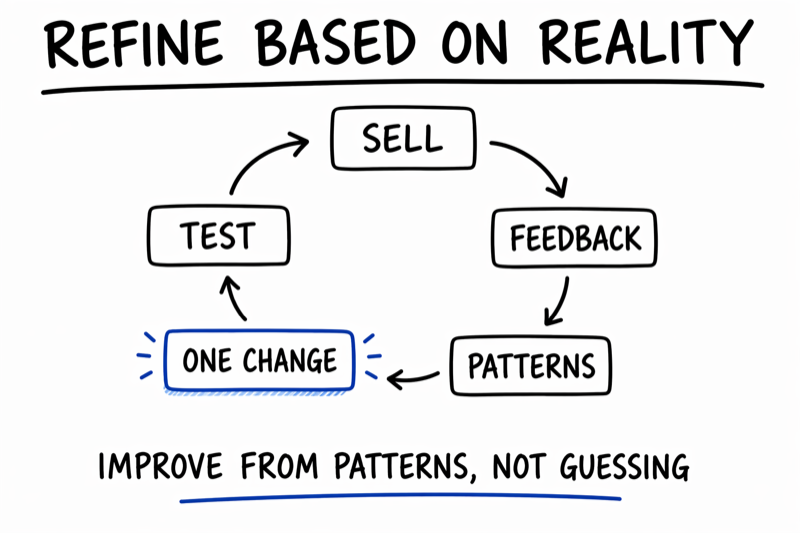
Test one variable at a time. That way you know what’s working.
Refinement isn’t a one-time event. It’s a loop:
After three or four cycles, you’ll have an offer that’s dialed in: profitable, repeatable, and aligned with what customers actually want.
That’s when you’re ready to scale.
Let’s validate that your offer is repeatable, profitable, and ready for growth.
The 3 things you must take away from this chapter
You’ve created your offer. You’ve tested your pricing. You’ve sold it a handful of times and refined it based on real feedback.
Now the question is: are you ready to scale?
Scaling means finding more customers, delivering consistently, and growing revenue without working 80-hour weeks. But here’s the catch: if you scale too early — before your offer is validated and profitable — you just amplify your problems.
This chapter helps you know when you’re ready to grow — and what to do next.
Don’t scale just because you’re excited or impatient. Scale when you see these three signals:
1. You’ve sold your offer 10–20 times.
Ten sales is the minimum to prove demand. Twenty sales means you have a repeatable process. If you’re not there yet, keep selling and refining.
2. Your offer is profitable at your current price.
Check your margins. After costs (materials, labor, overhead), are you making at least 30–50% profit per sale? If not, adjust your pricing or costs before you scale. Growing an unprofitable offer just loses money faster.
3. You can deliver consistently without reinventing the process each time.
If every customer requires a custom approach, you’re not ready to scale. You need a repeatable system — a process you can document, delegate, or automate.
Not all offers scale the same way. Here’s what separates a scalable offer from one that traps you:
Scalable offers have:
Non-scalable offers have:
If your offer fits the second list, go back to Chapter 11 and refine. Systemize before you scale.
Before you start spending money on ads, hiring help, or building complex systems, make sure you can answer “yes” to these questions:
1. I’ve sold this offer at least 10 times. ☐
2. My profit margins are healthy (30%+ after all costs). ☐
3. I have a documented process for delivering this offer. ☐
4. I can explain my offer clearly in under 60 seconds. ☐
5. Customers are happy — I have testimonials and referrals. ☐
6. I know where my next 10 customers will come from. ☐
If you checked all six boxes, you’re ready. If not, keep refining.
Scaling doesn’t mean you need to hire a team, rent an office, or raise funding. For most small businesses, scaling looks like this:
You don’t need to 10x overnight. Sustainable growth — 20–30% year over year — beats explosive, chaotic growth every time.
You now have a validated offer. You know what to sell, what to charge, and how to present it. You’ve made your first sales and refined based on reality.
The next challenge is finding more customers.
That’s what Guide 6 — How To Find Your First Customers — is all about. You’ll learn:
But before you jump into marketing, make sure your offer is solid. The best marketing in the world won’t save a weak offer.
If you’ve done the work in this guide — defined your transformation, set your price, tested it with real customers, and refined based on feedback — you’re ready.
Let’s go find your customers.