A practical guide to defining what you sell, deciding what to charge, and building an offer customers actually want
You've assessed your idea. You've validated demand. You've set up your business structure.
Now it's time to figure out how to communicate your VALUE to your customer in a way that moves them to buy from you.
Here's your big goal:
This guide will help you create your first offer—not a perfect one, but a real one that you can put in front of customers and start learning from.
Customers don't buy what you do—they buy the result it creates for them.
Most new business owners describe their offer in terms of what they do:
"I build websites."
"I offer bookkeeping services."
"I sell meal-prep kits."
Here's the shift:
Customers don't buy what you do. They buy the result of what you do.
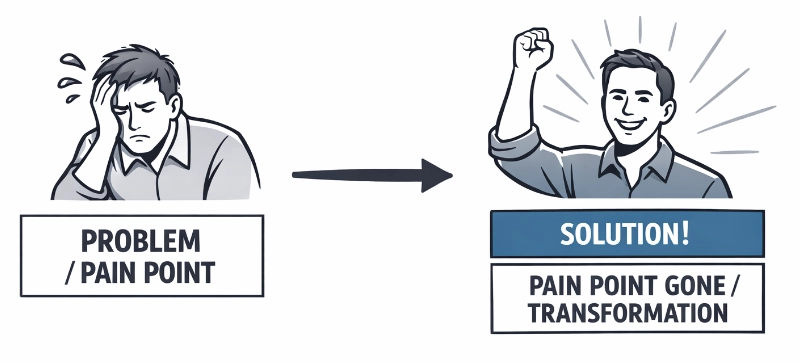
Every customer has a before state—where they are right now (problem, pain, frustration, unmet need).
They also have an after state—where they want to be (problem solved, goal achieved).
Your offer is the bridge between those two states - from PAIN to SOLUTION (relief).
When someone hires you to build a website, they're not buying HTML. They're buying the ability to reach more customers and look professional. That's the transformation.
A transformation doesn't HAVE to be pain to relief. It can be more subtle. Elevating the customers feeling of self-worth or importance can be the transformation - same as helping them go solve a really tangible problem can be.
When you think about your offer as a transformation:
1. Pricing becomes easier. Features are commodities. Transformations are unique. Value is in the result, not the hours.
2. Differentiation becomes clearer. You're not selling "website design," you're selling "a digital storefront that turns visitors into paying customers."
3. Marketing becomes simpler. Speak to the before state and the after state.
1. Where are they now? (Before state)
2. Where do they want to be? (After state)
3. What's your role in getting them there? (Your offer - the solution to their pain)
Template: I help [target customer] go from [before state] to [after state] by [your method/offer].
Now write your offer statement: Use the template above and fill in the blanks. Say it out loud. Does it clearly explain the transformation you deliver? If not, keep refining until someone who's never heard of your business can instantly understand what you do for them.
Your first offer should be dead simple: one deliverable, one price, one clear outcome.
You probably have ten ideas for things you could sell. Different packages, tiers, add-ons.
Resist that instinct. Start with one offer.
Your MVO is the simplest version of your business that delivers the transformation.
One clear deliverable. One clear price. One clear outcome.
Ask: what's the smallest thing I can sell that still moves the customer from before state to after state?
Service-Based: You trade time/expertise for money (consulting, coaching, design). Pros: Low startup cost, high margins. Cons: Hard to scale.
Product-Based: You create something once and sell it many times (physical products, software, courses). Pros: Scalable. Cons: Higher upfront costs.
Hybrid: Combine both (agency that offers templates, coach that offers workshops). Pros: Multiple revenue streams. Cons: More complex to manage.
My minimal viable offer is:
Type: ☐ Service ☐ Product ☐ Hybrid
Who it's for:
What they get:
Three proven pricing strategies to help you set a price you can defend and customers will pay.
Pricing terrifies new founders. You're afraid to charge too much (and scare people off) or too little (and work for pennies).
Three pricing strategies:
Calculate your costs, add a margin. Formula: Cost + Markup = Price
Good for products. Simple and safe.
See what competitors charge and price in that range. Go slightly lower (budget option) or higher (premium option).
Charge based on the transformation you deliver, not the time you spend. Best for services.
What's the result worth to your customer? That's what you should charge.
Use Cost-Plus if: You're selling physical products with clear material costs (meals, crafts, manufactured goods). You need predictable margins.
Use Competitive Pricing if: You're entering a crowded market where customers already know what things cost (tutoring, cleaning, common services). Check 3-5 competitors and price within their range.
Use Value-Based Pricing if: You're selling services, consulting, or solutions where the outcome is worth far more than your time (marketing that generates $50K in sales, design that increases conversions, coaching that transforms businesses). This typically yields the highest prices.
Starting out? Most founders use competitive pricing to start (safe and easy to justify), then shift to value-based as they gain confidence and testimonials.
Pick your pricing strategy right now: Which of the three approaches (cost-plus, competitive, or value-based) fits your business? Research 3-5 competitors and write down what they charge. Then decide where you'll position yourself and why.
Define exactly what's included (and what's not) so customers know what they're buying.
Your offer needs a clear scope: what's included and what's not.
What's included:
1.
2.
3.
What's NOT included:
Timeline/delivery:
The clearer your scope, the easier it is to sell and deliver.
Define your boundaries now: Complete the exercise above. Be specific about what's included and what's NOT. The "what's not included" list is just as important—it prevents scope creep and customer disappointment later.
Simple formulas to calculate your starting price for services and products.
For services:
For products:
My starting price: $
Why this price makes sense:
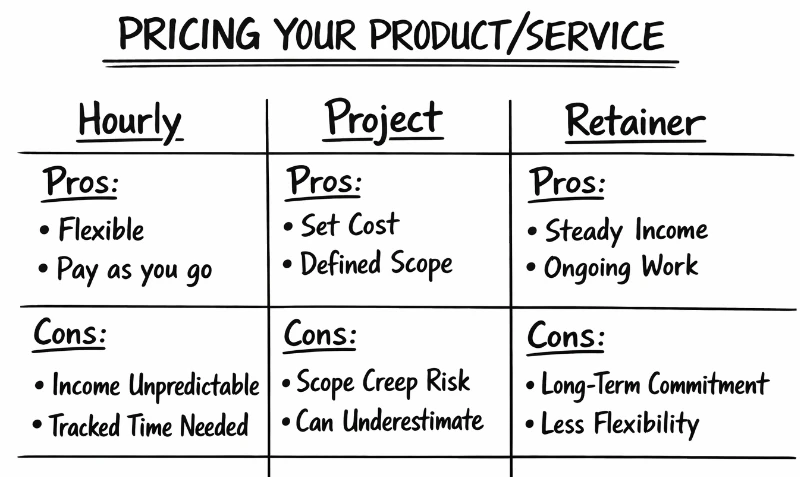
The only way to know if your price works is to test it with real customers—here's how.
The only way to know if your price works is to test it with real people.
1. Direct Ask: Present your offer to 10 potential customers. Track how many say yes vs. "that's too expensive."
2. Landing Page Test: Put your offer and price on a page. Drive traffic. Track conversion rate.
3. Two-Price Test: Offer two versions at different prices. See which converts better.
Price Is Right If:
Price May Be Too High If:
Test your price this week: Present your offer to 10 real potential customers. Don't explain or apologize—just state the price confidently and watch their reaction. Track how many say yes, how many balk, and what they say. That's your real-world data.
Once you've validated your core offer, add tiers to give customers choice and increase revenue.
Once you've validated your core offer, consider offering three tiers:
Why it works: Gives customers choice and anchors the middle tier as "best value."
When to use it: After you've sold your core offer 10+ times. Don't start with tiers.
Stay focused for now: If you haven't made your first 10 sales yet, bookmark this chapter and come back to it later. Your only job right now is to sell your one simple offer and learn from those customers. Tiers come after validation.
The six-step framework for presenting your offer so customers understand and want to buy.
Practice your offer pitch:
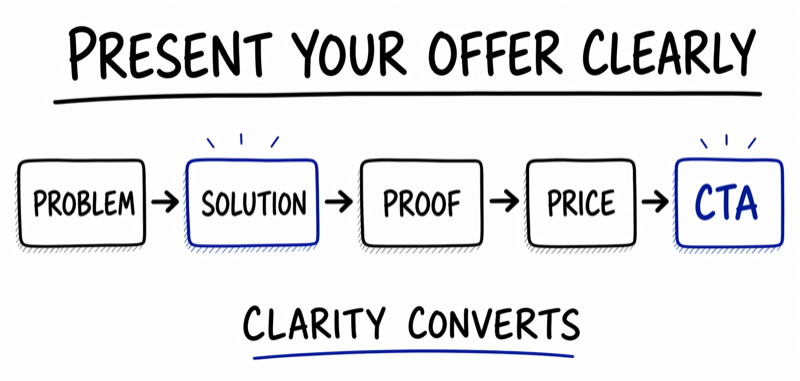
Does your website display your CLEAR OFFER before user scrolls? Your website absolutely must do that. If your user doesn't see the clear transformation you're providing within the first few seconds, you need to work on your homepage right away!
How to handle "too expensive," "I need to think about it," and other common objections without losing the sale.
"That's too expensive."
Response: "I understand. What would it would be worth to you if we can solve your specific problem within this timeframe?
Or: What are you comparing it to? Because when you consider [transformation/result], the investment pays for itself in [timeframe]."
"I need to think about it."
Response: "Of course. What specific questions do you have that would help you decide?"
"Can you do it for less?"
Response: "I could reduce the price if we reduce the scope. Which parts are most important to you?"
Practice these responses out loud: Right now, say each objection response from this chapter out loud three times. It will feel awkward at first, but when a real customer says "that's too expensive," you'll be ready with a calm, confident response instead of panicking.
Your step-by-step plan to land your first 1-3 paying customers in the next two weeks.
Your first sale is the hardest. Here's how to land it:
Your goal: Get 1-3 paying customers in the next two weeks.
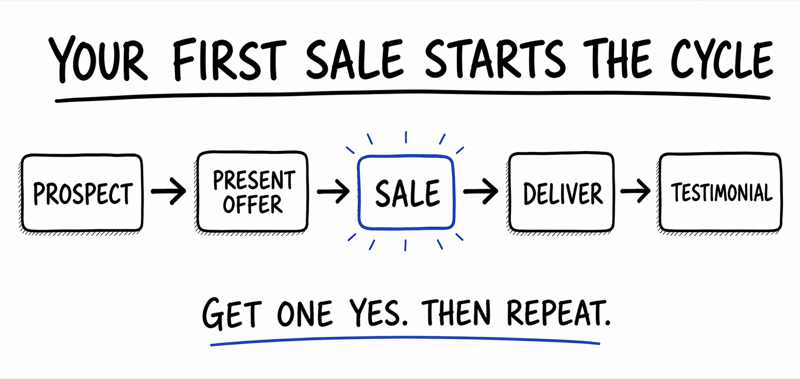
After 5-10 customers, use their feedback to refine your offer, pricing, and delivery.
After your first 5-10 customers, ask:
Use this feedback to refine your offer, adjust pricing, and improve delivery.
Once you've proven your offer works, it's time to scale with systems, marketing, and growth strategies.
Once you've sold your offer 10+ times and refined it based on feedback, you're ready to scale:
Your offer is no longer a guess. It's proven. Now grow it.
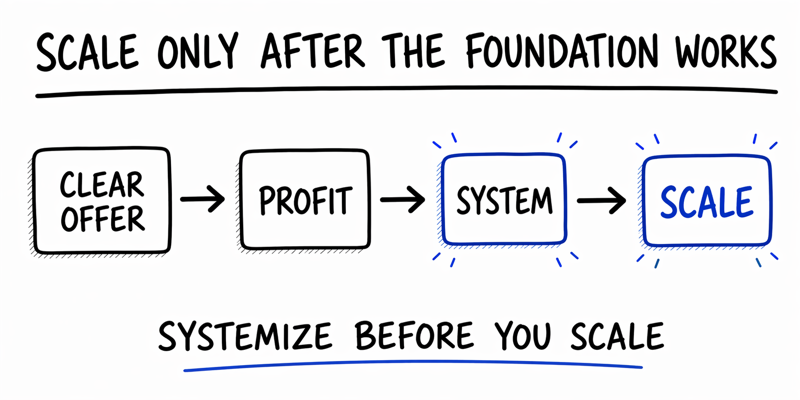
What's your first scaling move? Pick one thing from the list above—systems, marketing materials, tiers, or customer acquisition—and commit to completing it in the next 30 days. You've proven the offer works. Now it's time to make it repeatable and scalable.
You now have a clear, concrete offer with a price you can confidently charge.
Remember:
Now go craft an unbeatable offer, share it, and make your first sale!
Want the Complete Offer-Building Framework?
The full guide covers pricing, packaging, and presenting your offer in detail — with templates and real examples.
→ Read the Full Guide (complete deep-dive with worksheets and examples)
Complete guide series available at StartABusiness.Center
© 2026 StartABusiness.Center | All Rights Reserved
