A practical guide to business structures, legal requirements, pricing, funding, and financial foundations
The legal and financial side of starting a business feels intimidating. Lawyers using words like "fiduciary," accountants throwing around "pass-through taxation."
Here's the truth: you don't need to be an expert. But you do need to know enough to make smart decisions, protect yourself, and avoid expensive mistakes.
If you pick the wrong business structure, you could pay thousands more in taxes. If you don't get the right permits, you could be shut down. If you screw up your partnership agreement, you could lose your business—and your friendship.
This guide explains it all in plain English.
Don't waste money incorporating too early.
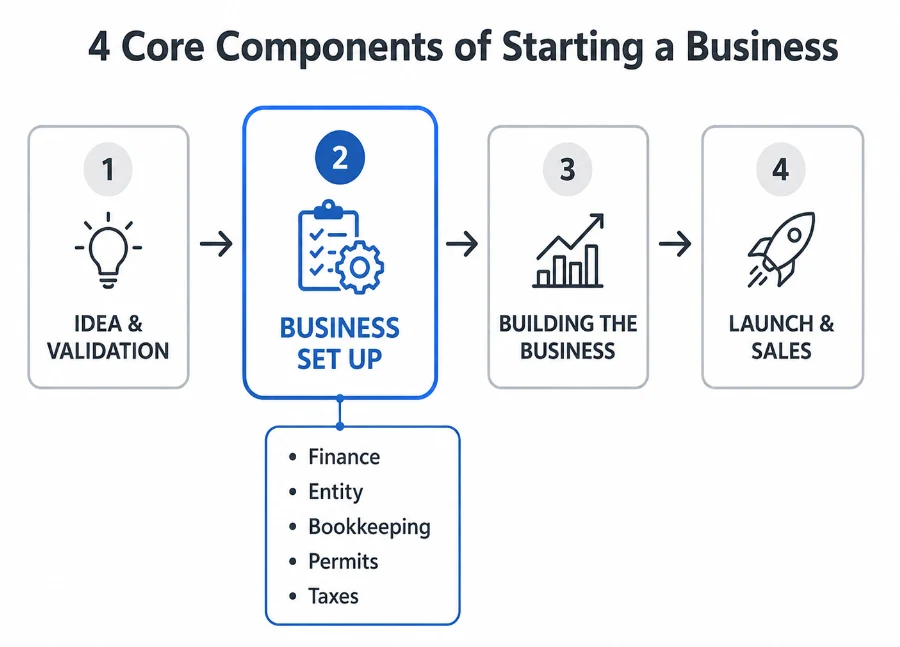
Most founders incorporate too early. They rush to "make it official" before they've validated demand or committed to the idea.
Stage 1: Testing (Don't Incorporate Yet)
You're validating your idea, talking to customers, building an MVP. Operate as a sole proprietor under your own name. No paperwork, no fees.
Stage 2: Committed (Time to Formalize)
You have paying customers and know this idea has legs. Now form your LLC or corporation. This is when you:
Stage 3: Growing (Optimize Your Structure)
You're profitable and scaling. Consider S-Corp election to save on taxes (usually at $60K+ profit).
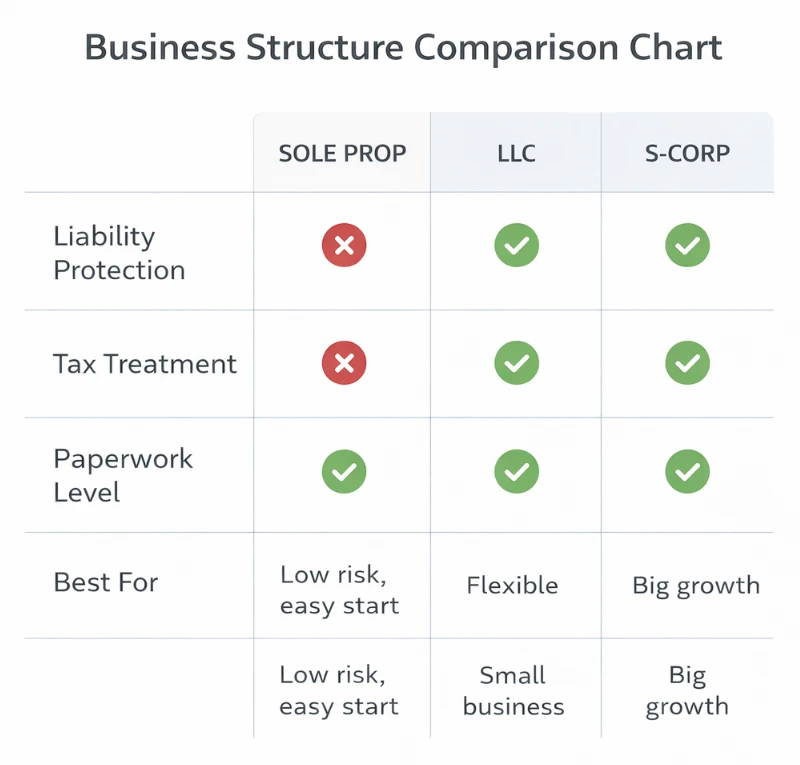
Pick the structure that saves taxes and limits liability.
Sole Proprietorship: Simplest option. You and the business are legally the same. No registration required. Report income on personal tax return.
LLC (Limited Liability Company): Shields personal assets from business debts and lawsuits. Taxes pass through to personal return. Cost: $50-$500 to file.
S-Corp: A tax designation (not a structure). Pay yourself salary + distributions to reduce self-employment taxes. Worth it at $60K+ profit.
C-Corp: For big companies raising venture capital. Most small businesses don't need this.
For most people, an LLC is the sweet spot. It gives liability protection without corporate complexity.
You make $80,000 profit. As an LLC, you pay 15.3% self-employment tax on all $80K = $12,240. As an S-Corp, you pay yourself $50K salary (payroll taxes = $7,650) and take $30K as distributions (no extra tax). You save about $4,590.
1. What's your liability risk?
2. Do you have partners?
3. Projected annual profit?
4. Which structure makes sense?
Get the permits you need so you don't get shut down.
Most businesses need at least a business license. If you're in a regulated industry (food, health, construction, childcare), you'll need additional permits.
1. Business License: Required by most cities/counties. Cost: $50-$200 annually.
2. Professional License: Required for doctors, lawyers, contractors, cosmetologists, etc. Check your state board.
3. Sales Tax Permit: If you sell physical goods, you need to collect and remit sales tax. Get from your state's Department of Revenue.
4. Industry-Specific Permits: Food handler's permit, health department inspection, building permits, etc.
Where to check requirements:
Permits I need:
Trademarks, copyrights, and what you actually need.
Intellectual property (IP) includes your brand name, logo, content, products, and proprietary processes.
1. Trademark: Protects your business name, logo, and brand. Cost: $250-$750 to file with USPTO. Takes 6-12 months.
2. Copyright: Automatically protects original creative works (writing, art, music, software). No registration required, but you can register for $45-$65 for stronger protection.
3. Patent: Protects inventions and processes. Expensive ($5,000-$15,000) and complex. Most small businesses don't need this.
Get a Trademark if:
Skip Trademark if:
Start by searching USPTO.gov to make sure your name isn't already taken. Then file a trademark application or hire a trademark attorney ($1,000-$2,000).
Charge what you're worth.
Most new founders price too low because they're afraid no one will buy. Don't do that.
Don't think: "I spent 10 hours, so $20/hour = $200."
Think: "What is the result worth to my customer?"
Example: A website takes 15 hours to build. Cost-based pricing = $1,500. But the website brings the client $50,000 in new revenue. Value-based pricing = $5,000 or $10,000.
1. Cost-Plus Pricing (Good for products)
Add up costs, then add markup. Formula: Cost + Markup = Price
2. Competitive Pricing (Good for crowded markets)
See what competitors charge and price around that range.
3. Value-Based Pricing (Best for services)
Charge based on the result you deliver, not the time you spend.
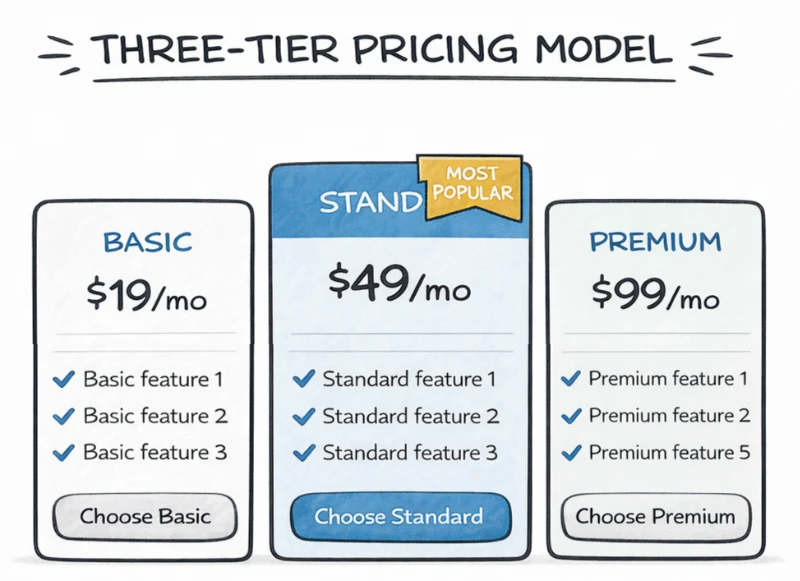
Offer three pricing tiers:
This gives customers choice and anchors the middle option as "best value."
1. What are you selling?
2. Cost to produce? $
3. What do competitors charge? $
4. Value to customer?
5. Your starting price? $
Set up a simple system so you don't get blindsided.
Common business expenses you can write off (but always ask your tax person):
Self-employment tax: 15.3% on net profit
Federal income tax: 10-37% depending on income
State income tax: 0-13% depending on state
Rule of thumb: Set aside 25-30% of profit for taxes.
Accounting software I'll use:
Business checking account opened: ☐ Done
Tax savings account set up: ☐ Done
Know your options and what they cost.
1. Bootstrap (Self-Fund): Use savings. No debt, no dilution. But limited by what you have.
2. Friends & Family: Borrow from people who believe in you. Keep it formal with written agreements.
3. Small Business Loan: Banks, credit unions. Need good credit and collateral. Interest rates 6-12%.
4. SBA Loan: Government-backed loans. Lower rates (5-8%) but slow approval process.
5. Business Credit Card: Quick access to $5K-$50K. High interest (18-25%). Good for short-term needs.
6. Crowdfunding: Kickstarter, Indiegogo. Raise money from customers before building. Test demand while funding.
7. Angel Investors: High-net-worth individuals invest $25K-$500K for equity. Expect to give up 10-25% of company.
Startup costs:
Equipment/inventory: $
Website/branding: $
Licenses/permits: $
Marketing: $
6 months operating expenses: $
Total needed: $
Funding source I'll use:
Can this idea actually make money?
Run the numbers before you invest serious money, time and effort. You need three projections: revenue, expenses, and profit.
Revenue Projection (Year 1):
Price per sale: $
Expected sales per month:
Monthly revenue: $
Annual revenue: $
Expense Projection (Year 1):
Cost of goods sold: $
Marketing: $
Rent/utilities: $
Software/tools: $
Misc expenses: $
Total annual expenses: $
Profit:
Revenue - Expenses = $
Profit margin: %
Break-even point = Fixed costs ÷ (Price - Variable cost per unit)
This tells you how many sales you need to cover all costs. If your break-even is 500 units/month and you can realistically sell 200, the math doesn't work.
Split it fair before it gets ugly.
Most founder breakups happen because equity wasn't split fairly at the start. Have this conversation early.
Equal split (50/50): Only works if contributions are truly equal. Often leads to deadlock.
Unequal split (60/40 or 70/30): Better when one person contributes more (idea, capital, expertise, or time).
Vesting schedule: Equity is earned over time (typically 4 years). If someone leaves early, they don't take all their equity.
1. Who's contributing what?
Partner A:
Partner B:
2. Who's working full-time vs part-time?
3. What happens if someone leaves?
4. Who makes final decisions?
5. Proposed equity split: /
You just covered the legal and financial foundations most founders avoid until it's too late:
This isn't the sexy part of entrepreneurship, but it's what separates businesses that last from businesses that fail.
Want the Complete Setup Guide?
The full guide covers every legal, financial, and structural decision with step-by-step detail and real examples.
→ Read the Full Guide (complete deep-dive with worksheets and examples)
Complete guide series available at StartABusiness.Center
© 2026 StartABusiness.Center | All Rights Reserved
